

The European Space Agency has completed assembly of its Themis reusable rocket demonstrator at Esrange Space Center in northern Sweden, installing four landing legs on the 30m-tall vertical take-off and landing test vehicle that will conduct Europe’s first full-scale recovery demonstrations using cryogenic propulsion systems.
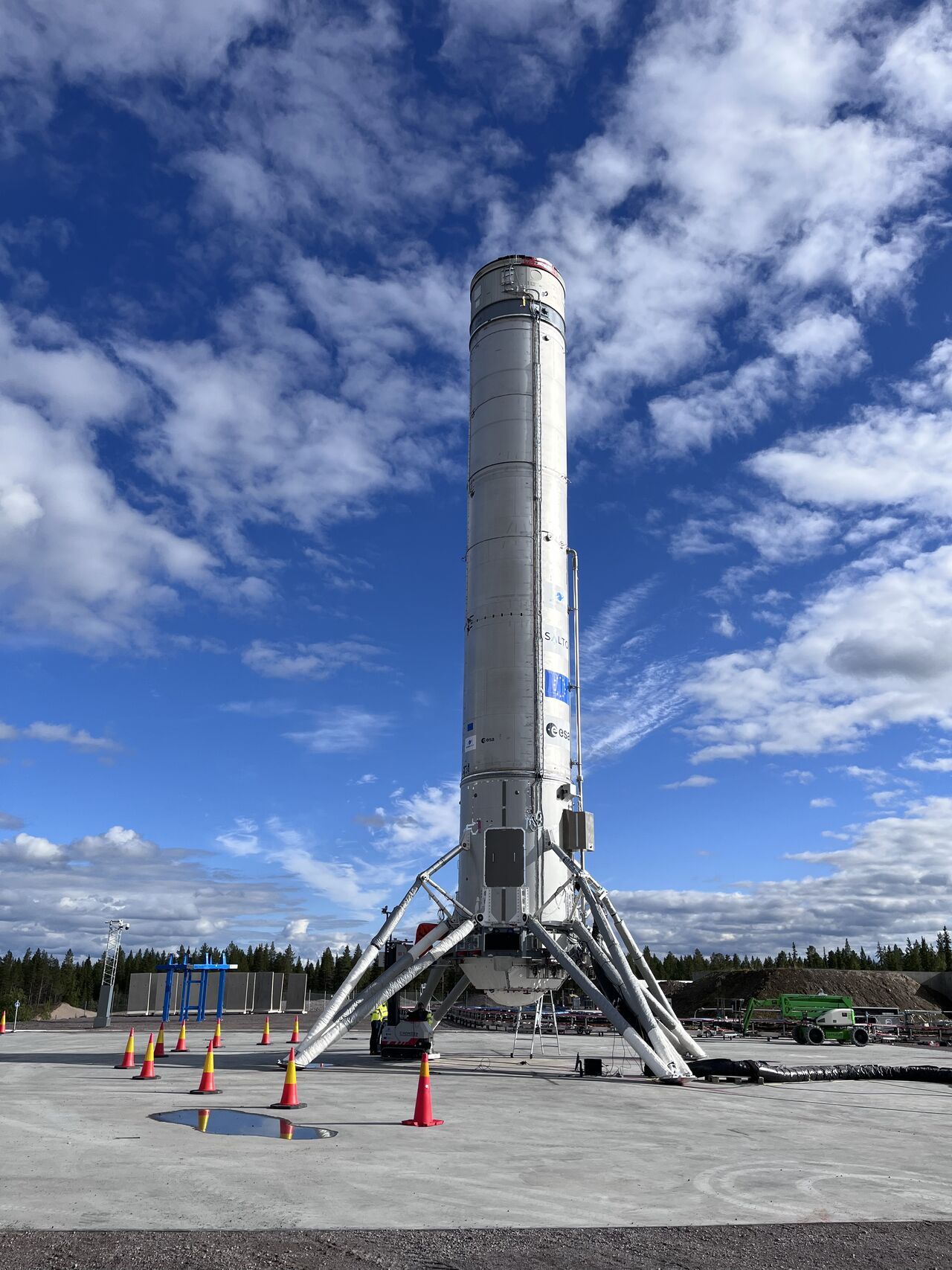
The demonstrator, designated T1H (Themis-1 engine-Hop), stands 30m (98ft) tall on its landing legs with a diameter of 3.5m (11.5ft). The vehicle integrates the Prometheus engine, which delivers thrust comparable to the Ariane 6 rocket’s main engine while incorporating restart capability and variable thrust throttling for controlled landing sequences.
Themis represents the European Space Agency’s (ESA) investigation into rocket stage recovery and reuse technologies. The demonstrator incorporates guidance, navigation, and control systems required for autonomous vertical landing operations following low-altitude test flights.
Themis’ first flight is planned for early next year.
ArianeGroup manufactured the vehicle at its Les Mureaux facility in France before transporting it 3,000km (1,864 miles) by truck to Sweden. The landing legs were shipped separately and installed after the main vehicle structure arrived at Esrange during summer operations.
“Themis is set to be the first European demonstration of a full-scale vertical take-off and landing rocket element that uses cryogenic propulsion,” the ESA said. The Prometheus engine burns liquid oxygen and methane propellants, enabling multiple restarts during flight operations.
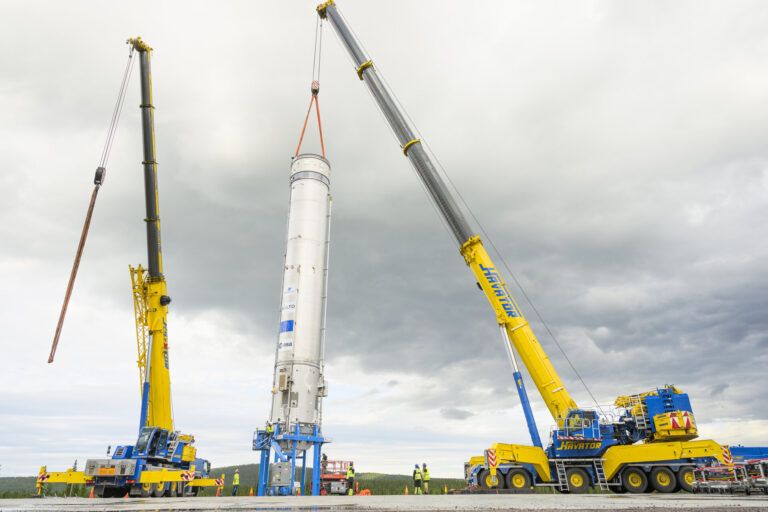
The assembly process involved hoisting the demonstrator onto specialized tooling at the launch pad to facilitate landing leg installation. This marks the first time the complete vehicle configuration has been assembled, with all four landing legs now supporting the structure’s weight.
The test campaign falls under the Salto project, funded through the European Union’s Horizon Europe programme. Twenty-five consortium partners from twelve European Union countries participate in the development and testing phases.
Following assembly completion, the vehicle will undergo wet dress rehearsal procedures involving propellant loading and systems verification before attempting its first hop tests. The initial flight campaign will demonstrate low-altitude take-off and landing capabilities, validating the throttling performance of the Prometheus engine and the effectiveness of the guidance systems.
The Esrange facility provides the necessary infrastructure for cryogenic propellant handling and range safety requirements for the vertical landing demonstrations. Swedish Space Corporation operates the site, which has supported sounding rocket and balloon operations since 1966.