

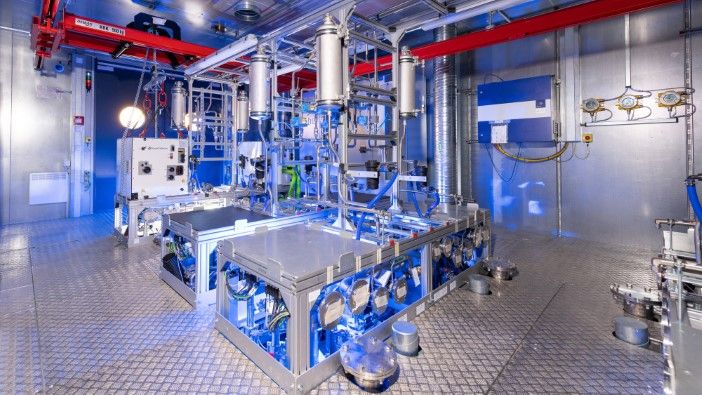
The German Aerospace Center has achieved a testing milestone by operating a fuel cell system and electric motor components at more than one megawatt each using its BALIS test infrastructure.
The propulsion systems under development by DLR, which output up to 1.5MW (2,011hp), could be used in applications including ships, heavy-duty road vehicles and aviation.
As part of the test program, researchers electrically coupled 12 fuel cell modules that exchange information and interact, with each module containing more than 400 individual fuel cells to power the propulsion system.
The BALIS testing rig is located at the E2U Empfingen Development Centre for Environmental Technology innovation campus.
“This is a milestone in the setup and commissioning of the test facility and the first generation of the fuel cell test system,” said Cornelie Bänsch, project leader from the DLR Institute of Engineering Thermodynamics. “Systems of this power class are not yet available on the market. The technical challenge lies in developing and integrating all the components so that they operate stably at high outputs of one megawatt or more.”
The BALIS program focuses on developing propulsion systems based on hydrogen fuel cells for applications requiring megawatt-range power outputs. The modular test infrastructure allows evaluation of individual components and entire powertrains through collaboration with aeronautics research institutes.
DLR researchers are developing operating strategies to control the complex setup and plan to operate the test system stably for extended periods while increasing output above one megawatt. The team will then run dynamic profiles with varying high power outputs for different durations to simulate real-world operating conditions.
According to DLR, fuel cell systems running on green hydrogen could enable carbon dioxide-free mobility while reducing dependence on fossil fuels. The technology aims to strengthen Germany’s high-tech industries’ capacity and competitiveness in advanced propulsion systems.