

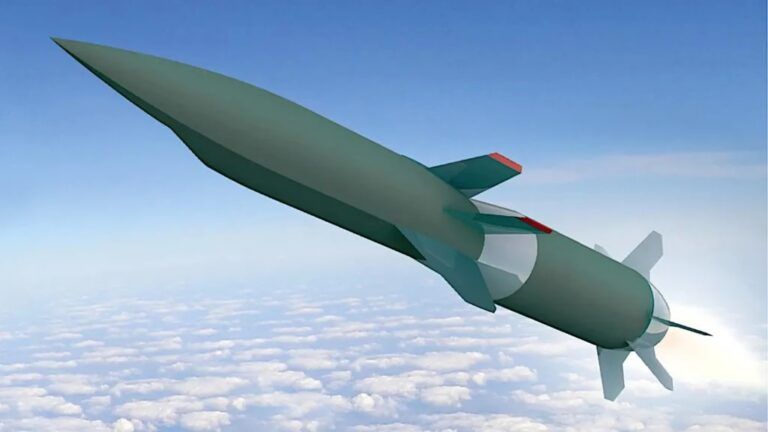
The US Air Force has begun flight testing its scramjet-powered Hypersonic Attack Cruise Missile, with the Royal Australian Air Force releasing a test vehicle over a range in Australia.
The milestone is the first flight test of the Hypersonic Attack Cruise Missile (HACM) after repeated delays. The Air Force confirmed the test to US outlet The War Zone, which first reported it, saying the Royal Australian Air Force “executed the release of a HACM flight test unit over a designated Australian test range”.
The Air Force did not name the test range, give a date, or identify the aircraft that carried the missile, and it is not clear whether the weapon flew under its own power after release, according to The War Zone.
HACM is a two-stage design, with a rocket booster and a scramjet-powered cruiser that separates from the booster before diving toward its target. Because scramjets do not work effectively at low speeds, the missile must be boosted to a high Mach velocity before its engine can take over.
Raytheon, now part of RTX, was selected with Northrop Grumman to develop the missile in 2022, drawing on the Defense Advanced Research Projects Agency’s earlier Hypersonic Air-breathing Weapon Concept (HAWC) program.
The work falls under the US-Australian Southern Cross Integrated Flight Research Experiment (SCIFiRE), which the Air Force said is built on more than 15 years of cooperation between the two nations. The US Government Accountability Office (GAO) had said in a 2024 assessment that the Air Force planned to conduct HACM launches in Australia, with Royal Australian Air Force F/A-18F Super Hornets carrying out some of them.
The War Zone reported that testing has long been expected at Australia’s Woomera Test Range, a remote site used for extended-range flight tests, while the F-15E Strike Eagle is the Air Force’s initial launch platform.
HACM has slipped repeatedly, with first flight testing moving from 2024 to 2026, and the Air Force has cut its rapid-prototyping effort from seven planned flight tests to five to protect the schedule, the GAO said in a July report. The program plans to build 13 missiles, and officials have said completing at least the first three flight tests is critical to a decision on whether to begin procuring HACM in 2027.
The first-flight target had already moved back a year, according to Air & Space Forces Magazine, reflecting how difficult scramjet-powered vehicles have historically proven to develop. Hypersonic speed is generally defined as above Mach 5, though the Air Force has not disclosed HACM’s peak speed.
The test is a key milestone for a US hypersonics effort that has faced repeated setbacks amid concern about a widening capability gap with China.