

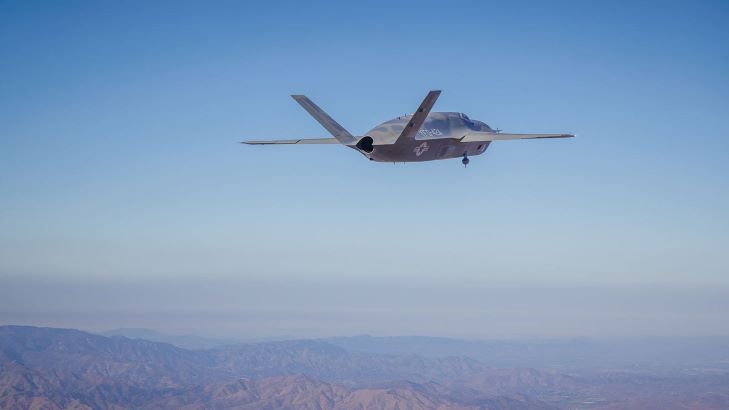
Collins Aerospace has demonstrated its Sidekick mission autonomy software in a successful four-hour flight test using a unmanned YFQ-42A drone for the US Air Force’s Collaborative Combat Aircraft (CCA) program.
During the flight test, autonomy mode was engaged to enable the aircraft to be managed by a human operator on the ground. The test paired the General Atomics YFQ-42A unmanned aircraft, reportedly recently named Dark Merlin with crewed fighter jets to enhance sensor range, increase weapon effectiveness and improve overall mission success.
Collins said the test demonstrated seamless integration between its autonomy software and the YFQ-42A’s mission systems, ensuring precise piloting commands. The Sidekick software was integrated with the aircraft’s flight control system via a government-owned Autonomy Government Reference Architecture (A-GRA), enabling what the US Air Force described as robust and reliable data exchange with the CCA’s mission systems.
“The rapid integration of Sidekick onto this platform to perform various combat-relevant tasks highlight the strength and adaptability of Collins’ open systems approach,” said Ryan Bunge, vice president and general manager for Strategic Defense Solutions at Collins Aerospace. “The autonomy capabilities showcased in this flight highlight nearly a decade of dedicated investment and close collaboration with our customers to advance collaborative mission autonomy.”
The A-GRA is a central element of the US Air Force’s Collaborative Combat Aircraft (CCA) program It is designed to prevent vendor lock-in and allow rapid installation of new software and algorithms.
The CCA program was launched in 2024. The first unmanned CCAs are expected to enter into service for the US Air Force by 2030.
Collins, which is working with General Atomics under the CCA program, is one of two companies selected to provide mission autonomy software for the program, alongside Shield AI, which is working with Anduril Industries on the competing YFQ-44A platform.
Sidekick is classified as mission autonomy software, which enables CCAs to execute complex actions when given basic directions from a pilot in a crewed aircraft. This is distinct from the flight autonomy software responsible for basic operations such as takeoff, flight path adherence and landing.
The CCA drones are part of the Air Force’s Next Generation Air Dominance family of systems, designed to fly semi-autonomously alongside fifth- and sixth-generation fighter jets including the F-35A and the F-47.
The US Air Force aims to field at least 1,000 CCAs in varying configurations to carry out missions including strike operations, reconnaissance, electronic warfare and as decoys.
General Atomics first flew the YFQ-42A in August 2025 and has since built and flown multiple aircraft, including instances of push-button autonomous takeoffs and landings. Collins was selected by the US Air Force to support development and testing for CCA Increment 1.