

The UK government has committed over £650 million (US$880 million) to upgrade the radar systems on Royal Air Force Typhoon fighter jets.
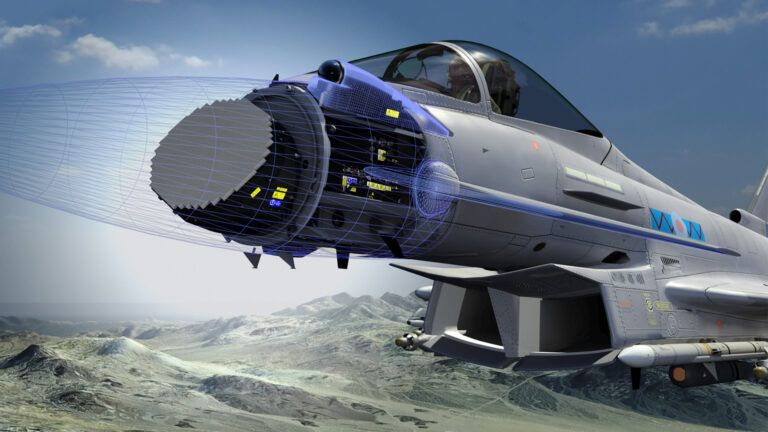
Under a £453 million (US$610 million) contract, BAE Systems, Leonardo UK and Parker Meggitt will manufacture and install 40 European Common Radar System Mk2 radars for the UK RAF’s Typhoons. The contract includes 38 new systems and modifications to two test systems.
The radar investment follows a £205 million (US$275 million), five-year contract extension awarded earlier this week to QinetiQ to provide engineering support to the Typhoons and maintain the aircraft’s airworthiness.
The ECRS Mk2 is multi-functional array radar that can perform both traditional functions such as search and targeting, as well as electronic warfare tasks.
The upgrade means that the Typhoons will be able to simultaneously detect, identify and track multiple targets in the air and on the ground. According to the UK’s Ministry of Defence, the system provides high-powered jamming capability while engaging targets beyond the reach of threats.
The development of ECRS Mk2 began in 2019, while flight testing in the UK began in 2024.
Mark Hamilton, managing director of Electronics UK at Leonardo, said, “ECRS Mk2 is equipped with advanced electronic surveillance and electronic attack capabilities which will make the RAF’s Typhoons more potent against their adversaries, adapting to new and unpredictable threats.
“This contract secures 300 highly skilled jobs at Leonardo’s Edinburgh site, and 100 at our Luton site. As well as supporting over 71 UK-based suppliers, we hope ECRS Mk2 will see wider adoption by other Typhoon export users given its advanced capabilities against current and future threats.”
Richard Hamilton, BAE Systems managing director for Europe and International, said, “The Typhoon programme is a fundamental pillar of the UK’s national defence and security. Operating at the heart of NATO operations, Typhoon aircraft provide air policing along Europe’s eastern flank.
“The continued investment in Typhoon capability is crucial and ensures we’re able to maximise the UK’s investment in the aircraft and accelerate combat air technologies critical for defence capabilities.”
The combined investment will sustain more than 1,500 UK jobs, with 300 roles at Leonardo UK’s Edinburgh facility, 120 in Lancashire and more than 100 in Luton. The full Typhoon program supports more than 20,000 jobs across 330 UK companies.
Typhoon remains the backbone of UK combat air capability and will continue protecting British airspace until at least the 2040s.