


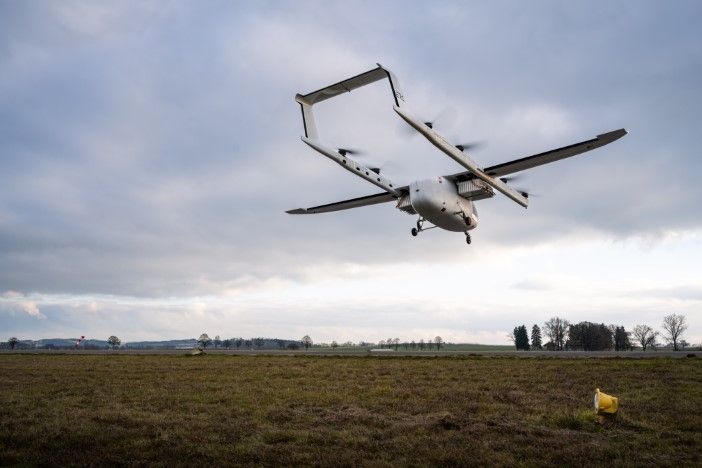
Munich-based startup ERC System has completed the maiden flight of its third-generation, full-scale electric vertical take-off and landing prototype, which the company says is the heaviest fully electric aircraft of its type to have flown in Europe.
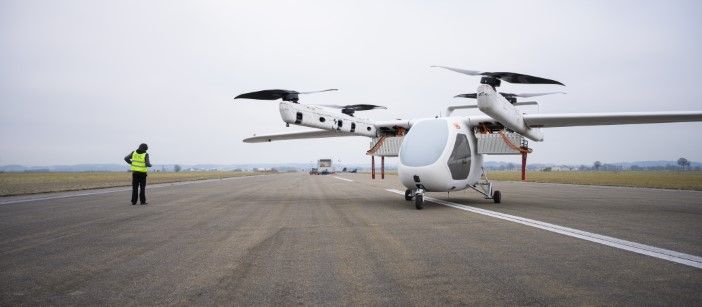
The eVTOL aircraft prototype, designated Romeo, weighs 6,030 lbs (2,735kg) and has a 52ft (16m) wingspan. It features eight electrically driven vertical lift units powering rotors of approximately 8ft (2.4m) in diameter, along with a large cabin representative of ERC’s future medical transport configuration.
Romeo first took to the air in November 2025 at the ERC Flight Test Center near Munich, Germany. The maiden flight marked the start of a flight test campaign focused on validating core flight characteristics under representative mass and system conditions.
The current test phase places emphasis on vertical take-off, slow and controlled maneuvers, and vertical landing. The aircraft is being flown in an uncrewed configuration, with a test pilot controlling it remotely from a ground control station.
(Image: ERC System)
Full-sized approach to flight testing
ERC has deliberately chosen to test at representative scale and mass from the outset, rather than beginning with small-scale or reduced-mass prototypes as many eVTOL developers do. The company says this approach is critical for validating propulsion architectures, energy and thermal management, and flight control behavior under realistic load conditions, as the physics of vertical take-off and landing aircraft do not scale linearly.
The strategy builds on experience gained with ERC’s first-generation demonstrator, Echo, a full-scale platform with a take-off weight of approximately 5,950 lbs (2,700kg) that first flew in 2023 in Manching Germany. Echo validated core vertical take-off and landing capabilities over more than 100 test days in 2023, delivering system-level insights in distributed electric propulsion and thermal management.

(Image: ERC System)
Romeo features an in-house-developed airframe and advanced redundant systems, and has received flight approval from Germany’s civil aviation authority the Luftfahrt-Bundesamt (LBA). The aircraft is being operated in accordance with applicable EASA standards.
Production aircraft Charlie
The flight test campaign supports development of ERC’s planned production aircraft, Charlie, a hybrid-electric, crewed aircraft targeting type certification in 2031 under EASA’s Special Condition VTOL (SC-VTOL) standards. Charlie is designed for interhospital patient transport and has a targeted maximum take-off weight of 7,275 lb (3,300kg), a useful load of 1,102 lb (500kg), and a maximum range of 497 miles (800km).
“We are excited to have reached this key milestone in our mission to make aerial transportation more economically feasible, especially for critical missions,” said Dr. David Löbl, co-founder and CEO. “The crewed aircraft we intend to certify in 2031 is hybrid-electric. It takes off and lands vertically like a helicopter but uses wings to cruise efficiently like an airplane.”
(Image: ERC System)
DRF Luftrettung, one of Europe’s leading helicopter emergency medical services (HEMS) operators, is ERC’s strategic partner on the project. “The prototype’s successful maiden flight represents the transition from concept to practical testing,” said Dr. Krystian Pracz, CEO of DRF Luftrettung.
ERC is also developing an uncrewed aerial logistics solution for defense, governmental, and commercial applications. The company plans to release details of this aircraft by the summer this year.