

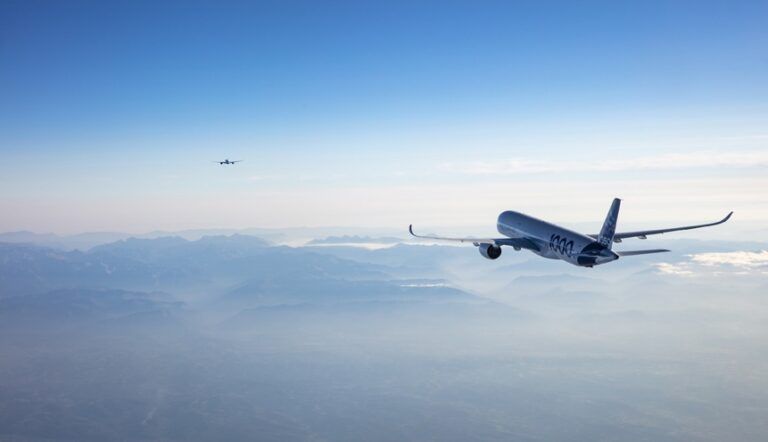
Airbus has completed a key phase of flight testing to validate its fello’fly wake energy retrieval flying technique.
Fello’fly takes inspiration from the flight of migrating geese – the first aircraft creates an uplift that is used by an aircraft following close behind, improving the second aircraft’s fuel efficiency.
Airbus estimates that wake energy retrieval could reduce fuel consumption by up to 5% on long-haul flights.
The Fello’fly project was originally launched in 2019, and in 2023 a successor called the GEESE project was funded and launched by the EU to support collaboration and testing.
GEESE has several partners, including Air France, Delta Air Lines, French bee, and Virgin Atlantic, and air navigation service providers, AirNav Ireland, DSNA, EUROCONTROL and NATS,
Eight flight trials have been done over the North Atlantic Sea during September and October 2025. These flights have shown that the operational concept is a feasible and safe way to guide two aircraft to meet at a precise time and place – the rendezvous process – while maintaining full vertical separation and remaining compliant with air traffic regulations.
While the actual wake energy retrieval technique is yet to be tested on commercial flights, the successful validation of the rendezvous process is a crucial first step toward future efficiency gains.
The completed trials used a four-step process designed to manage the high-precision maneuvers required:
- The Airbus Pairing Assistance Tool (PAT) computes the new aircraft trajectories and shared rendezvous instructions in real-time
- The airlines’ dispatcher, flight crew, and Air Traffic Control (ATC) assess the new trajectories to ensure operational acceptability. The EUROCONTROL Innovation Hub interface allows all stakeholders to have visibility of the decision status at any given moment
- One of the participating flights changing its planned route to join the other
- Both flight crews activate a cockpit function, committing the aircraft to arrive at the meeting point at an exact, predetermined time
Each trial required close coordination between the two airlines’ ground operational control centers, four air traffic control centers, and two flight crews. The active participation of AirNav Ireland, Air France, Delta Air Lines, DSNA, EUROCONTROL Network Manager, French bee, NATS, and Virgin Atlantic, using the EUROCONTROL Innovation hub interface, was key to proving the concept’s safety and practicality in real-world conditions.
Additional project partners on GEESE include Bulatsa, Indra, ENAC, CIRA, Boeing, Frequentis, UAB, Oro Navigacija, DLR, UCLouvain, and WaPT.