

The term helmet fire refers to when fighter pilots are overwhelmed by incoming data, and is relevant on 5th generation platforms. Given the anticipated demands that 6th generation fighters will place on human pilots, the chance of a pilot being tasked with information overload in the air combat environment is currently a real concern.
The need to constantly train, prioritize tasks swiftly and effectively, all while performing maneuvers in a high-g environment, is therefore a fundamental skill that any fast-jet pilot must master to be effective.
However, this ability may have reached its limit in terms of human capacity. As anti-aircraft weapon ranges have steadily expanded, so too has the weapons engagement zone. It now extends into an area where opposing pilots are likely to enter the threat envelope much faster and remain there much longer during a sortie. This increases the stress and pressure the pilot experiences inside the cockpit.
To keep the human pilot out of the weapons engagement zone while still conducting strikes, numerous aerospace firms have pursued the development of collaborative combat aircraft (CCA), also known as the Loyal Wingman concept.
One of the world’s leading defense companies actively exploring this idea is Lockheed Martin. Its renowned Skunk Works is playing a central role in developing an operational CCA concept that has successfully flown simulated attack missions.
Engineers within Skunk Works aim to understand better how a partnership between a human pilot and AI can operate most effectively within the air battle environment.

RESEARCH COLLABORATION
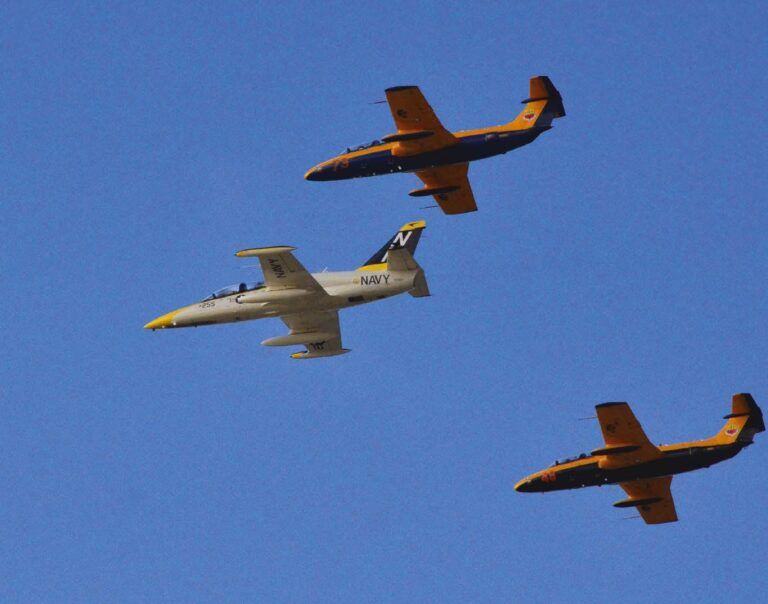
The research program initially started in 2023, with Lockheed Martin collaborating with the University of Iowa’s Operator Performance Laboratory under the name the Enhanced Collaborative High-Frequency Orientation System (ECHOS). Early trials for ECHOS involved two AI-controlled, but piloted L-29 Delfin aircraft which acted as surrogates for two unmanned aerial systems. These unmanned systems had previously learnt to geolocate and jam a target during earlier tests. The unmanned aerial systems also used a scripted virtual fighter platform, which served as the battle manager.

The trials demonstrated that AI could assist in rapid decision-making, thereby increasing the overall effectiveness of the mission by reducing the workload of fighter pilots. The success of the simulated electronic attacks by AI agents, as Lockheed Martin refers to them, showed AI’s ability to make swift decisions on autonomous, uncrewed aerial systems that could work in coordination with tactical, crewed aircraft in any future combat operations.
Gabe Beard, program manager for the tactical AI portfolio at Lockheed Martin’s Skunk Works, is aware of how rapidly the technology in this area is developing. This awareness lead to another round of tests during 2024.
Beard says, “We shifted to the air-to-air domain in contrast to the 2023 effort, which was also testing ECHOS in addition to our autonomous AI.
“This is AI operating the aircraft and managing the mission systems to ensure a successful sortie.
“There are several challenges to developing the AI algorithms and incorporating mission requirements. Then we must ensure the AI transfers behavior from the simulated to real environments.
“Like any software, there are inputs and outputs. In the AI domain, we refer to these as observation and action spaces. Therefore, the observation space includes everything the agent perceives, while the action space defines what the AI is allowed to do.
“Our AI agents must deal with uncertainty. The aircraft needs to use its sensors and onboard mission systems to read a developing environment.”
COMBAT CONDITIONS
For the 2024 tests, an air-to-air scenario was used. The aim was to integrate Lockheed Martin’s AI with OPL’s autopilot system, allowing the AI agent to operate and pilot the aircraft entirely without human input from the cockpit.
Beard says, “The first mission was simply a one-onone air-to-air engagement, to examine the new capability of the AI directly flying the jet. It consisted of a single live L-29 jet fighting a virtual adversary.
“For the second test, we launched two L-29 jets without a battle manager. These aircraft could make decisions regarding tactics and strategy. We had two live aircraft in the air communicating with each other to engage any opposition.”
This later test showed that the improvements in what Lockheed Martin calls “sim-to-real performance” were progressing. Beard says, “We hit the goal of two aircraft working collaboratively in the air, which was a first.”

“It was an exciting time, as we had two live aircraft in the air communicating with each other to complete the task of engaging the opposition,” Beard adds. “The AI agent identified the virtual adversary’s two-ship and engaged it successfully. The sim-to-real performance showed improvement between the two tests.”
In the final test of this series, the same scenario was used but with a third aircraft added: an L-39 Albatross with a battle manager seated at the rear, sending targeting instructions via a touchscreen display to both the AI-operated L-29s.
Instructions were given in the form of “Hawk One engage adversary number two”, with Hawk One being the call sign for one of the AI-operated L-29s.
Beard says, “To be clear, it wasn’t the battle manager directly flying the L-29s. He was simply telling the AI agents who they want to target, and then the AI flies the aircraft and fires the virtual missiles at the requested target.”
FAST DEVELOPMENT
This final test demonstrated the rapid pace of AI development, its growth, and benefits within the combat arena. Lessons learned reflect the swift progression of the technology.
Beard explains, “Things we learnt from this final test, as far as human-machine interaction goes, is that we are currently crawling in the way the human sends commands to the AI.”
For these tests, Lockheed Martin deliberately kept the interactions to single commands intentionally, to monitor the pace of the development. In time, a pilot will require far more interactive AI. Beard adds, “We’re exploring these areas of interaction for the future.”
Miguel Morales, Lockheed Martin associate fellow on the ECHOS program at the Skunk Works was the technical lead for some of the demonstrations and supports many AI-associated programs within the company. He says, “The final test involved many factors, making it easy to overlook specific key points – one of which is that the environment was inherently uncertain for the AI agent. It relied on sensor data to make decisions, but that information was unreliable, potentially containing errors or noise.
“Additionally, the AI had no prior knowledge of the opponent’s strategy. It wasn’t trained to complete the mission against a specific adversary, but needed to adapt, be robust, and avoid any weaknesses across the evolving scenarios.

“Due to the uncertainty, any AI must learn through simulation runs to ensure it can be generalized and perform effectively in a real-world environment. A mission isn’t designed for a single AI to achieve the objective alone; multiple AIs must work together as a team to accomplish the overall, broader mission.
“This distinction alters the nature of decision-making. It’s not about one AI defeating an opponent or eliminating a single target, but more about executing the mission successfully as a collective. In some future scenarios, this may even require strategic sacrifices to ensure the overall mission’s success.”
CRITICAL COMMUNICATION
Lockheed Martin continues to develop AI through its Skunk Works, with many specific details remaining sensitive. There is a vast amount of work to be done before deployment. Beard says, “We’re focused on improving the AI’s performance and deployment, which is crucial. We believe the technology we’re developing will enhance the war fighter’s effectiveness, which is ultimately our goal.
“We have the AI agent controlling the aircraft through specific commands interpreted by the autopilot. However, there are likely other ways to communicate with the aircraft using AI. This is an area we are currently exploring.
“The AI agent used in this final test could activate or deactivate the radar and virtually fire weapons at a target. Several sensors were available to the AI for use during the mission. As the AI agent continues to develop, it is likely to gain control over different sensors and additional modes, as it already does.”
The debate over whether it is suitable to introduce AI into the combat zone continues. However, for Lockheed Martin’s Skunk Works, this emerging technology is seen as a collaboration between human and machine, as Morales explains: “It’s examining how the partnership can operate.
“I believe it will be a significant milestone once we have a fully autonomous system in place, but a manned component will still be necessary. We aim to augment the human to enhance the team’s effectiveness, using the same number of platforms.
“I see it as having a human quarterback guiding unmanned platforms: this is the vision we are pursuing. The future we envisage is one where the human pilot is enhanced, enabling synergy between AI and humans. This allows humans to function as high-level decision-makers, serving as battle managers who can delegate complex tasks to AI systems that then carry them out autonomously.
“We have learnt that AIs can excel when properly trained for the complex operations warfighters will face. However, there remains a need for human-like intuition and ethically grounded decision-making.”

Beard adds, “It’s important to build confidence in the sim-to-real performance because we won’t have the ability to perform live verification for all the possible real-world use cases, such as destroying a bridge or a SAM system.”
Future fighter pilots might take on the new role of an air battle manager, as Lockheed Martin describes it. The pilot may still operate a 6th generation fighter but could shift to serving as a mini-Airborne Warning and Control System. Effectively their role would transform to be one of monitoring and coordinating their AI unmanned CCA. This CCA would accompanied them in formation to the edge of the battlespace and proceed into the weapons engagement zone to carry out the actual strike, while the pilot remains in orbit, away from the highest threats. Ground attack scenarios like these might not be too distant. However, operating CCA in a dogfighter environment, where both manned and unmanned aircraft jostle for missile firing positions amid high-G turns, may still be some way off.