

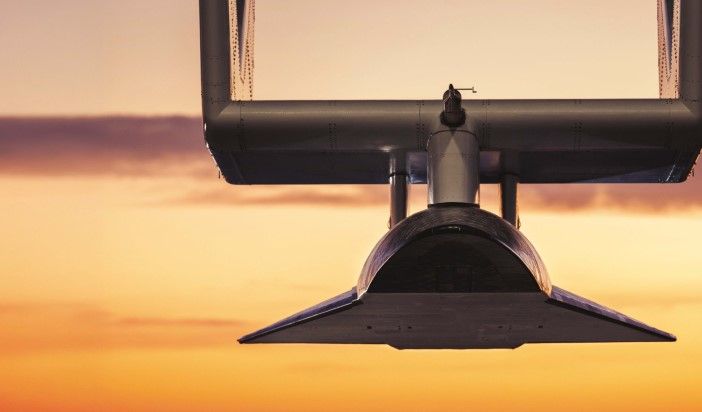
In March 2025, the Stratolaunch Talon-A plane separated from the mammoth Roc carrier plane, accelerated beyond Mach 5 and landed autonomously at Vandenberg Air and Space Force Base. Conducted with the Department of Defense, this followed Talon-A’s maiden hypersonic flight in December 2024, marking the first hypersonic flight using a reusable aircraft in the USA since 1968.
“These were successful tests,” says Stratolaunch CEO, Zachary Krevor. “We took off from Mojave Air and Space Port, flew hypersonic speeds in December, then even faster in March. Both flights culminated in runway landings, with the customers immediately able to retrieve payloads.”
Talon-A will provide a testbed for hypersonic technologies and test missile defense systems as the US strives to match the capabilities of peer adversaries. At hypersonic speeds of Mach 5 (3,806mph / 6,125km/h) upwards, friction between the aircraft and airflow creates extreme thermal conditions. Talon-A experienced temperatures exceeding 1100°C (2,012°F) during its flight.
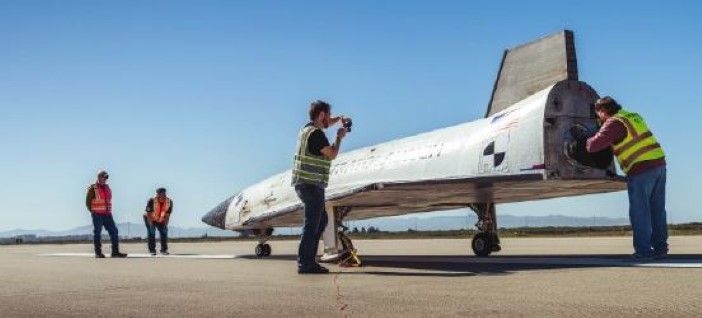
THERMAL PROTECTION
“Hypersonics is a hot topic,” quips Professor Luca Maddalena, director of the University of Texas at Arlington Aerodynamics Research Centre. “The energy-flux of the flow is proportional to the cubic power of velocity, so doubling speed eightfolds heating. We are working with several materials developers in the realm of aerothermodynamics.”
Designing thermal protection systems to withstand hypersonic temperatures is nothing new. Following the first crewed moon landing, the Apollo 11 command module impacted Earth’s atmosphere at Mach 32 (24,247mph/39,000km/h) and Space Shuttles routinely did so at Mach 23, making Talon-A’s speeds look pedestrian. Early spacecraft used ablative heat shields, while the reusable shuttles employed a mix of seven materials, including high-temperature tiles.
“Blunt Apollo capsules consumed their heat shields like cigarettes, then quickly slowed to land,” says Maddalena. “Now, we need military or commercial vehicles to fly longer missions and preserve their shape, so ablation isn’t good. This demands new materials and development cycles that can take several years.”
Stratolaunch employed proven hypersonic flight components to expedite delivery of the USA’s urgently needed hypersonic testbed capability.
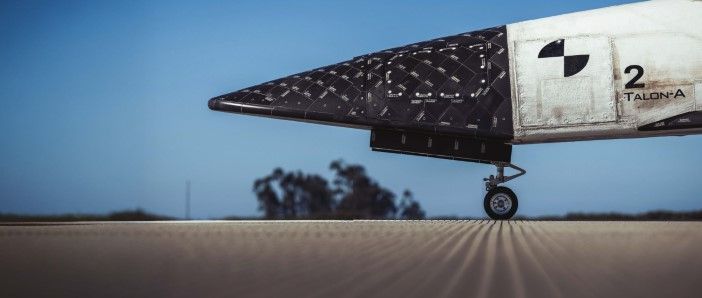
Space Shuttle-style blankets protect Talon-A’s body while Space Shuttle AETB-8 tiles protect the nosecone and leading edges, which bear the brunt of the 1100°C-plus flight temperatures.
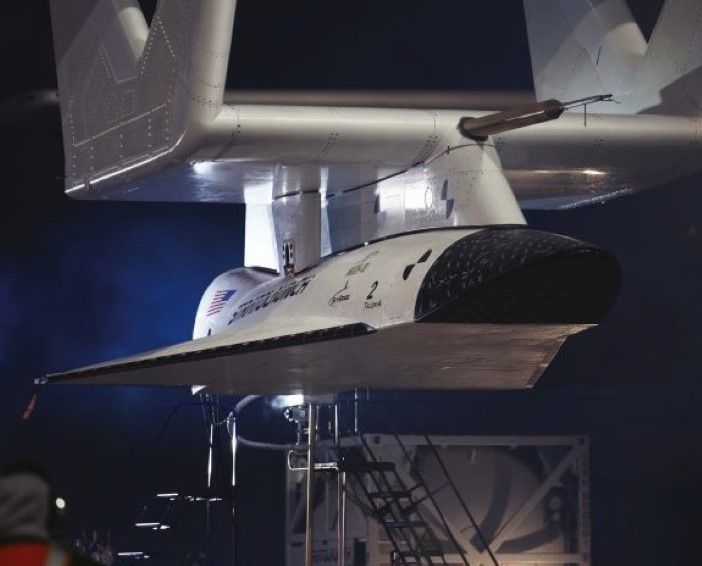
“AETB-8 stands for alumina-enhanced thermal barrier, and eight denotes their density,” Krevor explains. “They’re silicon carbide with a protective high-temperature coating, adhering to our composite substructure on flexible pads. Our NASA Ames partners taught us to build, integrate and repair them.”
SCRAMJET PROPULSION DEVELOPMENT
Whereas Talon-A launched from an aircraft then fired rockets to reach hypersonic speeds, the Delta Velos vehicle envisaged by Australian innovators Hypersonix will launch from a rocket, then accelerate using scramjet technology only operable at speeds above Mach 5. Performing combustion in hypersonic airflows should allow scramjets to achieve higher speeds than ramjets, which decelerate incoming air before combustion.
“Our vision is to fly to space, deploy small satellites, descend and land on a runway with autonomous, reusable planes far cheaper than rocket-based launch systems,” says Hypersonix co-founder and CTO, Dr Michael Smart.
“We can’t build the space vehicle yet, so we built the smallest, cheapest hypersonic plane possible to demonstrate capability.”
DART, a 3.5m (11.5ft), single-use demonstrator capable of Mach 7 (5,347mph/8,575km/h), should make its maiden flight before the end of the year. It already generates revenue, having been selected for the US Defense Innovation Unit’s High-Cadence Airborne Testing program to enable weekly hypersonic flight-tests. DART’s 3D-printed outer skin is made of Inconel, a nickel alloy used on NASA’s X-15.

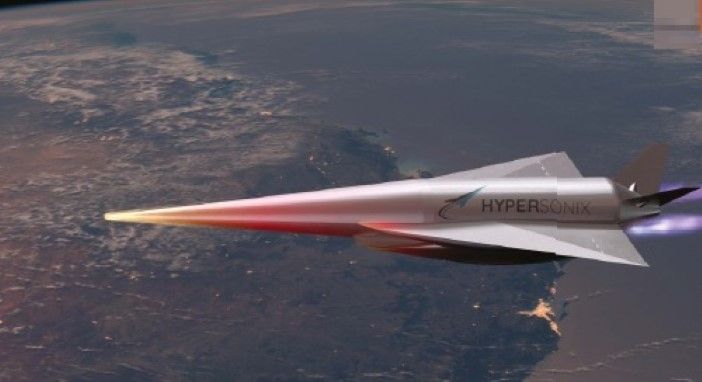
“Inconel is an unbelievable, high-strength material which operates at 800°C (1,472°F),” says Smart. “For the nose and leading edges where we expect temperatures of up to 1500°C (2,732°F), we use ceramic matrix composites. These have been processed in a furnace to produce a protective silicon carbide matrix.”
GROUND TESTING LIMITATIONS
Producing flight-relevant hypersonic conditions in ground tests is a challenge. Various hypersonic tunnels exist, including quiet, shock, blowdown, and arc-jet tunnels. But none can create all of the relevant conditions at the same time.
“We used a shock tunnel to understand control surface increments and a blowdown tunnel for general forces and moments,” says Krevor.
“But the physics of flight depends on several simultaneous parameters which no one tunnel can replicate. Tunnels usefully anchor simulations, especially for new shapes like Talon-A, but you want to fly as soon as possible.”
Hypersonix developed its Spartan scramjet engine across 6,000 experiments in the University of Queensland’s T4 free-piston shock tunnel. Pioneered by the godfather of Australian hypersonics, Professor Ray Stalker, such tunnels use super-hot compressed gas to send high-energy pulses down a tube.
“Free-piston shock tunnels can test to Mach 12 (9,135mph/14,700km/h) for around five milliseconds – sufficient for 5m (16.4ft) of hypersonic airflow to traverse your scramjet, providing a meaningful test. But nothing heats up, limiting their usefulness in materials testing.”
Hypersonix has modeled DART’s thermal performance and will validate using flight tests. Inconel skin specimens are lab strength tested, but physical thermal tests have been limited. The company has conducted hot tests of its electronics insulation system.
“We combined familiar insulation materials in interesting ways to protect electronics from both radiation and the conduction of heat,” Smart explains. “Heating a vehicle skin with electronics mounted behind in a fire lab showed we can keep electronics below 50°C for our ten-minute flight duration.”
DYNAMIC THERMAL CHALLENGES
Stratolaunch used arc-jets and thermal chambers to test TPS and internal components. Because Talon-A launches into freezing air at airliner cruise altitudes before accelerating to white-hot temperatures, components must be robust against dynamic thermal change. The rapid expansion of materials in the crucible of hypersonic flight is another challenge.
“We use flexible pads to attach silica-based tiles to our substructure, with spaces between containing thermal fillers,” says Krevor. “That accommodates expansion and contraction, since thermal expansion coefficients are not matched between materials.”
DART’s Inconel skin will warp and expand by 30mm (1.2in) in 800°C (1,470°F) flight conditions. Since internal structures maintaining its shape would create enormous mechanical stresses, Hypersonix adopted a free-to-grow monocoque aeroshell. Only flight testing will definitively prove whether DART’s guidance, navigation and control system can handle its altering of shape.
“We model that thermal expansion in simulation,” says Smart. “We have fed aerodynamic analysis into our guidance software for the hot and cold shape and built in margins, which should mean it can handle both.”
ADVANCED TESTING FACILITIES
Arc-jet tunnels use a high-voltage, high-current arc between electrodes to produce air temperatures of up to 7,700°C (13,900°F), which exceeds the surface temperature of the Sun. The University of Texas at Arlington (UTA) in the USA operates the only academically-run, large-scale arc-jet tunnel. The tunnel was developed with Office of Naval Research funding and opened in 2019.
“It’s a 3MW facility and mixes high voltage, high pressure gases and water. On your first day, you shadow an experienced operator. For six months, you repeat that first day, until we see that you are reliable. We’re running a monster and can’t have people playing around with it.”
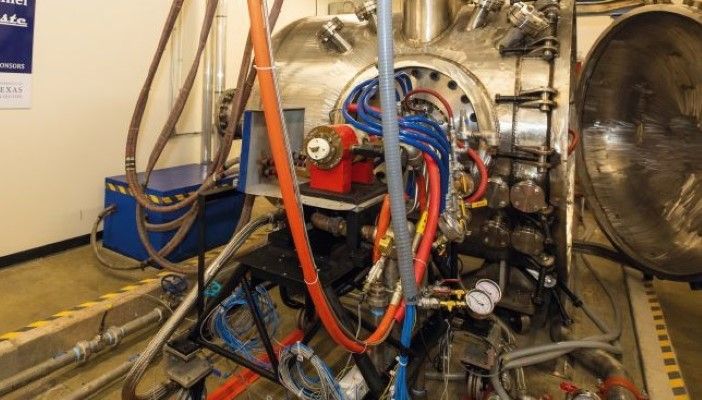
Arc-jet tunnels expose articles to hypersonic flows once hard to characterize, since conventional probes simply melt in their breath. Maddalena’s center has developed laser-based diagnostics to measure properties like turbulence impacting TPS performance.
Current work will compare TPS results from oxy-acetylene torch and plasmatron tests at the Universities of Arizona and Illinois with those from UTA’s tunnel.
These represent a TPS testing pyramid, at the base of which TPS screening exposes candidate materials to heat with oxy-acetylene welding torches, while intermediate plasmatron tests use radio-frequency induction to sustain plasma. The cost of arc-jet tunnels generally limits their use to final test and qualification.
“Over 70 years, we’ve developed expectations of subsequent material performance from oxy-torch tests, but never systematically compared results across the pyramid,” says Maddalena. “The tragedy would be rejecting a material in early screening which would have performed well in the arc-jet.”
Scientists are at the design and calibration stage of the comparative experiment, which may accelerate material development with a unified understanding of performance at different pyramid levels. Only the arc-jet tunnel combines heat with hypersonic shear stress, or friction with the airflow, a significant force on hypersonic vehicles, especially those launched in dense air at sea level.
“Some TPS systems develop protective oxide coatings,” Dr Daniel Palmquist, hypersonics project manager at HY-SET (HYpersonics Science Engineering Technology) says. “Those may perform well in static thermal tests, but the friction of a dynamic airflow may shear away the oxides and expose the substrate, which can quickly become fatal.”
NOVEL TESTING APPROACHES
Whereas oxy-acetylene screening offers no clue to such vulnerabilities, HY-SET’s novel Hypersonic Integration Facility (HIF) applies hypersonic temperatures in supersonic flows replete with shear. Located in Dallas-Fort Worth, HIF opened in June 2024 and has already attracted prominent defense customers. “We utilize supersonic injections and combustion of acetylene,” Palmquist explains. “Achieving the necessary choked flow would usually require upstream acetylene above the two atmospheres, at which it becomes unstable. We have a patent pending for changing the environment to inject and combust acetylene supersonically.”
HIF delivers energy equivalent to 200 oxy-torches and can test 25mm (1in) samples in a supersonic flow with known chemistry at several 1000°C (1,800°F) for up to one minute. Developed in just thirteen months in response to feedback from materials developers, it promises enhanced capabilities prior to arc-jet testing.
“Developers can test an array of samples in cost-effective, short-duration campaigns with rapid turnaround, obtain high-fidelity data, iterate and accelerate development,” says Palmquist. “We can even inject particulates relevant to a particular flight profile.”
Palmquist’s team is working to enable higher-temperature tests and accommodate specimens up to 300mm (11.8in). With customers interested in acquiring the technology, HY-SET is developing redundant safety mechanisms and software to limit controllability within safe parameters, enabling non-specialist operation.
“We’re refining our ability to offer variable trajectories, changing a flow’s profile to dynamically simulate what vehicles will experience in flight,” says Palmquist. “We anticipate transition to increased scramjet testing and can perform direct-connect tests, attaching an entire scramjet module to our facility.”
“When I started in hypersonic research, there wasn’t much interest,” says Maddalena. “Right now, we are busy. People want to go faster, not just for military applications. Hypersonic passenger travel will require advances in TPS and propulsion. We need TPS to land on other planets. For an aerospace engineer, hypersonics is the last frontier.”
WHY A HYPERSONIC FLYING TESTBED NEEDS TO BE REUSABLE
Stratolaunch designed the Talon-A reusable plane as a cost-effective hypersonic testbed for high-temperature materials, instrumentation and control sensors like the inertial measurement unit included in its March 2025 flight-test payload.
“We can test whether sensors can keep up in a hypersonic airflow, where even the smallest wrong input can result in vehicle loss,” says Zachary Krevor, CEO of Stratolaunch. “We’ve even shown the feasibility of testing an air-breathing engine.”
Reusability will allow scientists to capture 75 times the data provided by single-use vehicles which do not survive flight, retrieving and analyzing physical payloads. Where NASA’s X-15 was flown by a pilot, current research demanded full autonomy.
“Anyone doing hypersonics stands on the shoulders of the X-15 dataset,” says Krevor. “But today’s hypersonic systems maneuver beyond what the human body can tolerate, so we need an autonomous vehicle to test those capabilities.”
Following two successful hypersonic flight tests, Stratolaunch aims to decrease intervals between flights in pursuit of the DoD’s target cadence of 50 hypersonic flights per year. It is introducing a second launch vehicle – the now defunct Virgin Orbit’s Spirit of Mojave – and is looking to expand flights to new territories, including those of US allies.
In addition, Stratolaunch recently won a US$24.7 million US Missile Defense Agency contract under which it will help develop anti-hypersonic defense systems.
“Talon-A can act as an affordable, reusable surrogate, flying trajectories to stress defensive systems, so folks chartered with defending against hypersonics can see what that looks like and iterate quickly,” says Krevor.
NASA’S HYPERSONIC HERITAGE
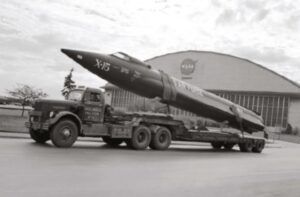
NASA’s Hypersonic Technology Project is a program of fundamental and applied research to enable routine flights with reusable, air breathing hypersonic vehicles that fly like conventional aircraft.
“We need high-performance propulsion systems operable over a wide Mach-number range, reusable high-temperature materials and structures and design tools with quantified uncertainty,” says NASA Hypersonic Technology Project (HTP) program manager, Mary Jo Long-Davis. “We will address those through simulation, ground-testing and flight-testing with industry, academia and government agency partners.”
NASA’s storied history of hypersonic experimentation stretches back to the X-15 program ran between 1954 and 1968. This accomplished 199 piloted hypersonic flights in a reusable, rocket-powered vehicle, setting unofficial world altitude and speed records of 354,199ft and Mach 6.7 (5,095mph/8,200km/h) respectively.
Between 1986 and 1992, the multiagency National AeroSpace Plane (NASP) program developed advanced propulsion and airframe technologies and high-temperature metal matrix and carbon-based composite materials.
“Perhaps NASP’s greatest contribution to science was the intensive development of computational fluid dynamics, which pervades aerospace design today,” adds Long-Davis.
NASP laid the foundations for the Hyper-X program, which saw the air-breathing scramjet X-43A attain record speeds of up to Mach 10 (7,612mph/12,250km/h) in 2004.
NASA operates a wealth of hypersonic propulsion, aerodynamics, structural and materials testing facilities. But simultaneously testing all flight parameters in one ground test remains challenging, as does full-scale and long-duration testing, large-scale thermal-structural testing, and testing in clean and undisturbed flows.
“Hypersonic flight requires integration of numerous disciplines, requirements and trajectories,” Long-Davis concludes. “Though successes have been realized, routine flight is feasible but not yet practical.”
TRACKING HEAT SIGNATURES AT HYPERSONIC SPEEDS
As interest in hypersonic projectile research grows, there is an increasing need to examine thermal effects on projectile aerodynamics. Ultra-high-speed imaging company Specialised Imaging is offering a solution with a new IR option that extends the capabilities of its SI Trajectory Tracker.
The SI Trajectory Tracker eliminates motion blur with a tracking mirror programmed to be synchronised with the movement of the projectile and a higher frame rate camera. The new IR option features a silver-coated tracking mirror which provides reflectance up to 8 μm, and a modular design that allows the standard silica protective window to be replaced with sapphire glass for wavelengths up to 5.5 μm, or germanium glass for wavelengths into the LWIR (Long Wave Infrared).
Moreover, the flexible modular architecture enables LWIR imaging beyond 8 um by replacing the silver-coated mirror with a gold-coated mirror and the window with germanium glass.
The SI Trajectory Tracker can be easily deployed using a fully adjustable mount amd provides consistent and accurate tracking of objects in flight using a computer controlled triggered rotating mirror positioned in front of a high-speed digital video camera or for infrared tracking an IR camera.