

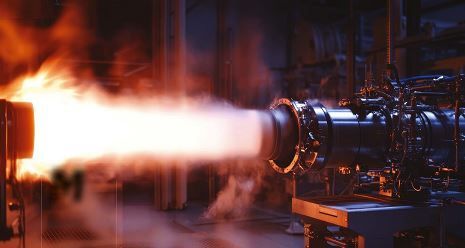
Measuring the processes inside a jet or rocket engine is one of the most challenging tasks an engineer can undertake – as searing temperatures of up to 3,632°F (2,000°C) in a jet engine and 5,972°F (3,300°C) in a rocket push testing setups to their limits. To tackle the challenges posed by operating in such extreme environments, engineers are exploring a range of imaging techniques and high-speed cameras that capture ultraviolet, visible, and infrared light – and transforming how engineers study combustion in aircraft engines.
By gathering data in multiple wavelengths simultaneously, engineers are now able to collect important details about flame temperatures, pollutant formation and combustion efficiency with a single cohesive approach. Specialized cameras capable of recording at 50,000 frames per second are beginning to reveal combustion details that were previously impossible to observe.
DETECTOR ARRAYS
As Daniel Pineda, associate director of the Center for Advanced Measurements in Extreme Environments (CAMEE) at The University of Texas at San Antonio, explains, combustion gases contain many types of molecules, some of which indicate how well fuel is being used and how much pollution is forming.
“These different molecules will interact with light at different wavelengths, and some of them have interaction in the mid-wave infrared and others in the ultraviolet,” he says. “Imaging of these interactions can help us understand what’s being formed and what’s being consumed.”
When carrying out such investigations, Pineda notes that high-speed IR cameras are particularly useful because the high frame rate means they are sensitive to light in the infrared. “In many ways, they are just like the digital cameras we use on a daily basis,” he says. “The pixels that we see in digital photographs typically each correspond to a detector within the camera behind the lens. The more of these detectors we can fit into an array, the higher resolution the camera will be.”
Depending on the materials used to make the detectors, they can become sensitive to UV, visible, or IR light – with some materials enabling a faster response than others. The fastest of these response materials are used to make detector arrays in high-speed cameras, and, according to Pineda, the ones that work in the IR usually work fastest or best at lower temperatures.
“In my research group, we’ve looked primarily at flames, stabilized on an additively-manufactured injector, with our high-speed IR cameras to better understand the combustion physics and the mixing for different injector designs,” he says. “We plan to use them to determine how well the fuel and oxidizer will mix, and how well a different design will burn. We can then easily 3D print a new injector design and then compare the performance.”
HAPPY CHILL STATE
Elsewhere, Michael Lengden, professor of electronic and electrical engineering at the Centre for Microsystems and Photonics, University of Strathclyde, uses an imaging technique called chemical species tomography (CST) to capture images of aircraft engine combustion. With CST, engineers can use either ultraviolet (UV) light sources to excite the electrons within an atom or a molecule, or infrared (IR) light sources to make a molecule vibrate.
In addition, by using lasers at a very targeted wavelength, Lengden explains that the researchers can be very selective on which species they are measuring. “This isn’t the case with cameras that have a lower wavelength resolution, leading to cross-talk in measurement of different gases – particularly hydrocarbons and water vapor,” he says.

According to Lengden, multi-wavelength cameras are useful for aerospace testing engineers because they can be used to capture images in both the ultraviolet and the infrared wavelengths. The wavelengths captured can be either directly emitted from the gas cloud, or via initial optical excitation of atoms and molecules within the gas cloud. In both cases, the user is accessing information from the quantum mechanical behavior of the atoms and molecules in the gas cloud through the energy excitation and relaxation of the electronic states of atoms and molecules in the UV, or the rotational and vibrational energy states of molecules in the infrared.

“The light emitted in these regions is caused by energy relaxation,” says Lengden, who is also technical program leader in the Laser Imaging of Turbine Engine Combustion Species (LITECS) project consortium. “Excited atoms and molecules with extra energy like to chill and so lose any extra energy to get back to their happy chill state.”
“The wavelength of the emitted light from a certain atomic and/or molecular species is unique, meaning that you can use multiple wavelengths to identify different gaseous species that are being emitted from the engine, and sometimes even quantify the amount of each species to understand engine performance and behavior,” he says. “Added to this, cameras can also be used in techniques such as Laser Induced Incandescence to measure particulate concentration through the measurement of the thermal radiation from optically heated soot.”
EXHAUSTIVE INVESTIGATION
In most of the cases where CST is used, the team employs infrared laser light to excite the ro-vibrational states of a target molecule – commonly H2O or CO2.
Once the light has crossed the engine exhaust, engineers measure how much light has been absorbed by the target molecule using a standard optical communications detector–cognizant of the fact that the amount of light absorbed is proportional to the concentration and temperature of the gas.
“One great thing is that we can take the ratio of two of these ro-vibrational states of a particular molecule – usually water vapor – that have different temperature dependencies, and then also extract temperature as well as concentration,” says Lengden.
During CST tests and experiments, the team uses multiple laser beams, typically 128, at different angles through the exhaust to get 128 measurements of absorbance of different CO2 and H2O gas features, before employing inverse mathematics to extract exhaust temperature and concentration images in a single plane of the flow – in contrast to images taken by cameras, which capture bulk emission across the whole z axis of the flow.
“We have been able to use this data to identify areas of higher and lower temperature in the exhaust, quantify CO2 images in very short millisecond timescales, and see the shape of the exhaust field,” he says.
CALIBRATION AND SETUP
When it comes to calibration and setup, Lengden notes that, in CST, he and his team are using the fundamental physical parameters of the gas, meaning they need to ensure that the models used are validated with controlled measurements of the gas of interest at the temperatures of interest in the lab. “The other calibration we need is a measurement of how the lasers’ wavelength tunes, which we can do on site in a matter of seconds,” he says.

“Finally, we have intensity variation as the light travels through the exhaust,” he says. “Here, we use a technique called Wavelength Modulation Spectroscopy, which is self-normalizing and inherently removes intensity variation of the light. This latter issue is a problem for camera systems, where light variation will cause imaging intensity variation that cannot be calibrated very easily.”
Whenever Pineda and his team use an IR camera to make measurements of temperature, he says they have to employ some calibration procedures “because the lens and its interaction with the camera internals will all affect the radiation that actually reaches the detector arrays.”
“There are assumptions that need to be made when taking the camera to image an object like an engine, but generally, if the surface properties of the hot materials are known, they can be accounted for and an accurate temperature can be determined, even outside the laboratory,” he says. “For other measurements – not related to temperature – especially those that are just showing the relative emissions of some gas, the calibration procedures are less relevant.”
FULL-ENGINE APPLICABILITY
According to Ryan Berke, associate professor of mechanical and aerospace engineering at Utah State University, because cameras work over a range of length scales as determined by the magnification of the lens, they should work on full-scale engines, provided they have line of sight. “Another key issue is making good use of the camera sensor,” he says. “The object needs to stay within view of the camera for the full duration of the test.”
In Berke’s view, combining thermal cameras and high-speed cameras is also tricky. Devices will have different pixel resolutions, so data will have to be mapped onto common coordinates and then interpolated in space. “Even if they have the same pixel resolution, they probably won’t have the same frame rate, so they’ll also have to be interpolated in time,” he adds.
“Most high-speed cameras have a maximum frame rate at full resolution – often in the order of 20,000fps for 1MP,” he says. “If you want to go any faster, you have to reduce the number of pixels. It’s very expensive to find thermal cameras over 1MP, and their frame rates are more on the order of 40fps.”
DESIGNING BETTER ENGINES
Dr Chang Liu, a key member of the LITECS consortium, is looking to commercialize CST systems for both research and commercial purposes. Liu has recently been awarded a Scottish Government Proof of Concept Award for on-airport diagnosis of aircraft-engine health for sustainable aviation. “It can be used to validate engines, carry out engine health monitoring, understand emissions and flow dynamics,” says Lengden.
Moving forward, Pineda envisages the creation of ever faster cameras with higher spatial resolution in the coming years. In terms of applications, he also thinks there are opportunities to combine mid-IR imaging with other techniques, such as Schlieren imaging, so that multiple variables can be measured in a flow. Current gaps in understanding of the physics required to push engines to the next generation are often limited by computer modeling.
“We often calculate the fluid mechanics elements entirely separately from the combustion and reaction elements, even though they are not independent,” says Pineda.
“By making multi-physical measurements, we can have a better understanding of how these phenomena affect each other and how they are coupled.
“We can use that information to design better engines.
“New experiments that can make as many measurements as possible simultaneously are an attractive target to accomplish this and I see the scientific community headed increasingly in this direction.”
SUSTAINABLE AVIATION FUELS
The multi-wavelength approach to capturing engine combustion data is particularly important for testing sustainable aviation fuels, which burn differently than conventional jet fuel. For Pineda, one of the most challenging things associated with testing sustainable fuels is the fact that they are usually not produced in large quantities when being developed. He says, “It is difficult to run an engine and measure the performance on only a few mL of fuel. Scientists and engineers then come up with different tests that use smaller amounts of fuel to measure combustion properties such as flame speed – with spherical combustion chambers or flat flame burners – or ignition delay time, in devices called shock tubes,” he says.
When it comes to hydrogen powered aircraft, Pineda argues that the challenges around cryogenic, pressurized storage are a major barrier, and that it is does not solve the pollution problem entirely.
“Aircraft generate nitrogen oxides during combustion, which can lead to smog, and the nitrogen comes from the air. Whether the fuel is traditional or hydrogen, this problem will persist without some clever burning techniques or emission control devices,” he says.
Meanwhile, in Lengden’s view, the testing of SAFs is no more challenging than conventional fuel. However, he also stresses that the cost of SAF is still much higher, making the costs of testing more expensive. “Using systems such as ours, that are very fast, reduces the overall cost by reducing testing time,” he says.