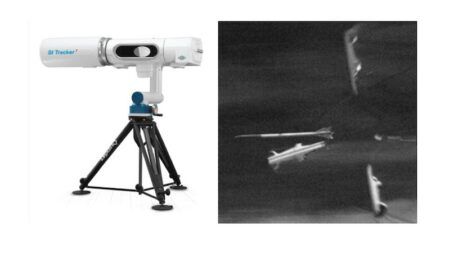



Not so long ago an aircraft satcom antenna was an extremely large piece of kit, typically sitting under a bulbous radome atop the fuselage. But antennas have inevitably become smaller as technology has advanced, while electronically scanned antennas (ESA) and phased arrays have abandoned the traditional parabolic shape in favor of flat form factors. Regardless of type or shape, a satcom antenna requires extensive testing through a range of parameters that include physical fit, the latter of which is sometimes challenging when the installation is by retrofit.

The low profile of California, USA-based satellite communications company ThinKom’s phased array antennas leaves them looking superficially like an ESA, but the underlying technology is different. Phased arrays mitigate some of the heat and power challenges faced by ESA manufacturers, but the two technologies ought to be considered complementary, with space for both in the market and, in some applications, on the same aircraft.
Considering its antenna testing, Bill Milroy, ThinKom’s chief technology officer and co-founder, says, “A good test program starts with a strong solution design. From there, we begin testing at the component level to certify the antenna for installation on the airplane. We must also make sure that the antenna components are within the physical design tolerances. We track the origin of all the different pieces and confirm that the material meets certification standards for an aeronautical use case.
“There’s an additional set of test parameters unique to each satellite operator and constellation. That means cooperating with our partners to demonstrate that the ThinAir antenna covers the full range of frequencies the satellite constellation needs and the linear or circular polarization requirements.
For non-geostationary orbit constellations, we also demonstrate beam switching speed, to ensure the terminal can hop between satellites or beams on the same satellite and not drop the connection. Finally, we test the systems against FCC and ITU standards, ensuring regulatory compliance.”

LABORATORY TRIALS
A new antenna design is well into its test program before it is first mounted on an aircraft. Stephane Klander, director of engineering, satcom from Honeywell Aerospace Technologies says, “Antennas undergo rigorous testing as standalone equipment in various laboratories, verifying individual performance before being integrated into a complete satcom terminal setup. By the time the antennas are part of flight trials, evaluation in lab environments has ensured their functionality and compatibility within the entire satcom system.
“The flight trial then serves to confirm reliable operation of the integrated system in real-time conditions rather than testing the antennas in isolation. Flight testing is required to ensure the satcom system can get aircraft state data and point correctly at the satellites in real-world flight conditions. This is needed for all different antenna types but can be more limited depending on how pointing is handled within the system architecture.”
Considering the operational use case, Milroy continues, “We fundamentally design our terminals from the bottom up to meet the full range of electrical, mechanical and birdstrike requirements from aircraft manufacturers and regulators. And then we do the testing to prove it. Bringing the finished product to an airframe means additional testing for electromagnetic compatibility with other radios and antennas to make sure we don’t jam those systems and that we’re not damaged by them. We also verify that the performance matches expectations, both for transmit and receive signal strength and to ensure that our terminal is not interfering with other satellites in orbit. Once installed on the aircraft, the system undergoes a final performance test before being returned to flight service.”

At Honeywell, Klander explains, “We use several dedicated anechoic chambers in our laboratories for comprehensive antenna testing and assess our satcom antennas on aircraft, including the Falcon 900, Gulfstream 550, Embraer 170, AW139, Boeing 757 and PC-12.”
Honeywell’s stalwart 757 is modified for connectivity and engine trials. It has multiple satcom systems, including antennas that may be changed depending on trial requirements.
Klander says, “Mounting a test engine on a pylon and configuring our 757 testbed for multiple dedicated antennas leads to several engineering considerations. Each aspect plays a critical role in ensuring optimal performance, safety and adaptability during testing. These considerations include the potential impact to the antenna/system performance, the performance of other systems, continuous airworthiness, aircraft performance and any impact on maintaining the systems onboard.
“Structural modifications are very involved and space to install new antennas is limited, even on large aircraft, when you consider spacing requirements and the large number of systems already installed.”
When Honeywell tests a new satcom, engineers first review the existing antennas on the aircraft to see if RF switches can enable sharing, or if an existing system can be temporarily disabled to free up the antenna for the test system. Sometimes an adaptor plate can be used.

“If none of these options are possible, we design a new antenna installation, which requires drawings, static strength and damage tolerance analysis, and a form FAA 8110-3, documenting conformity.
“We’ve been able to replace Honeywell’s JetWave with various antenna configurations without changing the radome. That allows for simple mechanical and electrical adapters to quickly install various antenna configurations without a major structural modification.”
ANTENNA STC
Once an antenna design has been certified, it is often up to MROs to design supplemental type certificates covering installation on specific aircraft models. This is true in the business / VIP aviation space, where Georgetown, Delaware-based Aloft AeroArchitects, a specialist in aircraft modifications with an emphasis on VVIP bizliners, recently completed development of the first FAA STC for the Gogo Galileo FDX antenna. The STC covers the Boeing 737NG-based Boeing Business Jet (BBJ) and enables full-duplex connection with Eutelsat OneWeb’s low-earth orbit (LEO) satellite constellation.

Speaking shortly after the STC was announced on October 6, 2025, Colby Hall, managing director, emerging technology and innovation at Aloft AeroArchitects, explained that the program had been one of the fastest in the company’s history. Even so, it had still taken close to nine months, much of it dedicated to test and analysis.
The Gogo Galileo FDX antenna, in common with other ESA units, is sealed and therefore does not require a radome. But it must still undergo physical birdstrike testing to satisfy FAA demands.
Hall says, “Our installation puts a fairing around the antenna, partly to reduce drag but primarily for birdstrike protection. We use an antenna mounted on a section of fuselage for the tests, which we send to an external agency for them to perform.”
Depending on an antenna’s shape and size, Hall says the FAA may accept birdstrike behavior modeling data for certification, but cautions that it depends if the antenna falls into the category of what the FAA terms a large antenna. He adds, “EASA defines large antenna slightly differently, and is more willing to accept modeling over physical trials. But our FDX installation was just a little too tall for the FAA to accept modeling only. We still model extensively and the birdstrike test is a validation of those modeling predictions.”
Indeed, modeling plays a major role in designing the installation and proving its airworthiness. Hall lists aerodynamic, birdstrike and flutter analysis are among the test plans that are written long before a single mounting hole is drilled in a fuselage. The trial process even extends to the most prosaic level of comparing holes and attachment points on the antenna with the positions anticipated from Gogo’s drawings.
Acknowledging that radomes are not a requirement for all antenna types, Klander notes that where they are needed, further testing is involved. “The significance of birdstrike trials for radomes varies based on size, installation location and platform type. This often presents challenges during evaluation. Beyond birdstrike resistance, radomes undergo comprehensive testing to assess several critical aspects.
“These include RF performance to ensure signal integrity, lightning protection for safety and aerodynamic performance to maintain airflow characteristics.
“Each of these tests helps ensure that the radome not only protects the antenna but also enhances functionality and safety in diverse operational environments.”
At ThinKom, Milroy says, “Birdstrike qualification remains a critical test point, even with the extremely low profile of the ThinAir terminal, to ensure any incident with the radome and antenna won’t cause damage to the rest of the aircraft. We’re supportive of a move towards using digital twins to improve this facet of the testing program, but those results are only as good as your digital twin is a representation of the real antenna. Nobody has been able to figure out yet how to get a digital twin that’s accurate enough to reliably show compliance to all the different regulations across the nuance of antenna characteristics. So we still perform the physical testing today – following intensive digital simulations – to ensure safety of the terminal on board.”
STC AMENDMENTS
With its FDX STC complete, Aloft has already embarked upon an amendment. The initial STC covers a forward fuselage mounting position, one that was dictated by the subject aircraft’s existing antenna fit but shown by trials to be less aerodynamically ideal than an aft installation. Add to this that no two BBJ 737s are alike, thanks to the bespoke nature of their configurations and, says Hall,
“We’re working on an amendment for an aft install, for better ‘aeros’ and for flexibility in siting the antenna, because the existing antenna on the BBJ 737s vary and we need to find space for a new antenna where there is no interference with other systems.
“We have customers requesting quotes for FDX on aircraft that have already had three antennas in the same location, and that means we need to carefully assess the aircraft and any previous modifications before going ahead with the installation.”


Hall notes the huge task of record keeping, analysis and report writing required for STC qualification, on top of the work already done by the antenna OEM.
At Honeywell Aerospace Technologies, Klander says, “Data gathered for the FAA, EASA and other certifications involves meticulous documentation at every step of the process. We create plans and design documents for approval from the certification agencies, including detailed hardware and software design documents, test plans, procedures and reports.
“Additionally, comprehensive documentation on aircraft modifications and continuous airworthiness is maintained, along with on-wing test plans, procedures and reports.
“This systematic approach ensures that all complexities are addressed and validated, while facilitating compliance with regulatory requirements.”
Adding to Klander’s thoughts on regulatory requirements, Milroy says, “They are mostly about ensuring that the antenna won’t cause any damage or interference on the aircraft, both while operating normally and in crash-safety scenarios. Those are well documented, and the parameters drive the test programme start-to-finish.
“Beyond that, we also differentiate in testing and qualification for retrofit installations versus being qualified by a manufacturer to be installed at the factory. Boeing and Airbus have additional requirements for testing that goes well beyond FAA or EASA standards to become line-fit offerable.”
Milroy also highlights that military and special mission cases use a different set of qualification standards: “There is some overlap, as a lot of the underlying aircraft are the same, such as a 767 frame for tankers or the 737, 747, and 757 for executive transport. But they have their own – generally more stringent – criteria for environmental performance, electromagnetic interference and electromagnetic compatibility.”
Even with trials complete and regulatory approval granted, Milroy says ThinKom adds an additional layer of approval: “Every unit goes through an acceptance test procedure before delivery to the customer where we measure the antenna patterns of the system. Every antenna goes through a temperature cycling test, which puts it through multiple cycles between the hot and cold extremes it will experience in flight.
“And every antenna goes on a vibration table to show that it meets requirements and survives in a highvibration environment.”