

It has been a longstanding challenge in aviation, persisting for decades and never fully realized to achieve the speed of a fixed-wing aircraft while keeping the flexibility of a helicopter that needs no runway. For years, emerging aircraft designs have had to choose between two very different advantages – aircraft that cover speed and distance but need long runways for take-off and landing, and helicopters that can operate from almost anywhere, including rough terrain, but are limited in how fast they can fly.
The challenge has recently been an operational focus for the Defense Advanced Research Projects Agency (DARPA), in partnership with US Special Operations Command (USSOCOM). Although the Speed and Runway Independent Technologies (SPRINT) program has remained behind closed doors for most of its life, key details emerged when it began Phase 1A on November 1, 2023, with four companies contracted to develop conceptual designs.
In May 2024, Aurora Flight Sciences and Bell Textron were awarded Phase 1B preliminary-design contracts to refine their concepts into potential operational aircraft. That phase lasted about a year and, by June 2025, one design stood out – Bell Textron’s, which won a contract to advance to Phases 2 and 3.
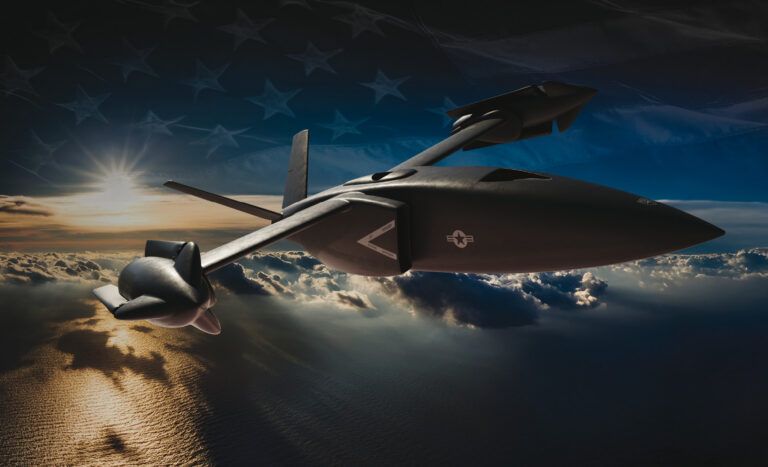
Phase 2 covers detailed design, manufacturing, assembly and ground testing of the X-76, followed by a flight-test program in Phase 3 planned for early 2028. The program’s ambitious goals raise questions about how they will be tested and proven over the coming years.
SPRINT program manager Cmdr. Ian Higgins of the US Navy explains to Aerospace Testing International what is behind the X-76 and why the capability is only now becoming a reality. “With SPRINT we’re not just building an X-plane, we’re building options. We’re working to deliver the option of surprise, rapid reinforcement and life-saving speed, anywhere on the globe without needing a runway,” says Higgins.
“The SPRINT X-76 is intended to be a proof-of-concept technology demonstrator, and its flight-test program seeks to validate enabling technologies and integrated concepts that can be scaled to different-sized military aircraft.
“These variants would be capable of cruising at 460 – 518mph at relevant altitudes and of taking off, landing and hovering in austere environments and on unprepared surfaces.
“The core of the technology challenge is creating a platform that balances two opposed aerodynamic principles: the powered lift required for vertical take-off and landing, and the wing-borne lift needed for efficient, high-speed forward flight. This is a DARPA-hard problem because designs optimized for hovering are traditionally inefficient at high speeds, and vice versa,” he adds.
Proving performance
The novel technology Bell’s X-76 requires brings the need for new approaches to validation.
“As the program moves into fabrication and flight testing, the focus will shift from concept validation to demonstrating the performance of the integrated system. Success will ultimately be measured not just by speed or hover capability, but by the ability to validate scalable enabling technologies applicable to future operational aircraft,” says Higgins.
He regards these challenges as the next step, drawing on lessons from earlier programs: “The SPRINT program continues to incorporate lessons learned from previous and ongoing aerospace efforts, including Critical Design Review lessons. Digital design, analysis and model-based systems engineering tools – not available during the V-22’s development – are being widely used in the design, manufacturing, assembly and testing of the X-76.
“These tools are crucial to the detailed design and planning needed to achieve a successful Critical Design Review while maintaining an aggressive schedule.”
Osprey’s legacy
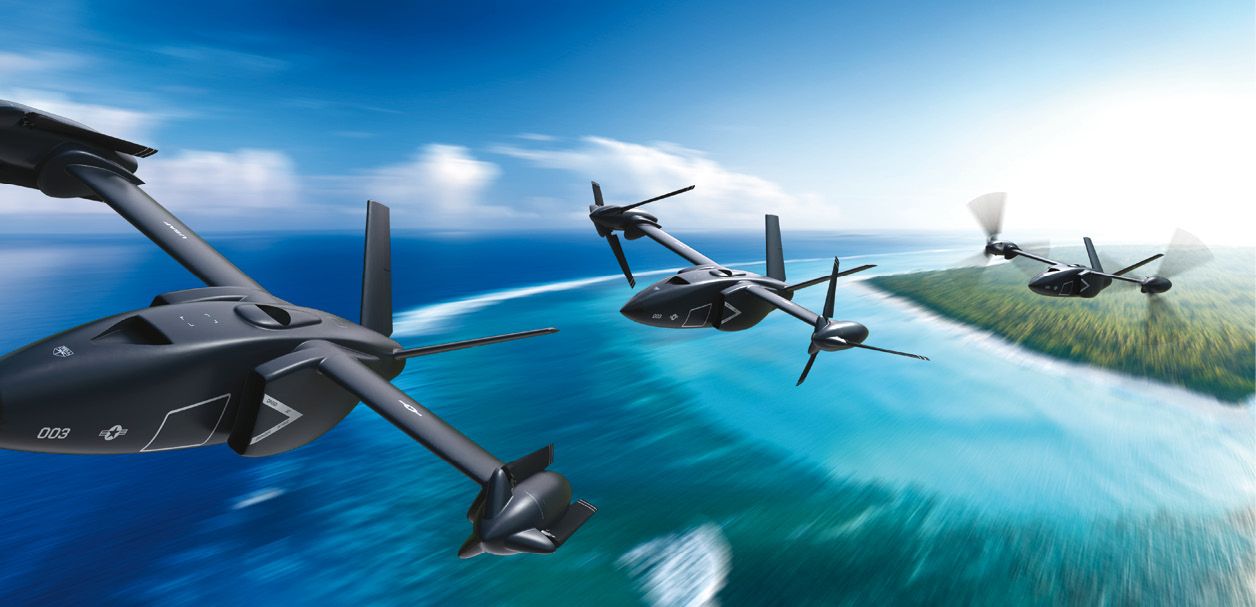
Discussing the lessons Bell has drawn on for the X-76, Higgins adds: “As the developer of the V-22, we have incorporated numerous lessons from the Osprey into the design of the X-76. The most visible change is moving the engines from the rotating pylons, as on the V-22, to the center fuselage. Even highly detailed changes within the drive-system components have been incorporated, all expected to benefit the manufacturing, production, assembly and testing of the X-76.”
With such a new concept, Higgins continues: “The program is designing and building around system integration labs to reduce the risk of the key enabling flight hardware and software technologies before flight test. There are inherent risks in trying something new, and the system integration labs help to increase confidence that the key enabling technologies will operate as expected in their intended environment.”
Tackling transition
As with all tiltrotor concepts, the transition phase is the most critical. During the Osprey’s development, losses occurred both in testing and in operational service. Bell has continued to develop and improve this flight phase, and those concepts are being adopted for the X-76.
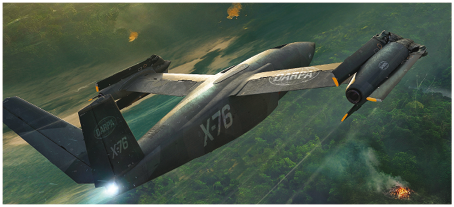
Higgins explains: “Bell’s stop-fold tiltrotor design addresses a key limitation of conventional aircraft. Although helicopters and tiltrotors can take off and land vertically, their exposed rotors create drag and limit speed in forward flight.
“This concept uses rotors where they are most effective – during take-off, landing, hover and low speed flight – and then removes them from the airstream for high-speed cruise.”
“The most challenging aspect is the transition to and from rotor-borne and fixed-wing flight. As the aircraft accelerates, lift shifts from the rotors to the wing, and propulsion changes from rotor-driven thrust to a jet or turbofan system. The rotors must be slowed, stopped and folded while maintaining vehicle stability and staying within component load limits.
“The process is reversed during the transition from high speed to vertical flight. It requires tightly integrated flight controls, propulsion and structural design to ensure a smooth, safe transition between the aircraft’s modes of operation.”
Bell has explored both manned and unmanned concepts for the X-76.
“The X-76 is an unmanned vehicle, with an operator monitoring its status and providing heading and altitude commands. Control is always handled by the flight control computer. However, future variants could be piloted or fully autonomous,” says Higgins.
Reshaping flight
As the X-76 is a technology demonstrator, DARPA created vehicle performance and payload attributes to help size it. The aircraft should carry 1,000 lb (450kg) of payload while flying a meaningful flight-test mission defined by the program office. The top speed should be 460-518mph (740-830km/h). “The X-76 is expected to meet both objectives,” says Higgins.
The technology SPRINT is demonstrating could reshape battlefield tactics by allowing high-speed, runway-independent operations. That would reduce the military’s reliance on large, established air bases and increase flexibility in contested environments.
“Although conventional helicopters and tiltrotor aircraft are vital for operating from austere locations, their limitations in speed and range create logistical challenges. They cannot fully support a distributed and agile force, which often forces reliance on fixed-wing aircraft dependent on vulnerable, fixed-runway infrastructure,” says Higgins.
“The high-speed vertical take-off and landing capability this program demonstrates will enable future aircraft that bridge this critical gap and provide real capability for various critical mission sets.”
DARPA and Bell aim to give USSOCOM the increased speed and range it is seeking for mission profiles – similar goals to those being developed for the Bell MV-75 Cheyenne II, winner of the Future Long-Range Assault Aircraft competition.
Higgins adds: “We believe the technologies developed within the SPRINT program will help inform many of the services, beyond USSOCOM, as they look to develop their next-generation vertical-lift platforms.”
The conflict in Ukraine has driven the rapid growth in operational capability of unmanned platforms and shown their potential, especially in offensive roles.
Higgins addresses several different types of mission profiles that could emerge from the X-76: “The operational missions for an unmanned X-76-type platform will be at the discretion of the services.
“Possible missions include routine combat resupply and contested logistics, where the supply chain may be disrupted by enemy action, particularly when resupplying special forces deep behind enemy lines.
“Other roles could include electronic warfare over the battlefield or at higher altitudes, with the ability to remain on station far longer than a manned platform.
“Further profiles, such as strike and attack, could include special forces infiltration and exfiltration and personnel recovery, with either a manned or unmanned variant. Beyond these are high-value asset escort and manned-unmanned teaming missions,” says Higgins. “There are similar opportunities in the commercial sector, to provide rapid transit for emergency medical support or high-speed regional air mobility.”
DARPA’s cautious approach – pursuing SPRINT as an X-plane program rather than a direct acquisition – reflects the ambitious concept being developed. On their own, runway-independent and high-speed are not difficult goals. Combining them in a single aircraft with useful payload capacity, manageable complexity and a transition mode that is both safe and repeatable is tough.