


Aerospace Testing InternationalAerospace Testing International
  • News
    • A-E
      • Acoustic & Vibration
      • Avionics
      • Data Acquisition
      • Defense
      • Drones & Air Taxis
      • Electric & Hybrid
      • EMC
      • Engine Testing
      • Environmental Testing
    • F-L
      • Fatigue Testing
      • Flight Testing
      • Helicopters & Rotorcraft
      • High Speed Imaging
      • Industry News
    • M-S
      • Materials Testing
      • NDT
      • Simulation & Training
      • Software
      • Space
      • Structural Testing
      • Supplier News
    • T-Z
      • Technology
      • Telemetry & Communications
      • Weapons Testing
      • Wind Tunnels
  • Features
  • Magazines
    • September 2026
    • June 2026
    • March 2026
    • Dec 2025 / Jan 2026
    • Showcase 2026
    • August / September 2025
    • Archive Issues
    • Subscribe Free!
  • Opinion
  • Webinars
  • Events
    • All Events
    • Aerospace Test & Development Show
  • Podcasts
  • Videos
  • Suppliers
    • Supplier Spotlights
    • Press Releases
    • Technical Papers
LinkedIn YouTube X (Twitter)
Subscribe to magazine Subscribe to email newsletter Media Pack
Aerospace Testing InternationalAerospace Testing International
  • News
      • Acoustic & Vibration
      • Avionics
      • Data Acquisition
      • Defense
      • Drones & Air Taxis
      • Electric & Hybrid
      • EMC
      • Engine Testing
      • Environmental Testing
      • Fatigue Testing
      • Flight Testing
      • Helicopters & Rotorcraft
      • High Speed Imaging
      • Industry News
      • Materials Testing
      • NDT
      • Simulation & Training
      • Software
      • Space
      • Structural Testing
      • Supplier News
      • Technology
      • Telemetry & Communications
      • Weapons Testing
      • Wind Tunnels
  • Features
  • Magazines
    1. September 2026
    2. June 2026
    3. March 2026
    4. Dec 2025 / Jan 2026
    5. Showcase 2026
    6. August / September 2025
    7. Archive Issues
    8. Subscribe Free!
    Featured
    2nd September 2026

    In this issue: September 2026

    Online Magazines By Ben Sampson
    Recent

    In this issue: September 2026

    2nd September 2026

    In this issue: June 2026

    16th June 2026

    In this issue: March 2026

    24th March 2026
  • Opinion
  • Webinars
  • Events
    • All Events
    • Aerospace Test & Development Show
  • Podcasts
  • Videos
  • Suppliers
    • Supplier Spotlights
    • Press Releases
    • Technical Papers
LinkedIn YouTube X (Twitter)
Aerospace Testing InternationalAerospace Testing International
Opinion

Ice protection you can paint on

Blai López Rius, AIMPLASBy Blai López Rius, AIMPLAS2nd November 20264 Mins Read
Share LinkedIn Twitter Facebook Email
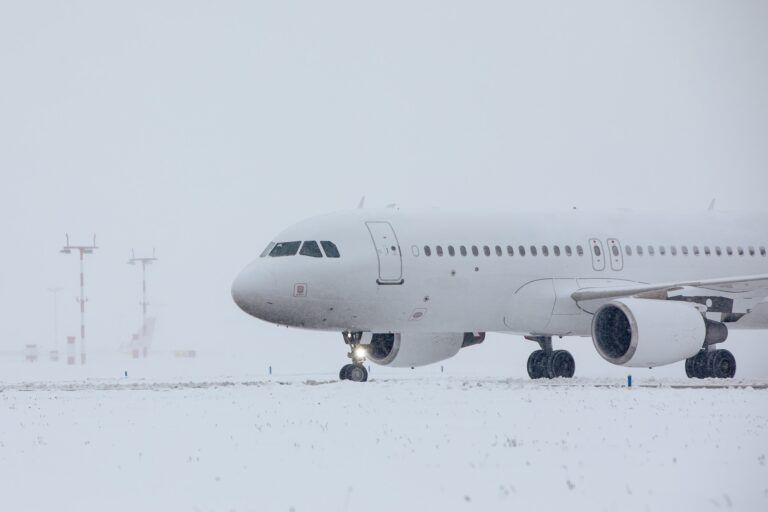
Traffic at airport during snowfall
Snow and ice remain a costly operational challenge in aviation – the problem low-energy heated coatings aim to address” (Photo: AIMPLAS)

Ice formation on aircraft is one of the main challenges in aviation, for both safety and operational efficiency. Ice building up on critical surfaces such as the wings or stabilizers can cause a significant loss of lift and an increase in aerodynamic drag, compromising performance and increasing fuel consumption.

The limits of today’s systems

Current ice protection systems (IPS) used in aeronautics have a number of limitations. Technologies such as hot air bled from the engines, pneumatic systems and conventional electrothermal systems involve high energy consumption, added weight and complex integration. Many of these solutions are also difficult to control or offer limited efficiency under certain flight conditions.

Against this backdrop, there is a need for new solutions that improve flight safety while reducing energy consumption and the sector’s environmental impact. One of the most promising alternatives is a functional coating with a heating capability.

A coating that generates heat

The COAT-IPS project follows this approach, aiming to develop a low-energy heated coating that can operate in both anti-icing mode (preventing ice from forming) and de-icing mode (removing ice that has already formed). The coating is conceived as a technical paint applied directly to the aircraft surface – a significant advantage over more complex systems.

These coatings work on the Joule effect, in which electrical energy is converted into heat as an electric current flows through a conductive material. That requires formulations incorporating conductive materials that reach the necessary conductivity without compromising the coating’s other properties.

Getting the dispersion right

One of the main challenges is ensuring the conductive fillers are properly dispersed within the polymer matrix, which guarantees a stable formulation and uniform heating. Poor distribution can lead to efficiency losses or system failures, so formulation design and control of the dispersion process are critical to the technology’s success.

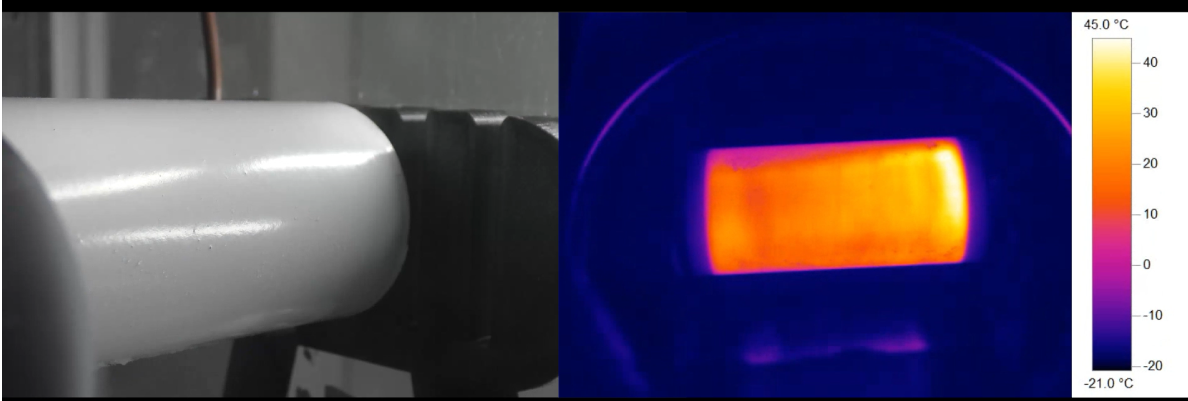
In operation, the COAT-IPS coating is designed to reach moderate temperatures in anti-icing mode, keeping the surface above 32°F (0°C) to prevent ice forming, and higher temperatures in de-icing mode, so accumulated ice melts rapidly. This is achieved with short response times and optimized energy consumption.
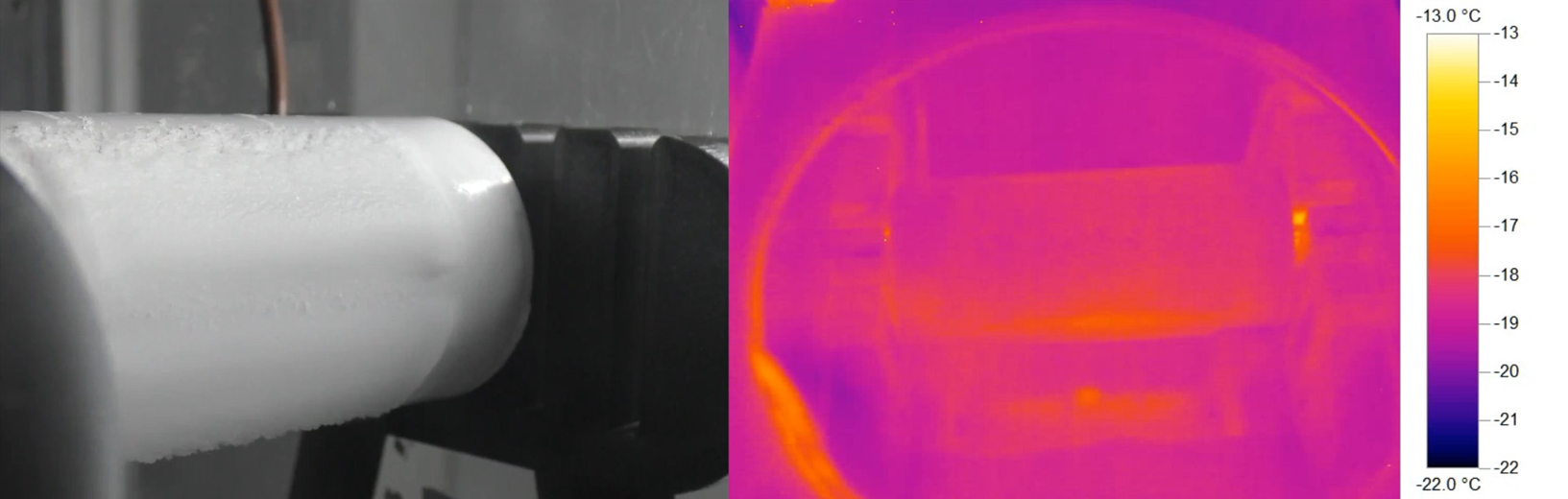
A coated test specimen accumulates ice in the icing test; the thermal image (right) shows the surface held well below freezing (Image: AIMPLAS)
With the coating powered, the same specimen heats up – the thermal image (right) shows the surface warming to prevent or melt ice (Image: AIMPLAS)

The advantages of a paint

From an application standpoint, one of the main advantages is that the solution is a paint. That lets it be integrated easily into standard aeronautical manufacturing and maintenance processes without additional infrastructure. Because it can be applied to complex surfaces, it can also be used on different parts of the aircraft, including hard-to-reach areas.

Another important advantage is the ability to repair it in situ. If damaged, the coating can be replaced locally through simple steps such as sanding and reapplying the paint, avoiding the need to replace entire systems. That reduces maintenance costs and increases aircraft availability.

The coating’s light weight also helps reduce the total weight of the ice protection system, directly improving fuel efficiency. That is especially relevant in a sector seeking to cut its carbon footprint and move toward more sustainable mobility.

This kind of solution applies not only to commercial aircraft but also to uncrewed aerial vehicles (UAVs) and other sectors where ice is a problem, such as wind energy.

A collaborative project

COAT-IPS is being carried out through a collaboration between OMAR Coatings, AIMPLAS and INTA, combining expertise in coating formulation, advanced materials development and validation under aeronautical conditions. This makes it possible to take the development from laboratory scale through to validation in environments representative of real-world use, including testing in icing wind tunnels.

At AIMPLAS, the Plastics Technology Centre, several lines of research are under way in functional coatings and energy-efficient technologies, aimed at the current challenges facing the mobility sector. In this context, COAT-IPS represents a significant step toward more efficient, lightweight and sustainable ice protection systems.

The COAT-IPS project is funded by the Spanish Ministry of Science, Innovation and Universities through the State Research Agency (AEI) Public-Private Collaboration call, and co-funded by the European Union through the European Regional Development Fund (ERDF). This publication is part of R&D&I project CPP2022-010107, funded by MICIU/AEI/10.13039/501100011033 and by the European Union NextGenerationEU/PRTR.

Share. Twitter LinkedIn Facebook Email
Previous ArticleHypersonica raises €100m to develop and test European hypersonic missile
Blai López Rius, AIMPLAS

Blai López Rius is a researcher in coatings, adhesives and converting at AIMPLAS

Related Posts

supersonic aircraft
Materials Testing

Supersonic heating: the structural challenge for future aircraft

2nd September 20263 Mins Read
Flight Testing

Insight: In support of the flight test failure

19th August 20263 Mins Read
Opinion

Explaining DO-178C: The safety standard for software in aviation

12th August 20268 Mins Read
Latest Posts
Traffic at airport during snowfall

Ice protection you can paint on

2nd November 2026

Hypersonica raises €100m to develop and test European hypersonic missile

2nd November 2026
arc-jet wind tunnel with a laser based measurement technology

US researchers pioneer better way to measure hypersonic airflow

2nd November 2026
Supplier Spotlights
  • JDA Systems (Europe) GmbH
  • Precision Filters, Inc. (PFI)
  • Evolution Measurement
  • CALCULEX
  • Hottinger Brüel & Kjær
  • AVL List GmbH
  • Tekna
  • InnovMetric
  • CGM CIGIEMME S.p.A.
  • SET GmbH
  • Tyto Robotics
    Tyto Robotics Inc.
  • Ametek
    AMETEK Programmable Power
  • Delta Information Systems logo
    Delta Information Systems
  • Helling GmbH
    Helling GmbH
  • Matec Instrument Companies, Inc.
    Matec Instrument Companies, Inc.
  • Endevco
  • Ipetronik
    IPETRONIK GmbH & Co. KG
  • VJ Technologies
  • Durr NDT
    DÜRR NDT GmbH & Co. KG
  • Dewesoft
  • Bruker Alicona Dimensional metrology & surface roughness measurement
    Bruker Alicona
  • ATG Advanced Technology Group
    ATG – Advanced Technology Group
  • Dytran Instruments, Inc.
  • Kistler Group
    Kistler Group
  • Diversified Technical Systems (DTS)
  • Scanivalve Corporation
  • G Systems
  • CEC Vibration Products LLC.
  • dSPACE
  • Safran Data Systems
  • Photron
  • YXLON International
  • Telspan Data
  • TotalTemp Technologies, Inc.
  • Vector Informatik GmbH
  • Vibration Research
  • TEST-FUCHS
  • Siemens Digital Industries Software
    Siemens Digital Industries Software
  • PCB Piezotronics, Inc.
  • Testia
  • Treo – Labor für Umweltsimulation GmbH
  • W5 Engineering
  • National Institute for Aviation Research
  • North Star Imaging
  • MK Test Systems Ltd.
  • Intertek
  • I.N.C.A.S. – NATIONAL INSTITUTE FOR AEROSPACE RESEARCH “ELIE CARAFOLI”
  • FMV Test & Evaluation
  • Glenn L Martin Wind Tunnel
  • GRAS Sound & Vibration
  • Elsys AG
  • EMCCons DR. RAŠEK GmbH & Co.KG
  • European Test Services (ETS) B.V.
  • Chemetall GmbH logo
    Chemetall GmbH
  • Curtiss-Wright
  • Data Physics Corporation
  • AOS Technologies AG
  • Airmo Inc. Pressure Technologies
    Airmo Inc.® Pressure Technologies
Our Social Channels
  • Twitter
  • YouTube
  • LinkedIn
Getting in Touch
  • Subscribe To Magazine
  • Contact Us
  • Meet the Team
  • Media Pack
Related Topics
  • Aircraft Interiors
  • Business Jet Interiors
FREE WEEKLY NEWS EMAIL!

Get the 'best of the week' from this website direct to your inbox every Wednesday

© Copyright 2026 Mark Allen Group. All rights are reserved, including those for text and data mining, AI training, and similar technologies.
  • Cookie Policy
  • Privacy Policy
  • Terms & Conditions

Type above and press Enter to search. Press Esc to cancel.