



A new technology for assessing the performance of aircraft wings in flight and warning pilots of dangerous ice buildup is being developed through a new partnership between Surrey Sensors and Cert Center Canada.
In-flight ice buildup has been a major contributing factor in a number of catastrophic aircraft incidents in recent years. Ice accretion can block aircraft air data probes, leading to incorrect angle-of-attack, airspeed or altitude readings and a disagreement between different instruments. Ice can also build up on the wing surfaces to make them rough and irregular, considerably changing the handling characteristics of the aircraft. With incorrect or contradictory information from the air data systems and higher sensitivity to stall, ice accretion can be very dangerous to aircraft operations.
Ice is commonly detected on the aircraft using specialized ice sensors, or through visual inspection by the pilots. Both of these techniques only provide an indication of whether the aircraft is flying through icing conditions. The new High Integrity Airfoil Performance Monitor (HI-APM) being jointly developed by teams in Canada and the UK directly measures the effect of the ice on wing performance through the turbulence characteristics within the wing boundary layer.
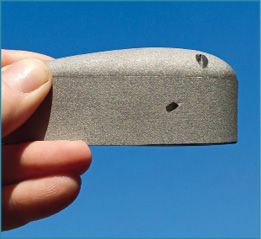
A small mast on the wing is used to collect air flow measurements at different positions above the surface using two different sensing technologies: first, with conventional pressure sensors, and second, using proprietary heat-transfer-based velocity sensors. Together, these two sensing technologies provide complementary measurements of the same phenomena with no common failure modes: a requirement for high design-assurance-level (DAL) air data instrumentation.
A direct measure of the effect of ice on flight handling characteristics would provide pilots with the real-time data needed to make real-time, evidence-based judgments on whether their high-power ice protection systems are needed, rather than activating these systems under any flight conditions where ice accretion may occur.
As an added advantage, since the sensors will also be responding to the flow around the mast itself, and because the flow around the mast will depend on the aircraft’s speed and direction, the system will also be able to provide independent measures of airspeed, angle of attack and sideslip. Like any air data probe, the mast itself is also heated to protect it from ice, but located away from the leading edges and with no holes to become blocked, the heat-transfer based sensors will provide a valuable check against pressure port fouling.
Because pressure sensors work by measuring the deflection of a thin membrane, one major disadvantage is that they will misinterpret vibration or acceleration as being changes in pressure. This makes measurements in rotating environments – like rotorcraft or wind turbine blades – extremely difficult. A miniature variant of the Airfoil Performance Monitor is also being developed for these use cases, based on the heat-transfer sensors alone.
These postage-stamp-sized semiconductor sensors are impervious to acceleration, and so this ‘micro-APM’ may be the first deployable technology for detecting ice, erosion or debris on rotors during flight. Once the next round of flight testing is complete, the airfoil performance monitor will be available for fitting to aircraft, dramatically improving pilot information and flight safety.