

Aerospace Testing InternationalAerospace Testing International
  • News
    • A-E
      • Acoustic & Vibration
      • Avionics
      • Data Acquisition
      • Defense
      • Drones & Air Taxis
      • Electric & Hybrid
      • EMC
      • Engine Testing
      • Environmental Testing
    • F-L
      • Fatigue Testing
      • Flight Testing
      • Helicopters & Rotorcraft
      • High Speed Imaging
      • Industry News
    • M-S
      • Materials Testing
      • NDT
      • Simulation & Training
      • Software
      • Space
      • Structural Testing
      • Supplier News
    • T-Z
      • Technology
      • Telemetry & Communications
      • Weapons Testing
      • Wind Tunnels
  • Features
  • Magazines
    • Showcase 2027
    • September 2026
    • June 2026
    • March 2026
    • Dec 2025 / Jan 2026
    • Showcase 2026
    • Archive Issues
    • Subscribe Free!
  • Opinion
  • Webinars
  • Events
    • All Events
    • Aerospace Test & Development Show
  • Podcasts
  • Videos
  • Suppliers
    • Supplier Spotlights
    • Press Releases
    • Technical Papers
LinkedIn YouTube X (Twitter)
Subscribe to magazine Subscribe to email newsletter Media Pack
Aerospace Testing InternationalAerospace Testing International
  • News
      • Acoustic & Vibration
      • Avionics
      • Data Acquisition
      • Defense
      • Drones & Air Taxis
      • Electric & Hybrid
      • EMC
      • Engine Testing
      • Environmental Testing
      • Fatigue Testing
      • Flight Testing
      • Helicopters & Rotorcraft
      • High Speed Imaging
      • Industry News
      • Materials Testing
      • NDT
      • Simulation & Training
      • Software
      • Space
      • Structural Testing
      • Supplier News
      • Technology
      • Telemetry & Communications
      • Weapons Testing
      • Wind Tunnels
  • Features
  • Magazines
    1. Showcase 2027
    2. September 2026
    3. June 2026
    4. March 2026
    5. Dec 2025 / Jan 2026
    6. Showcase 2026
    7. Archive Issues
    8. Subscribe Free!
    Featured
    4th November 2026

    In this issue – Showcase 2027

    Online Magazines By Web Team
    Recent

    In this issue – Showcase 2027

    4th November 2026

    In this issue: September 2026

    2nd September 2026

    In this issue: June 2026

    16th June 2026
  • Opinion
  • Webinars
  • Events
    • All Events
    • Aerospace Test & Development Show
  • Podcasts
  • Videos
  • Suppliers
    • Supplier Spotlights
    • Press Releases
    • Technical Papers
LinkedIn YouTube X (Twitter)
Aerospace Testing InternationalAerospace Testing International
Defense Opinion

The new technologies in the UK defence investment plan

Arun Dawson, PhD Candidate, Department of War Studies, King's College LondonBy Arun Dawson, PhD Candidate, Department of War Studies, King's College London6th July 20266 Mins Read
Share LinkedIn Twitter Facebook Email
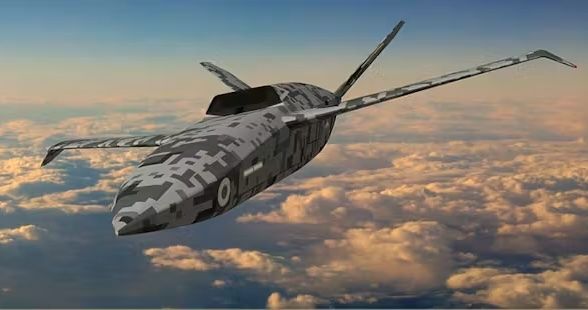
The MOD’s Lightweight Affordable Novel Combat Aircraft (LANCA) initiative aims to develop low-cost, uncrewed fighter drones. UK MOD / Crown Copyright

Seventy years ago, Britain confronted a dilemma. It wanted to remain a leading military power but no longer had the economic resources to sustain all the conventional capabilities it had inherited from the second world war.

The solution proposed in the 1957 Sandys defence white paper was technological. Guided missiles, Duncan Sandys argued, were transforming warfare so fundamentally that many traditional capabilities, including some crewed combat aircraft, would become obsolete.

In other words, by embracing this technological revolution, Britain could achieve defence on the cheap. Britain’s new Defence Investment Plan (DIP) reflects a similar strategic instinct. The technologies may have changed but the underlying dilemma has not.

Announcing the DIP in the House of Commons, Dan Jarvis, the defence secretary, said the UK would be making its “largest ever investment in drone warfare: £5 billion for strike, protector and surveillance drones across the Royal Navy, the Army and the Royal Air Force.”

Here are some of the key technologies discussed in the Dip.

Drone ships

At least a quarter of the £5 billion announced for drone warfare is going towards a “hybrid fleet,” a fundamental re-imagining of the Royal Navy. The UK’s sole ballistic missile defence capability – the Type 45 destroyers – will no longer be replaced by a like-for-like. Instead, a network of Crewed Combat Vessels (CCVs) will act as control hubs for specialised, uncrewed boats.

These would include Type 91 missile barges, Type 92 and Type 93 anti-submarine and underwater surveillance platforms, and Type 94 radar vessels. In principle, distributing the sense, decide and strike functions across the navy offers several advantages.

It could ease chronic personnel shortages by reducing crew requirements, extend radar and sonar coverage over a wider area, and make the fleet more resilient by dispersing combat power rather than concentrating it in a handful of expensive warships.
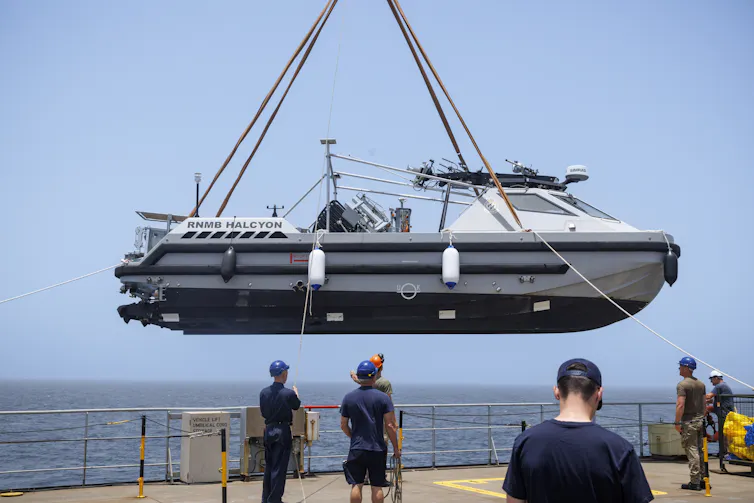
The MOD has experimented with using the RFA Lyme Bay as a mothership for autonomous craft.
UK MOD / Crown Copyright

Uncrewed vessels could also be rearmed or maintained independently and without the
design constraints of supporting sailors at sea. However, the challenges are significant.

The DIP envisages this concept becoming proven and operational before the Type 45 retires in the mid-2030s, despite the fact that resilient communications and electronic warfare protection for autonomous warships remain immature.

Nor is Ukraine’s use of naval drones a straightforward template. The Royal Navy’s principal tasks – particularly anti-submarine warfare in the High North and North Atlantic – are far more demanding than Ukraine’s use of maritime drones in the Black Sea.

While experiments such as using RFA Lyme Bay as a mothership for autonomous mine countermeasures (including drone minesweepers) are encouraging, retiring Britain’s only ballistic missile defence destroyers before the wider architecture has been proven would entail significant operational risk.

AI targeting network

The army’s Project Asgard illustrates the same technological philosophy in a different domain. Asgard aims to transform how – and how quickly – the army identifies and strikes targets, by linking sensors, armoured vehicles, drones and long-range weapons into a single, AI-enabled targeting network.

First trialled in 2025, Asgard is now receiving £370 million to develop an operational capability, reflecting the Army’s ambition to achieve a tenfold increase in combat power primarily through automation rather than expanded forces.

This idea has an important intellectual history. During the 1990s, the United States championed the concept of network-centric warfare: the proposition that superior information sharing would enable smaller, more agile forces to defeat numerically superior opponents. But Britain was soon concerned about the affordability and technological challenge of creating such highly connected forces, adopting in its place a lighter version: network-enabled capabilities.

The DIP suggests that the government now believes the technology is catching up with the theory. But old weaknesses remain. Networks only work if they survive. Communications can be jammed, satellites disrupted and software attacked, and Russia has the electronic warfare capabilities that could, without adequate safeguards, do all three.

‘Loyal wingmen’

It is also the case that what has worked at smaller levels now needs to be scaled across Nato. If it works, Project Asgard would provide Nato land forces with the ability to control long-range weapons of their own, reducing their reliance on air forces which will need to focus on supressing and destroying enemy air defences.

That task is motivating the DIP’s investment in Collaborative Combat Aircraft (CCAs) – uncrewed platforms that will fly alongside the RAF’s Typhoons and F-35s.
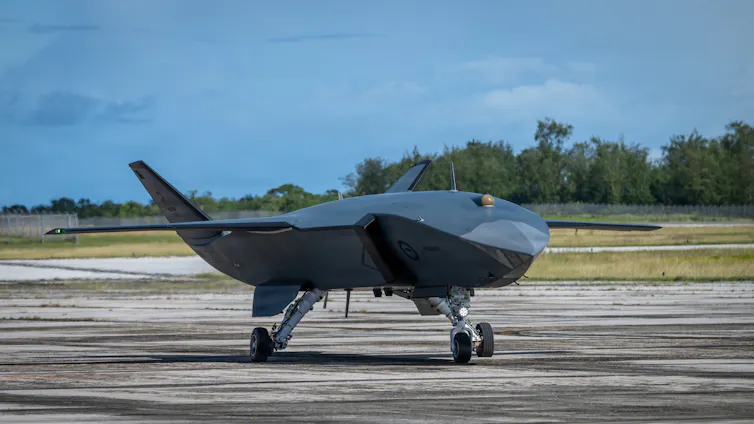
Boeing’s MQ-28 Ghost Bat is designed to act as a ‘loyal wingman’ to extend the reach of piloted aircraft.
US Air Force / Senior Airman Adrien Tran

These “loyal wingmen” drones would support crewed aircraft by acting as scouts, decoys, absorbing enemy fire or jamming enemy radars. They could be controlled by the pilot of the combat jet, or work autonomously.

Systems such as the MQ-28 Ghost Bat are at an early stage of development. To be militarily useful CCAs must combine long range, high speed, low observability, resilient data links and meaningful payloads, requirements that quickly approach the complexity, and potentially the cost, of the crewed aircraft they are intended to complement.

Will it be cheaper?

Against these challenges, the government’s headline commitment of £5 billion on these systems therefore seems more like a down payment than the full mortgage. Spread across four years, three armed services and an exceptionally diverse range of programmes, it is less transformative than some may believe, and certainly not on the timelines some think are necessary as tensions continue with Russia.

The unit costs of what will be specialist equipment may remain prohibitively expensive. Take the hybrid Navy as an example. The autonomous systems in question require resilient communications, sophisticated sensors, electronic warfare protection and high engineering reliability, meaning the combined cost of CCVs and their uncrewed flotillas could approach that of the destroyers they replace.

Even if the funding can be found – and there are good reasons to question whether it can – Britain must still demonstrate that its defence industry can deliver this technology-intensive force. Expanding military output requires far more than larger budgets: it demands additional factory capacity, skilled workers, shipbuilding infrastructure and resilient supply chains. This is particularly true for autonomous systems whose military value depends on being produced, sustained and replaced at scale.

The DIP rests on three assumptions: that autonomous systems mature quickly, prove affordable and can be produced at scale. The Sandys Review rightly foresaw the missile age but underestimated the staying power of conventional forces; new technologies reshape warfare but they rarely replace its enduring fundamentals.

If Britain is to bet on autonomy, therefore, it also needs the spending profile to make that bet credible. After all, the most important judgement on the DIP will not be that of future historians, but of the occupant of the Kremlin today.The Conversation


This article is republished from The Conversation under a Creative Commons license. Read the original article.

Share. Twitter LinkedIn Facebook Email
Previous ArticleFAA sets out noise-based certification path for supersonic flight over the US
Next Article Edgewing awarded £4.6bn to push GCAP fighter into detailed design and test phase
Arun Dawson, PhD Candidate, Department of War Studies, King's College London
  • Website

Related Posts

Jacqueline Castle, CTO of the ATI
Industry News

Aerospace Technology Institute CTO: UK suppliers must be ready for next-gen single-aisle by 2030

26th November 20267 Mins Read
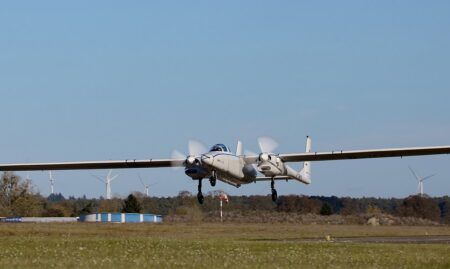
A white twin-engine, twin-boom AeroForce X drone with a long straight wing flying low over a grass airfield, wind turbines on the horizon, its landing gear down and a pilot visible in the cockpit
Defense

Germany’s Aerodata flies large surveillance drone for first time

20th November 20262 Mins Read
Merlin wins contract to install autonomy on C-130J Hercules Standfirst: A US Special Operations Command task order advances Merlin’s self-flying technology for the military transport aircraft STARTS Autonomous flight company Merlin has won a new contract to prepare its self-flying technology for installation on the US military’s C-130J Super Hercules transport aircraft. The US$8.9 million task order from US Special Operations Command (USSOCOM) funds the next phase of Merlin’s C-130J autonomy program, following completion of its preliminary and critical design reviews. The phase covers system integration, ground-test preparation, cybersecurity approval and airworthiness acceptance to support future flight demonstrations. Merlin’s technology, the Merlin Pilot system, is designed to reduce crew workload across all phases of flight. The company says the work will show how the system can ease the demands on C-130J aircrews and expand the aircraft’s operational capacity. The task order advances integration and validation through flight control law tuning, human factors evaluations, failure mode testing and simulated flight-test dry runs to verify how the system behaves and whether it is ready before installation on the aircraft. It also updates test plans, procedures, verification matrices and safety assessments for government review ahead of ground testing. The work further advances the cybersecurity assessment and documentation required for an Interim Authorization to Test (IATT), and delivers an updated airworthiness plan to support the flight-test demonstrations. Matt George, CEO and founder of Merlin, said, “This next phase puts our design to the test, validating how the system performs, how crews interact with it, and how it responds in off-nominal conditions. Through our work with USSOCOM, we’re building a path from autonomy development to practical mission capability, giving aircrews greater support and commanders more flexibility in how they employ their aircraft.” The C-130J program sits under an indefinite-delivery, indefinite-quantity contract with USSOCOM worth more than US$100 million, which opens the way for Merlin to integrate its system across the wider special operations fixed-wing fleet. Merlin completed the preliminary design review in March 2026 and the critical design review in June 2026, moving the program from design development toward aircraft integration. Merlin describes itself as building “the operating system of record for autonomous flight” and says the Merlin Pilot system has flown hundreds of autonomous flights across a range of aircraft types and mission profiles. The company has also partnered with Honeywell on autonomy for fixed-wing military aircraft. The C-130J is one of the most widely exported military aircraft in service, flown by around 23 operator nations, including the US, UK, Australia, India, Italy, Canada, Israel and Egypt, which joined the fleet in 2024. Lockheed Martin has delivered more than 500 of the aircraft.
Avionics

Merlin wins contract to install autonomy on C-130J Hercules

11th November 20263 Mins Read
Latest Posts
Jacqueline Castle, CTO of the ATI

Aerospace Technology Institute CTO: UK suppliers must be ready for next-gen single-aisle by 2030

26th November 2026
A render of a small box-shaped OneWeb satellite with two solar panels and a dish antenna in orbit above a cloud-covered Earth, the Sun rising beyond

Airbus to sell US satellite business to private equity firm Cerberus

26th November 2026
A rugged black portable data acquisition unit with a carry handle, its front panel showing five sets of channel inputs, a battery charge indicator, a mode button and USB and DC power connectors

IST launches 15-channel field recorder for aerospace testing

25th November 2026
Supplier Spotlights
  • JDA Systems (Europe) GmbH
  • Precision Filters, Inc. (PFI)
  • Evolution Measurement
  • CALCULEX
  • Hottinger Brüel & Kjær
  • AVL List GmbH
  • Tekna
  • InnovMetric
  • SET GmbH
  • Tyto Robotics
    Tyto Robotics Inc.
  • Ametek
    AMETEK Programmable Power
  • Helling GmbH
    Helling GmbH
  • Matec Instrument Companies, Inc.
    Matec Instrument Companies, Inc.
  • Endevco
  • Ipetronik
    IPETRONIK GmbH & Co. KG
  • VJ Technologies
  • Durr NDT
    DÜRR NDT GmbH & Co. KG
  • Dewesoft
  • Bruker Alicona Dimensional metrology & surface roughness measurement
    Bruker Alicona
  • ATG Advanced Technology Group
    ATG – Advanced Technology Group
  • Dytran Instruments, Inc.
  • Kistler Group
    Kistler Group
  • Diversified Technical Systems (DTS)
  • Scanivalve Corporation
  • G Systems
  • CEC Vibration Products LLC.
  • dSPACE
  • Safran Data Systems
  • Photron
  • YXLON International
  • Telspan Data
  • TotalTemp Technologies, Inc.
  • Vector Informatik GmbH
  • Vibration Research
  • TEST-FUCHS
  • Siemens Digital Industries Software
    Siemens Digital Industries Software
  • PCB Piezotronics, Inc.
  • Testia
  • Treo – Labor für Umweltsimulation GmbH
  • W5 Engineering
  • National Institute for Aviation Research
  • North Star Imaging
  • MK Test Systems Ltd.
  • Intertek
  • I.N.C.A.S. – NATIONAL INSTITUTE FOR AEROSPACE RESEARCH “ELIE CARAFOLI”
  • FMV Test & Evaluation
  • Glenn L Martin Wind Tunnel
  • GRAS Sound & Vibration
  • Elsys AG
  • EMCCons DR. RAŠEK GmbH & Co.KG
  • European Test Services (ETS) B.V.
  • Curtiss-Wright
  • Data Physics Corporation
  • AOS Technologies AG
  • Airmo Inc. Pressure Technologies
    Airmo Inc.® Pressure Technologies
Our Social Channels
  • Twitter
  • YouTube
  • LinkedIn
Getting in Touch
  • Subscribe To Magazine
  • Contact Us
  • Meet the Team
  • Media Pack
Related Topics
  • Aircraft Interiors
  • Business Jet Interiors
FREE WEEKLY NEWS EMAIL!

Get the 'best of the week' from this website direct to your inbox every Wednesday

© Copyright 2026 Mark Allen Group. All rights are reserved, including those for text and data mining, AI training, and similar technologies.
  • Cookie Policy
  • Privacy Policy
  • Terms & Conditions

Type above and press Enter to search. Press Esc to cancel.