

The Aerospace Technology Institute is the UK’s funding body for aerospace industry research. It updated its technology investment priorities earlier this year to strengthen competitiveness, capture growth on next-generation aircraft and reduce aviation’s environmental impact.
In the interview below, conducted at the Aerospace Technology Institute’s (ATI) annual conference last week, its chief technology officer, Jacqueline Castle, reveals the thinking behind its strategy, which is titled Engineering Growth.
She explains why companies in the aerospace supply chain must mature technologies and demonstrate manufacturing capability before airframers launch new aircraft. These include Airbus’s and Boeing’s successors to the A320 and 737 respectively, known as next-generation single-aisle (NGSA) aircraft.
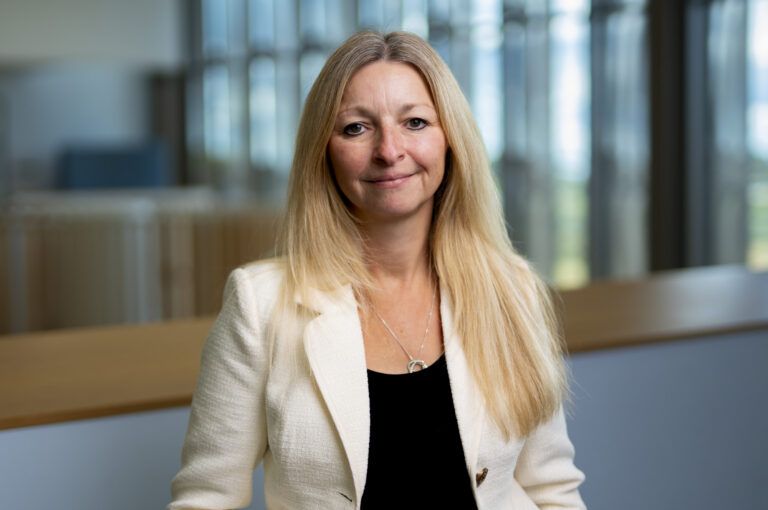
Jacqueline Castle joined the Institute as CTO in June 2023. Before that she spent more than 25 years at Airbus, most recently as UK chief engineer for the A320 family.
Q: How does the Aerospace Technology Institute’s Engineering Growth strategy differ from the previous strategy?
A: It’s an evolution of the progress driven by our preceding strategy. It covers four technology roadmaps: ultra-efficient, zero-carbon, industrial competitiveness and non-CO₂. All four areas are important and we review the strategy roughly every four to five years. It’s industry-led, and we consult widely across the UK and globally.
Within the roadmaps there are technology bricks, and their position indicates the target date for reaching technology readiness level 6 (TRL 6), aligned with opportunities on current or future aircraft.
In the online version of the strategy you can click on each brick in the roadmaps. It shows the current state of the art, where we want to get to, and guidance for low-TRL academic researchers, so we can pull that work through to industrial TRLs.
Q: How has NGSA shaped the strategy?
A: It shaped Destination Zero as well, but this time we’ve reinforced the market opportunity. We’ve spelled out the growth potential in propulsion, aerostructures and systems, the three big areas for NGSA.
The picture is also clearer now. Airbus is signaling a possible launch toward the end of this decade or the start of the next, with entry into service in the second half of the 2030s. Boeing suggests market readiness may push it later into the 2030s, but the timeframes are broadly similar
Our analysis is that we should push technologies hard to be ready by the end of this decade.
Q: Which aerospace technologies matter most to the UK?
A: It’s about protecting what we’ve got, adapting it if it’s going to change, and pursuing growth. Engines and wings contribute most to the UK economy today, and they’re the biggest growth opportunities.
NGSA’s wings are likely to move from metallic to composite. The supply chain, the design technologies and the manufacturing capability have to be ready for that, or we risk losing work.
On engines, Rolls-Royce has been very public about wanting to return to the single-aisle market. With 70% of future aircraft predicted to be single-aisle, winning even part of that market would be a massive growth opportunity.
Q: Is the focus on materials or something broader?
A: There’s a definite focus on composites. They are key to the wing opportunity. They matter for engines too. The very large fan of a high-bypass-ratio engine will have composite blades.
Engines also need high-temperature metallics. On wings, next-generation designs will have higher aspect ratios and a folding portion at the end of the wing. They’ll be very slender, so you can’t fit the same hydraulic systems in them. That calls for new actuation and smaller, more-electric systems.
This is where much of the UK’s test effort is concentrated. At Farnborough 2026, Airbus announced flight testing of ATI-funded Wing of Tomorrow technologies. It also announced a £16.6m (US$22m) project to flight-test fixed wing extensions to study high-span folding wings.
Q: Where do hydrogen, battery-electric and hybrid propulsion sit within the new strategy?
A: The zero-carbon roadmap is still core to our strategy. Some areas have accelerated and others have slipped. Airbus’s push for a regional-sized hydrogen aircraft has slipped by about 10 years. That makes it hard for companies to build an internal business case in the short term, so we’ve adjusted the roadmap to those timescales.
We’re still pushing these technologies. They are the future beyond the next generation. Airbus has pushed its ZEROe aircraft out to the 2040s, but it has also just launched a venture with MTU to pursue the technologies on a smaller aircraft sooner. We’re funding an appropriate level of projects to protect UK expertise.
Q: How important is non-CO₂ mitigation compared with on-aircraft technology?
A: It matters for sustainability, and there could be a business opportunity too. Addressing CO₂ through improved fuel efficiency does not address all of aviation’s climate challenges.
Non-CO₂ effects, especially contrails, could have a bigger warming impact than carbon itself, although they are shorter-lived. There is still a lot of science to understand. That’s why the non-CO₂ roadmap is now fully part of the strategy.
A good example of our work in this area is Operation Blue Skies, which is led by Google. It uses satellite imagery and AI to forecast ice-supersaturated regions on aircraft routes so flight altitudes can be adjusted to avoid them. It’s a novel, large-scale trial in UK-controlled airspace over the Atlantic. Some aircraft keep their normal flight plans and others are rerouted, in a minor way, exactly like would be done to avoid flying though bad weather. That gives you a control sample and an adapted set, so you demonstrate the avoidance potential.
The £5m (US$6.5), 30-month trial runs in the Shanwick oceanic airspace, which accounts for about 5% of global contrail warming. It’s the world’s first oceanic airspace-scale contrail avoidance trial, but we have other non-CO₂ projects as well, including work on using sustainable aviation fuel in the smartest way.
Q: Is there one project that sums up what ATI funding can deliver?
A: There are so many, but Wing of Tomorrow is the flagship program. It’s an ongoing portfolio of projects, and I’d pick it because of the growth opportunity for the UK economy.
Wing of Tomorrow isn’t just about design engineering. It’s about keeping the manufacturing in the UK. It involves a range of UK supply chain partners, the High Value Manufacturing Catapult centers, and academia working on areas including new composite processing techniques such as iCOMAT’s rapid tow shearing deposition technology. To compete for workshare on next-generation aircraft, we need to demonstrate that we can manufacture at the required rate, quality and cost.
Q: Should companies be getting ready for NGSA now?
A: Yes, otherwise we could miss the boat. We never know for certain whether Boeing and Airbus will launch, but we have to act as if they will.
If the technology isn’t ready, the airframers can’t select it. If suppliers can’t demonstrate they can manufacture, they won’t be considered.
The airframers will set the aircraft’s requirements around 2030. They’ll base them on the technologies they think will deliver a fuel-burn reduction of around 25%. If the UK isn’t providing technologies into that equation, we miss one or perhaps even two generations of opportunity. We want suppliers to bring their ideas to the table, and we can help connect them with the larger players.
Q: What role do you see AI as playing?
A: There’s a real opportunity to explore the design space in much more depth. At our conference, Alex Simpson from GE Aerospace showed the AI-driven, supercomputer-scale computational fluid dynamics (CFD) work on an open-rotor installation, and how it has opened their eyes to options they wouldn’t otherwise have seen.
There are also opportunities in manufacturing and quality control, which we’re pushing hard to develop in assembly and automation.
AI should be seen as an enabler to reaching the ambitions set out in the strategy. It appears explicitly in the strategy’s technology bricks, including AI-enabled onboard systems, trusted AI in design and validation, and AI-assisted assessment and decision-making.