

Wisk Aero and NASA have completed a simulation showing that a single ground-based supervisor can manage three autonomous aircraft at once while they operate alongside conventional air traffic in controlled airspace.
The exercise tested Wisk’s target ratio of one supervisor to three aircraft, with the company’s Multi-Vehicle Supervisor (MVSor) overseeing the flights while controllers used existing tools and procedures. Wisk described the result as a critical milestone for advanced air mobility.
The simulation is one of the latest steps under a five-year Non-Reimbursable Space Act Agreement between the two organizations, focused on flying autonomous aircraft under instrument flight rules (IFR) in the National Airspace System (NAS). It linked Wisk’s Autonomy Lab in Mountain View, California, with NASA’s air traffic control (ATC) simulation facilities at the Ames Research Center.
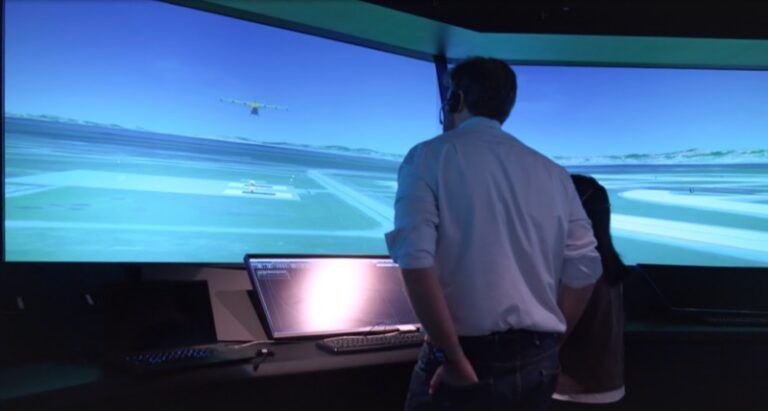
Testing used NASA’s Future Flight Central, a two-story facility at Ames that provides a full-scale, 360-degree airport simulation environment. Flights followed predetermined IFR routes between Moffett Federal Airfield and San Martin Airport in California’s San Francisco Bay Area.
In the human-in-the-loop exercise, air traffic controllers communicated with Wisk’s supervisors across a series of nominal and contingency scenarios developed jointly with NASA. By testing the methodology against worst-case situations, Wisk assessed whether it stays resilient enough to support larger-scale operations.
Erick Corona, Wisk’s head of system and operations integration, said, “This is an incredible milestone for Wisk as it’s the first time we’ve tested our 1:3 supervisor-to-aircraft ratio with NASA in a high-fidelity, high-workload environment that mirrors the complexity of the National Airspace System. Wisk is doing more than building an autonomous aircraft. We are working closely with organizations like NASA to mature and modernize the broader aviation ecosystem. Proving that a single ground-based supervisor can manage multiple flights safely and efficiently is paramount to making commercial air taxi operations scalable and affordable. We are deeply grateful to the NASA team for their professionalism, expertise, and commitment to this project.”
The campaign used Wisk’s Remote Supervision System to manage navigation and communication, while the teams captured data on communication response time, task latency, situation awareness and cognitive workload. Workload was measured using NASA’s Task Load Index and the Bedford Workload Scale.
Wisk said the findings will help shape standardized communication and procedures to reduce controller and pilot workload, supporting future rules on how such communication could be streamlined and digitized, such as automated flight rules. The two organizations plan to continue joint studies on autonomous integration in the NAS.