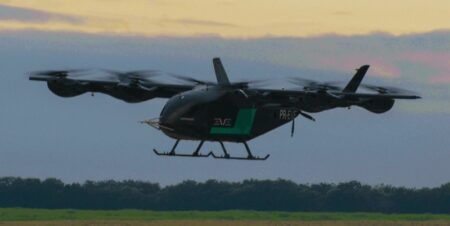


Vertical Aerospace has completed a two-way piloted transition flight with its tiltrotor eVTOL aircraft, becoming only the second company in the world to achieve the milestone.
Chief test pilot Simon Davies flew the VX4 prototype from Cotswold Airport in Gloucestershire, UK on April 14, transitioning from vertical take-off to wingborne cruise and back to a vertical landing in a single continuous sortie.
Vertical said it was the first eVTOL developer to complete the maneuver under civil aviation Design Organisation Approval (DOA) regulatory oversight, with US-based Joby Aviation being the only other company to have achieved two-way piloted transition in a full-scale tiltrotor eVTOL.
The milestone builds on a thrustborne transition completed during April 2 flight testing, which demonstrated the VX4’s ability to switch from vertical lift to forward wingborne flight.
Completing the return to vertical landing means Vertical has now proven all phases of flight required for commercial eVTOL operations, including vertical take-off, wingborne cruise and the transitions between the two.
Stuart Simpson, CEO of Vertical Aerospace, said, “This is the most significant technical milestone in our history. Full piloted transition is the most critical and complex challenge in eVTOL development, and we’ve achieved it under more rigorous regulatory oversight than anyone in the category.
All Vertical flight tests since 2023 have been conducted with oversight from UK’s regulator the Civil Aviation Authority, which is partnering with the European Union Aviation Safety Agency to certify Valo, the company’s commercial aircraft successor to the VX4 prototype.
The six-passenger Valo is designed to fly at speeds of up to 150mph (241km/h) over distances of up to 100 miles (161km).
Future testing and certification plans
With the transition milestone achieved, Vertical is moving into the next phase of certification testing. This will include critical design review, followed by the build of seven pre-production Valo aircraft in the UK for compliance and verification testing with the CAA and EASA.
The company is targeting certification of Valo in 2028, with entry into service planned shortly thereafter. Its certification approach is designed to be transferable to other regulators including the Federal Aviation Administration (FAA) in the USA, supporting global deployment with airline partners including American Airlines, GOL and Japan Airlines.
Vertical plans public flight demonstrations at the Farnborough International Airshow in July, alongside progression of its hybrid-electric demonstrator and production of the first full-scale Valo certification aircraft.
Fly-by-wire controls
The VX4 prototype uses a compact Fly-by-Wire system supplied by Honeywell Aerospace.
Bob Buddecke, president of Electronic Solutions at Honeywell Aerospace, said, “Successful transition flight represents meaningful progress not only for Vertical, but for the entire advanced air mobility industry.
“Our Compact Fly-by-Wire team worked closely with Vertical’s team to help enable the successful flight, and we expect countless more to come.”
Legal case for IP-infringement
Vertical is currently invovled in a legal case with US-based Archer Aviation, which alleges that Vertical’s Valo copies key design elements of its Midnight eVTOL.
The patent infringement complaint was filed in the US District Court for the Eastern District of Texas in February, following Vertical’s launch of a marketing campaign in the USA. The complaint claims that Vertical’s Valo mimics the visual and functional characteristics of Midnight to the extent that an observer could confuse the two.