


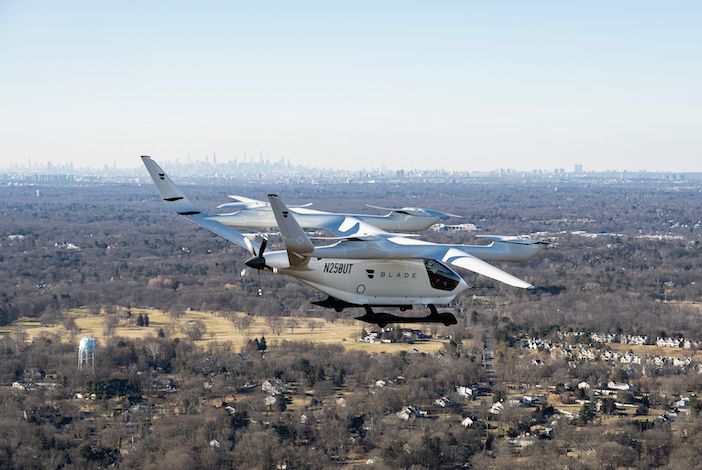
A US program launched this week to trial eVTOL and electric aircraft from nine companies fly in 26 states across the country.
The Federal Aviation Administration’s (FAA) eVTOL Integration Pilot Program (eIPP) will form public-private partnerships between the regulator, state and local governments and aircraft developers. Operations are expected to begin by summer 2026, with the program planned to run for three years.
Operational concepts span urban air taxis, regional passenger services, cargo logistics, emergency medical response and autonomous flight technologies. Data gathered from the projects will inform future regulations for scaling advanced air mobility operations.
Chris Rocheleau, FAA deputy administrator, said, “These partnerships will help us better understand how to safely and efficiently integrate these aircraft into the National Airspace System. The program will provide valuable operational experience that will inform the standards needed to enable safe Advanced Air Mobility operations. We appreciate the strong interest reflected in the many proposals we received.”
The projects include a trial of eVTOL passenger services from a Manhattan heliport, led by the Port Authority of New York and New Jersey with Archer, BETA Technologies, Electra and Joby Aviation. The Texas Department of Transportation will coordinate regional flights connecting Dallas, Austin, San Antonio and Houston.
A 13-state consortium led by Pennsylvania aims to revitalize regional air routes. Florida will progress through three trials covering cargo delivery, passenger transportation and medical response.
Louisiana will test cargo and personnel flights to offshore energy facilities in the Gulf of America. North Carolina will establish piloted medical flights and develop autonomous operations extending into Virginia.
The City of Albuquerque will focus on autonomous flight through a partnership with Reliable Robotics, and Utah’s project spans four states from the Pacific Northwest to Oklahoma.
Nine companies are participating, including Archer, BETA Technologies, Electra, Joby Aviation, Wisk, Ampaire, Elroy Air and Reliable Robotics. None has received FAA type certification, though all must already be undergoing the formal certification process to participate.
BETA Technologies, which is involved in seven of the eight projects, said its initial eIPP flights would carry cargo and medical supplies before progressing to passengers. Speaking during an earnings call and as reported by Aerospace America this week, Kyle Clark Beta’s founder and CEO said that aircraft that are part of the eIPP are expected to enter service within 90 days.
“We’re planting the seeds that will germinate into much larger orders in the future, getting these aircraft out in the world,” Clark said.