


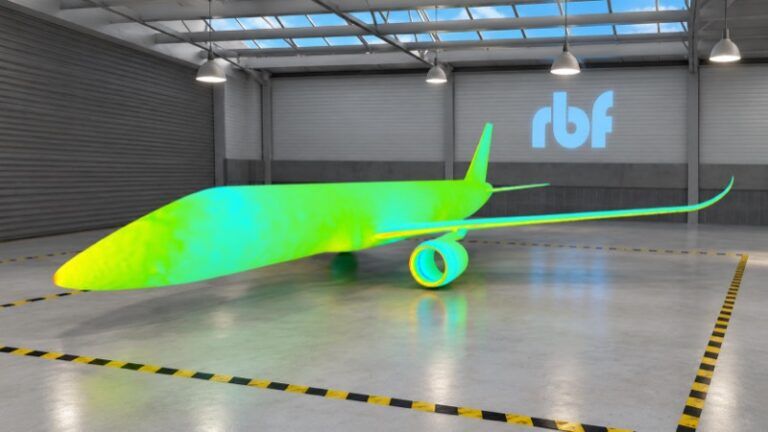
RBF Morph has launched rbfCAE, a new platform combining AI and virtual reality with engineering simulation to change how complex products are designed and evaluated.
The Italy-based software company, which has spent two decades developing mesh-morphing and simulation technology, said the platform combines AI, virtual reality (VR) and high-performance reduced-order modeling to give designers, analysts and decision-makers a faster, more collaborative way of working.
RBF Morph’s mesh-morphing technology can rapidly generate geometric variants and synthetic datasets, used as a data engine for AI. The platform enables the creation and training of reduced-order models based on proper orthogonal decomposition (POD) and deep learning, which predict a new geometry’s aerodynamic, structural or thermal performance within moments, including a reliability estimate.
The platform’s native VR integration lets designers, engineers and other stakeholders step inside a 3D model, modify geometry, observe performance effects in real time, and discuss changes remotely. RBF Morph said this accelerates decision-making, letting companies explore design alternatives quickly rather than waiting days for a single simulation.
The platform interfaces with major industrial and open-source solvers through a series of connectors, synchronizing different physics and models within a single automated workflow, reducing manual intervention and enabling multisolver processes. RBF Morph said this lets companies work up to five times faster than traditional workflows.
Ivan Spisso, senior high-performance computing (HPC) specialist for CFD/CAE applications at Leonardo, said, “In the POC developed within the PNRR project with the DAMAS Digital Hub, rbfCAE plays a key role in integrating advanced simulation with HPC infrastructures. Workflow automation and the use of AI-based predictive models allow us to create scalable industrial demonstrators, reducing analysis time and improving design decisions.”
The rbfAI environment includes four modules: rbfROM compresses large volumes of simulations into reduced-order models that operate in near real time, while rbfVR brings these into VR so users can modify geometry through natural gestures and instantly see performance changes.
rbfADJOINT gives real-time indicators of how a design change affects key performance indicators, reducing trial-and-error experimentation, while rbfROC connects geometric variations back to the CAD model, adapting meshes and updating CAD data to reflect simulated deformations. The modules are linked through rbfCONNECT, a suite of connectors letting rbfCAE interface with different solvers in the same workflow.
Claudio Ponzo, research and development digital lead at Nissan Motor Corporation, said, “Thanks to an integrated multiphysics approach, we can explore lighter and more efficient structural solutions much more quickly. It is a real leap forward in the way we design.”
RBF Morph said the technology is already used in aerospace, to analyze full-scale aircraft before they exist; automotive, to support faster styling and engineering decisions; and medicine, to help develop demonstrators assisting surgeons with complex procedures, including through the European ROMed2VR project on pediatric cardiac surgery.
Marco Evangelos Biancolini, founder of RBF Morph, said, “With rbfCAE, we bring artificial intelligence and virtual reality into the heart of design. It is a paradigm shift that transforms simulation from a technical tool into an immersive and collaborative experience, capable of accelerating innovation across all industrial sectors.”