


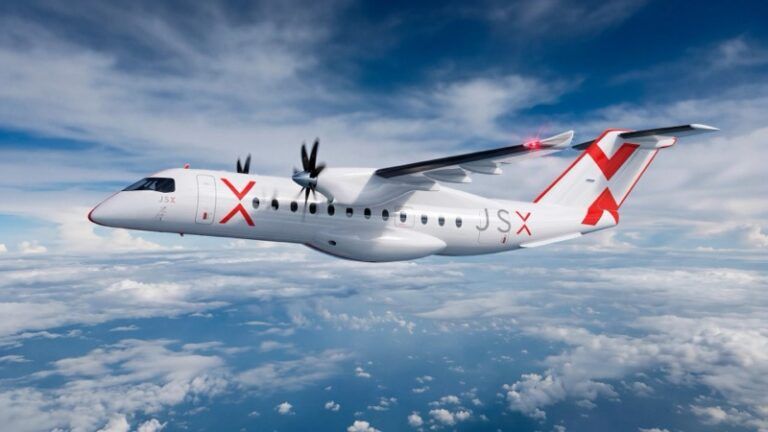
Heart Aerospace has unveiled the ES-36, a 36-seat hybrid-electric regional airliner that supersedes the company’s previously announced ES-30 design as its production aircraft.
The ES-36 uses a simplified two-nacelle airframe and series-hybrid propulsion to improve its cost advantage over legacy regional aircraft. Compared with the ES-30, it adds six passenger seats and 1,415lb (640kg) of payload capacity, a 20% increase in both, while retaining the same maximum takeoff weight and battery capacity as the prior design.
Its optimized airframe dedicates more capacity to passengers and payload, increasing revenue potential, while the shift from four nacelles and propellers to two reduces the components to maintain, lowering maintenance costs.
Propulsion system changes
Superseding the ES-30’s four-engine independent-hybrid configuration, the ES-36 adopts twin series-hybrid powertrains, each using a 1.65MW electric motor to drive a propeller. Ground-charged onboard batteries provide an all-electric range of 125 miles (200km), plus reserves, for short-haul routes with no fuel burn, while a megawatt-class turbogenerator in each powertrain extends the hybrid range to 745 miles (1,200km), plus reserves.
Each turbogenerator is powered by its own compact, commercially available gas turbine, generating electricity in flight to supplement the batteries and power the electric propulsion motors.
Ben Stabler, chief technology officer at Heart, said, “The ES-36 design is a direct result of what Heart learned designing, building, testing and flying our X1 demonstrator aircraft. Those learnings have helped us make the production aircraft more capable in the air and more productive for operators.”
“The ES-36 carries more passengers and payload, creating greater revenue-generating potential for operators like JSX, while targeting operating costs at least 40 percent lower than legacy regional aircraft,” he added.
JSX Order after design tweaks
Alongside the unveiling, JSX announced a deposit-backed purchase agreement for 50 ES-36 aircraft, with purchase rights for 50 more, converting its 2023 letter of intent into a firm commitment.
The ES-36 is intended to help JSX grow service at the community airports it already serves, including Santa Monica, Westchester County, Naples and Napa Valley. Its short-field performance supports constrained airfields, while a 95ft (29m) wingspan, about 11ft (3.4m) shorter than the ES-30’s, is designed to support higher-frequency service and greater aircraft utilization.
Anders Forslund, founder and CEO of Heart Aerospace, said, “With the ES-36, Heart is bringing to market a more capable aircraft with an even stronger value proposition for air carriers, and JSX’s partnership underscores that opportunity. We’re grateful to Alex for believing in Heart early and championing electric aviation as he builds JSX’s fleet of the future.”
The unveiling follows the mid-August first flight of Heart’s X1 demonstrator, described by the company as the largest battery-electric aircraft flown to date. Heart is building its first pre-production ES-36 at its Los Angeles pilot plant, targeting first flight in late 2028 and entry into service in 2031, following Federal Aviation Administration (FAA) Part 25 certification.