

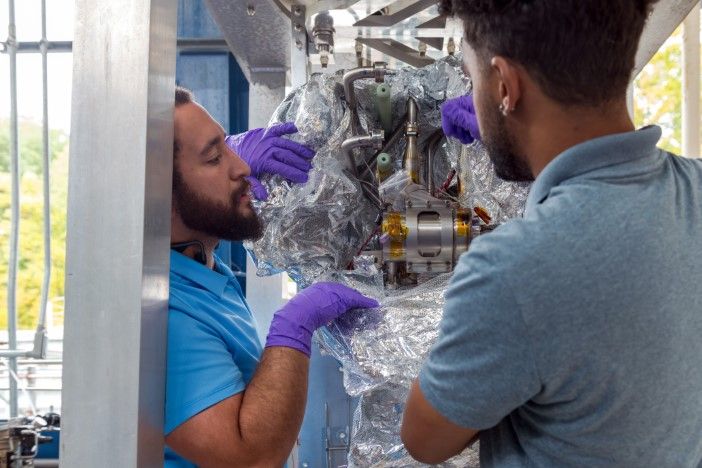
NASA engineers at Glenn Research Center in Cleveland, Ohio, are testing technology designed to liquefy oxygen on the lunar surface for use as rocket propellant.
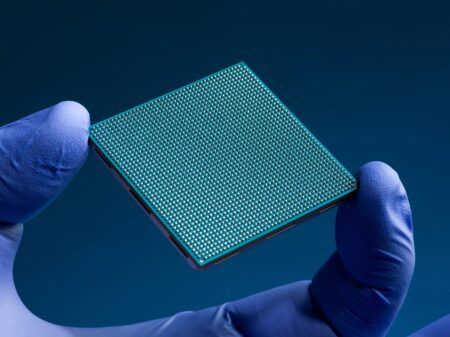
The Cryogenic Fluid In-Situ Liquefaction for Landers (CryoFILL) project aims to demonstrate how oxygen extracted from water ice in permanently shadowed regions of the Moon can be cooled and condensed into liquid form. A flight-like cryocooler developed by Creare LLC through NASA’s Small Business Innovation Research (SBIR) program is being used to remove heat from the extraction system, allowing the oxygen to condense and remain at temperatures below -300°F (-184°C).
The technology addresses a fundamental challenge in deep-space exploration: the more fuel a spacecraft carries, the heavier it becomes, requiring even more fuel to launch from Earth. Producing propellant at the destination could reduce launch mass requirements.
“If you think about how much fuel your spacecraft would need to go to Mars and come home, it’s quite a lot,” said Evan Racine, CryoFILL project manager at NASA Glenn. “If we can produce and liquefy oxygen on the Moon or Mars, we can fuel landers on the surface where they land, reducing the amount of propellant needed to launch from Earth.”
Oxygen is a key ingredient of rocket fuel and can be extracted from lunar water ice in gas form, but it must be cooled to extremely low temperatures to condense into the liquid state required for propellant use.
“We’re testing with flight-like hardware to see how oxygen liquefies and how the system responds to different scenarios,” said Wesley Johnson, CryoFILL lead engineer. “These are critical steps toward scaling up and automating future in-situ refueling.”
Over the next three months, engineers will study how oxygen condenses under various conditions and use the data to validate temperature computer models. The results will inform how the technology can be scaled for larger applications and guide designs for use on the Moon, Mars or other planetary surfaces.
CryoFILL is managed by the Cryogenic Fluid Management Portfolio Project, a cross-agency team based at Glenn and NASA’s Marshall Space Flight Center in Huntsville, Alabama. The portfolio comprises more than 20 individual technology development activities under NASA’s Space Technology Mission Directorate.