


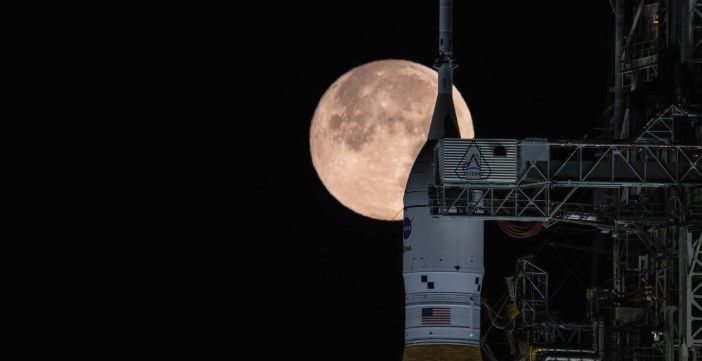
NASA has added a new crewed mission to its Artemis lunar program that will test rendezvous and docking with commercial landing vehicles in low Earth orbit before the agency attempts a crewed surface landing in 2028.
The redesigned Artemis III mission is scheduled for 2027 and will focus on testing systems and operational capabilities needed for subsequent lunar landing missions.
Astronauts will attempt to rendezvous and dock with one or both commercial lunar landers being developed by SpaceX and Blue Origin. Testing objectives include integrated checkout of life support, communications and propulsion systems on the docked vehicles, as well as trials of the new extravehicular activity (xEVA) suits.
NASA said it will further define the test flight objectives after completing detailed reviews with its industry partners. The phased approach mirrors the Apollo program’s Apollo 9 mission in 1969, which tested rendezvous and docking in Earth orbit before attempting the Apollo 11 lunar landing four months later.
Safety concerns drive phased testing approach
The decision follows a report from NASA’s independent Aerospace Safety Advisory Panel that raised concerns about the risk level of the original Artemis III lunar landing plan.
“Standardizing vehicle configuration, increasing flight rate and progressing through objectives in a logical, phased approach, is how we achieved the near-impossible in 1969 and it is how we will do it again,” said NASA Administrator Jared Isaacman.
Under the revised architecture, the first crewed lunar landing is redesignated as Artemis IV, targeting 2028, with at least one surface landing mission planned every year thereafter. NASA also plans to standardize the Space Launch System (SLS) rocket in its current Block 1 configuration for all subsequent missions, rather than introducing an upgraded variant.
“The entire sequence of Artemis flights needs to represent a step-by-step build-up of capability, with each step bringing us closer to our ability to perform the landing missions,” said NASA associate administrator Amit Kshatriya. “We want to fly the landing missions in as close to the same Earth ascent configuration as possible.”
Workforce rebuild to accelerate launch cadence
NASA said it will rebuild core competencies in its civil servant workforce, including more in-house and side-by-side development work with Artemis partners, to enable a safer and faster launch cadence.
Artemis II targets April after helium issue
The announcement issued today about the extra mission also addressed the status of the Artemis II mission. The SLS rocket and Orion spacecraft were rolled back to the Vehicle Assembly Building at Kennedy Space Center on February 25 to troubleshoot a helium flow issue in the rocket’s interim cryogenic propulsion stage, discovered after a wet dress rehearsal concluded on February 19.
Teams are working to resolve the helium issue and replace batteries in the flight termination system, with NASA targeting an April launch window. The 10-day Artemis II mission will send four astronauts on the first crewed flight around the Moon since Apollo 17 in 1972.