

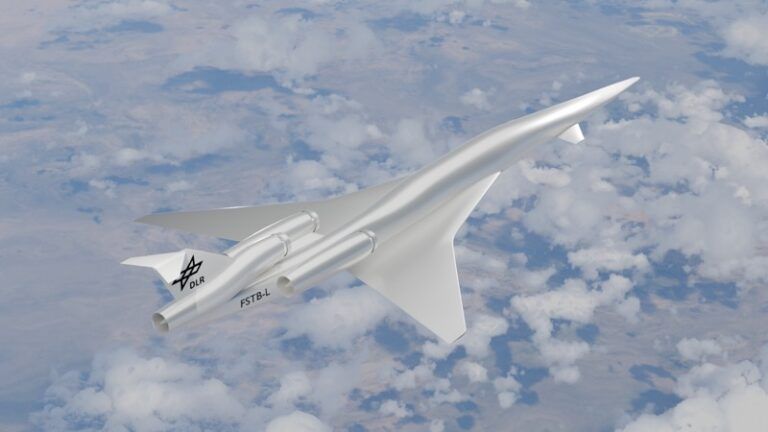
Researchers at the German Aerospace Center are using higher-fidelity computational methods to predict the noise and sonic boom signatures of civil supersonic aircraft, in work intended to underpin future international certification standards.
The project, STORMIE-2, follows on from the Supersonic Transport Open Research Models and Impact on Environment (STORMIE), during which German Aerospace Center (DLR) researchers built an integrated platform for designing and assessing civil supersonic configurations between 2023 and 2026.
That earlier work set out to reliably predict environmental impacts including take-off and landing noise emissions and sonic boom.
Civil supersonic aviation could cut journey times on many routes through higher cruise speeds. However, there are currently no generally applicable certification regulations for the aircraft that would fly them.
Manufacturers must therefore make key design decisions without confidence that they will meet future international standards. Certification authorities face a parallel problem, developing regulatory frameworks for aircraft on which only limited data exists.
DLR describes its role in STORMIE-2 as that of “a virtual manufacturer operating at the interface between industry and the authorities”.
Three configurations designed under the predecessor project are being reanalyzed using higher-fidelity aerodynamic and flight-mechanical methods. Design variants are also being examined to assess sensitivities and uncertainties, and to quantify their effect on environmental impact.
The aerodynamic work uses the in-house DLR flow solver TAU and CODA, a computational fluid dynamics (CFD) code developed jointly by ONERA, DLR and Airbus.
Flight characteristics and pilot visibility are being evaluated in the Air Vehicle Simulator (AVES), alongside the other DLR institutes involved in the project.
Fleet and airport scenarios are also being analyzed to establish the effect of supersonic aircraft on the air transport system as a whole.
Findings will be contributed by nominated DLR experts to the work of the Committee on Aviation Environmental Protection (CAEP) of the International Civil Aviation Organization (ICAO), which is developing the environmental standards that will shape future supersonic certification requirements.
DLR said it will share designed configurations and selected results with interested partners, in compliance with export control regulations.