

GE Aerospace and its Italian subsidiary Avio Aero have completed two test campaigns in Germany advancing hydrogen combustion and hybrid-electric propulsion technologies for next-generation commercial aircraft engines.
The tests were conducted in support of the CFM International Revolutionary Innovation for Sustainable Engines (RISE) technology demonstration program, a 50-50 joint venture between GE Aerospace and Safran Aircraft Engines. Both campaigns were carried out under the European Union’s Clean Aviation public-private research initiative.
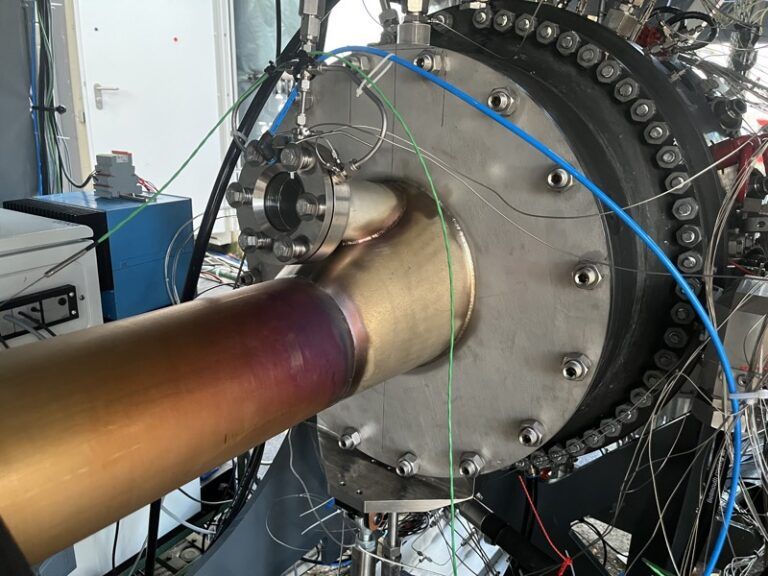
The hydrogen work, conducted under the EU-funded HYDEA (HYdrogen DEmonstrator for Aviation) project led by Avio Aero, produced what the company described as its first successful engine relight using hydrogen fuel in simulated altitude conditions. Testing took place at the DLR Institute of Space Propulsion in Lampoldshausen, Germany.
Engineers built a custom hydrogen sector combustor test rig incorporating a synthetic air generator that used vaporized liquid oxygen and nitrogen to replicate the low-humidity atmospheric conditions encountered at altitude. The campaign established a relight operability envelope, with the ignition system designed and manufactured by Unison, also a GE Aerospace company, specifically for hydrogen operation.
A multi-cup hydrogen sector combustor was central to the test design, providing a more representative combustor geometry and improved igniter placement compared with a single-cup configuration. DLR’s high-speed camera system allowed engineers to observe cup-to-cup flame propagation and igniter-to-flame interactions during testing. The team will now use the data and operability insights to design a full annular hydrogen combustor test rig.
“Avio Aero and GE Aerospace teams in Europe are proud to be at the forefront of new technology innovation. Together with our European partners and research institutions, we’re turning ideas into real, tested capability,” said Luca Bedon, head of research and technology at Avio Aero.
In a parallel campaign at DLR’s BALIS ((Fuel Cell Propulsion Power Integration and Scaling) test facility, teams from Avio Aero and the GE Aerospace engineering center in Munich completed testing of a proprietary fuel cell system under the Clean Aviation project AMBER. The campaign validated the dynamic behavior of the fuel cell system from idle to maximum power output across short transient times, as well as its resilience under power modes simulating both short- and long-range flight operations.
The AMBER (InnovAtive DeMonstrator for hyBrid-Electric Regional Application) program is targeting the development and demonstration of a megawatt-class hybrid electric propulsion system integrating fuel cells, power electronics and an electric drive.
“The future of flight is more electric. We’re proud to partner with DLR and others around the world to advance the building blocks to help make hybrid-electric flight a reality,” said Roman Seele, future of flight leader for GE Aerospace in Germany.
GE Aerospace and Avio Aero engineering centers in Germany, Italy, Poland and Türkiye are engaged across multiple Clean Aviation projects, including TAKE OFF (Technology And Knowledge for European Open Fan Flight) and OFELIA (Open Fan for Environmental Low Impact of Aviation), focused on open fan ground and flight test demonstrators led by Safran Aircraft Engines, alongside AMBER and HYDEA.
The CFM RISE program has to date accumulated more than 350 tests and more than 3,000 cycles of endurance testing, covering advanced engine architectures including open fan, compact core and hybrid electric systems. The program targets fuel burn improvement of more than 20% compared with current production engines.