

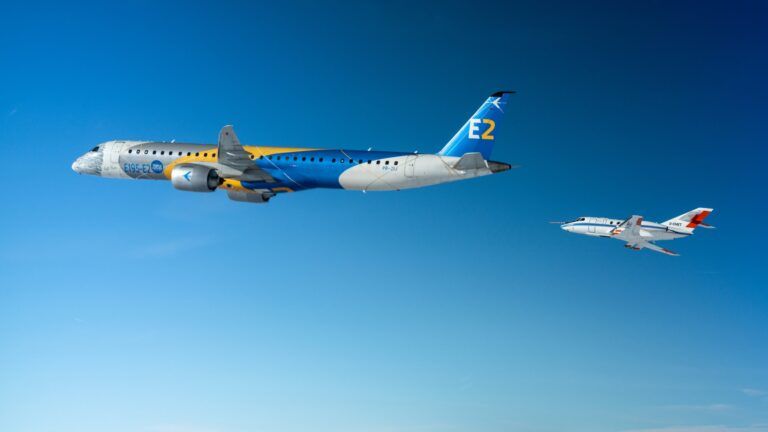
Researchers have flown a jet to within 100ft of an Embraer E195-E2 airliner, sampling its exhaust in flight to study how low-sulfur fuel changes the contrails that modern engines leave behind.
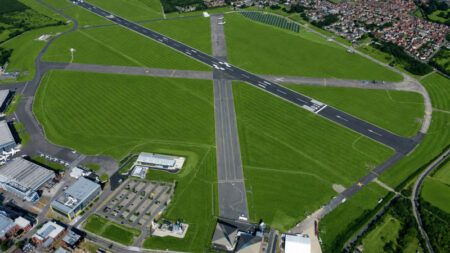
The flights were part of the International Ground and Inflight Turbine Emission Experiment (IGNITE-X), led by the German Aerospace Center (DLR) to investigate how fuel composition, particularly sulfur content, affects engine emissions and contrails. Over about four weeks in October and November 2026, the teams ran ground measurements at Manching, Bavaria, and flight measurements over Bavaria and Saxony.
The test aircraft was an Embraer E195-E2, known as the Profit Hunter, powered by Pratt & Whitney GTF (geared turbofan) PW1900G engines, whose advanced combustor is designed to cut particulate emissions, including soot, against previous-generation engines. The team used two fuels – one very low in sulfur, the other conventional kerosene with its naturally occurring sulfur – to isolate how fuel properties influence particle formation.
Chasing the plume at 100ft
For in-flight sampling under cruise conditions, DLR’s Falcon 20E research aircraft flew directly into the airliner’s exhaust plume, approaching to as close as 100ft (30m). To capture the resulting contrails, it also took far-field measurements between 6 and 19 miles (10–30km) behind.
Flying into the plume demanded a high level of piloting skill, so specially trained pilots from DLR’s Flight Experiments facility, which operates the Falcon 20E, flew the missions. The DLR Institute of Atmospheric Physics ran the airborne measurements.
Markus Fischer, DLR divisional board member for aeronautics, said, “We measured the emissions directly within the exhaust plume – this is extremely challenging, both from a scientific and operational perspective. The test procedure, which involves using low-sulphur fuel in the modern Pratt & Whitney engines of an Embraer E2 passenger aircraft, provides unique insights into the potential for reducing emissions.”
Soot, sulfur and ice crystals
Contrails form at cruising altitude when hot exhaust meets very cold, humid air, with soot particles acting as nuclei on which ice crystals grow. Volatile particles, whose formation is influenced by fuel sulfur content, can also seed them, so IGNITE-X is testing whether pairing a low-soot engine with low-sulfur fuel can significantly reduce contrails.
The campaign adds to recent chase-flight emissions research, from DLR’s 100% sustainable aviation fuel tests behind an Airbus A350 and an A321neo to the NASA, Boeing and GE ecoDemonstrator flights and Rolls-Royce’s high-altitude study. Those tests sharply cut soot and contrail ice crystals, raising the question IGNITE-X now tackles: whether other particles still seed contrails once soot is reduced.
Measuring the engines on the ground
On the ground, led by the DLR Institute of Combustion Technology, the team measured each engine individually across the full thrust range, from idle to takeoff, using a sampling probe in the exhaust plume. This let researchers attribute emissions to a specific engine and operating condition.
Particular attention went to the smallest particles, in the nanometer range, whose number and size distribution reveal early particle formation. Detecting them demanded a specially configured set-up, and the ground tests ran at the Manching air base with support from the German armed forces’ Technical Center for Aircraft and Aeronautical Equipment (WTD 61).
Graham Webb, vice president of advanced commercial engine programs at Pratt & Whitney, said, “The results of this campaign will inform the development of advanced engine technologies for future aircraft by validating the exceptionally low emissions performance of our GTF engine and its Talon X combustor design.”
The low-sulfur kerosene was produced specifically for the campaign and is certified for use in any aircraft. With testing complete, DLR and its partners – Embraer, RTX’s Pratt & Whitney, Aerodyne Research and Missouri University of Science and Technology – are now analyzing the data.