

Boeing researchers have used Frontier, described by Oak Ridge National Laboratory as the world’s most powerful supercomputer for open science, to refine the aerodynamic simulations that predict how ice accumulation and turbulent airflow affect aircraft performance during take-off and landing.
The work focused on high-lift aerodynamics, which covers the low-speed take-off and landing phases of flight.
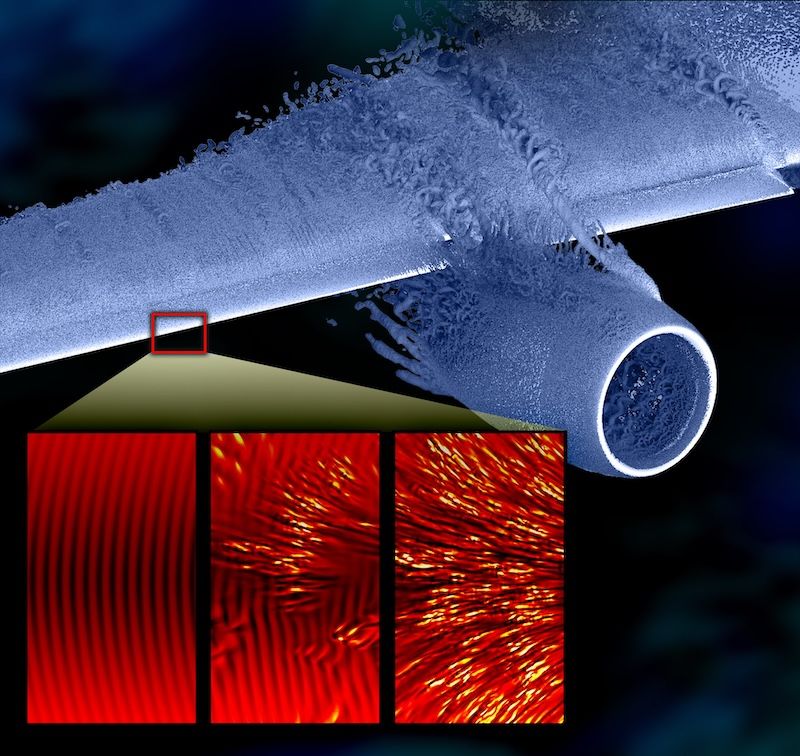
Higher-fidelity computational fluid dynamics (CFD) simulations run on Frontier helped to explain previously unexplained wind tunnel results for some high-lift wing designs, said the laboratory.
The researchers said the simulations predicted the coefficient of lift to within 1%. According to the team, that accuracy provides the confidence needed to advance certain prototypes into production faster than before.
Adam Clark, an aerodynamics engineer at Boeing, said, “Over the last 20 to 30 years, computer modeling has allowed us to go from having to perform 20-plus wind tunnel experiments on different wing variations to now just a couple. The goal isn’t to replace wind tunnels, but oftentimes, in physical testing, we see things that we can’t explain — things that we literally have no data for, and that’s what CFD simulations can shed a light on.”
Frontier is an exascale system with a peak performance of two exaflops, or two quintillion calculations per second. Boeing gained access through the US Department of Energy’s INCITE Leadership Computing program and worked with specialists at the Oak Ridge Leadership Computing Facility to increase the speed and resolution of its simulations.
Konrad Goc, an aerodynamics engineer at Boeing and co-investigator on the project, said, “Not only did Frontier allow us to run simulations that we couldn’t do before, but we were also able to get results in a matter of days, which would have taken months using a typical industrial-scale computing system.”
Full-aircraft CFD has long relied on Reynolds-averaged Navier-Stokes equations, which model turbulence statistically, whereas wall-modeled large eddy simulation and direct numerical simulation resolve more of the turbulence at much greater computational cost.
Clark said a full-scale wall-modeled simulation could take several months to produce a single solution on Boeing’s in-house system, whereas the team needs ensembles of solutions to be confident in its turbulence modeling code.
The researchers used Frontier to study how wings respond to airflow when turbulence is modeled at full complexity and how ice accumulation affects wing performance in icing conditions.
Clark said, “All of our airplanes are certified to operate safely in those conditions, and with Frontier, we were able to simulate flight through cold, icy clouds to understand how different ice shapes, sizes, and textures affect performance.”
Because wing temperature influences how air moves over the surface, the simulations, which were accelerated by graphics processing units, also gave the team a new way to evaluate its anti-icing technology.
The direct numerical simulations also examined laminar-to-turbulent transition and the effect of wall heating on a turbulent boundary layer, which Goc said cannot be observed in wind tunnels or during flight tests. Related findings on surface heating effects on attachment-line transition and relaminarization have been published in the Journal of Fluid Mechanics.
Research by Boeing shows that a 1% reduction in drag in cruise conditions can lower fuel consumption on a flight by about 0.75%. The Frontier simulations are expected to guide aerodynamic design improvements and help mitigate issues found during flight testing.