

eVTOL aicraft first emerged as a potentially disruptive technology just over a decade ago. Since then, the market for them has grown to an estimated US$3.3 billion in 2025 and is predicted to rise to around US$216 billion within the next 10 years. This growth has created a challenge for testing, says Noah Schiller, former project manager for NASA’s Revolutionary Vertical Lift Technology Project, which aimed to improve vertical-flight aircraft.
“Advanced air mobility aircraft such as eVTOL aircraft span a range of configurations, many with complex propeller-propeller and propeller-airframe interactions,” says Schiller. “The unconventional designs introduce flow physics that today’s design and analysis tools don’t fully capture.”
To close the gap, physical testing is required. “Wind tunnels offer a stable environment,” he says. “They allow long on-condition operation without gusts or atmospheric variability, while still providing representative freestream flow. They also enable the use of highly instrumented test articles and can generate measurements that would be impractical or impossible to obtain in flight.”
Validation
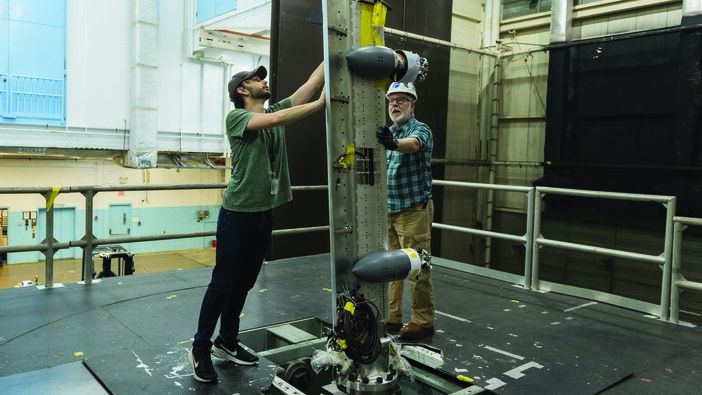
As part of its efforts to help the nascent eVTOL industry, NASA has been conducting wind tunnel tests at its Langley Research Center in Virginia. The purpose is to create a dataset that can be released publicly and used in the development of eVTOLs.
“These benchmark datasets provide the high-quality, well-controlled reference data needed to validate and improve the predictive tools used across industry, government and academia,” says Schiller.
The idea is to use the wind tunnel tests to validate computational fluid dynamics (CFD) simulations. “Wind tunnel testing and CFD are complementary,” says Catharina Moreira, chair of aerodynamics and fluid mechanics at the Technical University of Munich’s School of Engineering and Design.
“The interacting flow field of an eVTOL, with multiple tilting, operating rotors, gives rise to highly complex, unsteady and non-linear aerodynamic phenomena,” says Moreira, who was recently part of a research project that developed a modular wind tunnel model for testing eVTOLs.
“Accurately predicting these interactions numerically remains an active research challenge, and high-fidelity CFD is computationally expensive and impractical for large designs and operating envelopes. Consequently, many simulation studies rely on mid- or low-fidelity methods that introduce modeling assumptions, such as simplified rotor representations.
“Wind tunnel testing enables a much broader test matrix to be investigated within a practical timeframe while capturing the full physical flow field, including 3D wake interactions, flow separation, rotor-wing interference and unsteady aerodynamic loads. Wind tunnel measurements provide the experimental evidence to validate high-fidelity CFD and the lower-fidelity models on which routine design and optimization work depend.”
The propeller-wing problem
The first wind tunnels predate the development of powered flight. But the design of eVTOLs creates challenges that wind tunnel testers have never faced before. One of the biggest is understanding the flow dynamics of the propeller-wing interaction, says Schiller.
“On many advanced air mobility aircraft, the propellers blow directly across the wing and control surfaces. That interaction strongly influences performance, handling quality and noise, especially in hover and transition, which is how these vehicles will be flying when close to neighborhoods and vertiports.”
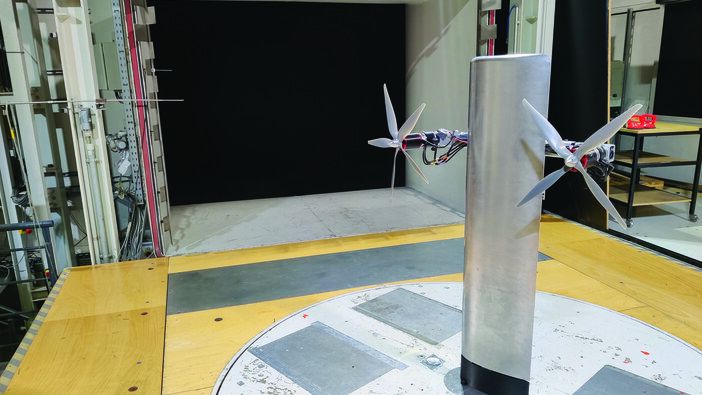
The importance of the propeller-wing interaction means that wind tunnel tests of eVTOLs, unlike tests of conventional aircraft, require the model to be powered. Schiller says, “A fixed-wing model sits at modest angles of attack with relatively clean airflow over the wings. Testing eVTOL configurations is very different. Our recent test of a 7ft (2.1m) semi-span tiltwing model involved a wing at a much larger range of angles of attack, up to 90°, along with multiple electric motors powering propellers that produced strong slipstreams over the airframe and control surfaces.
“This type of powered, highly coupled testing requires custom models, dense instrumentation and carefully designed test matrices to efficiently explore a much larger parameter space.”
Transitional times
One of the key areas of eVTOL flight that wind tunnel testing can help with is the critical transition between hover and forward flight, says Moreira.
“The transition for aircraft designs with tilting propellers is a flight regime that is particular to this class of aircraft,” she says.
“The interaction between the propellers and the wing creates unsteady, non-linear loads that do not show up in classical fixed-wing or helicopter aerodynamics. Understanding the underlying flow physics and interaction phenomena in that regime is an essential first step toward evaluating the design trade-offs that will ultimately determine the viability of eVTOL designs.”
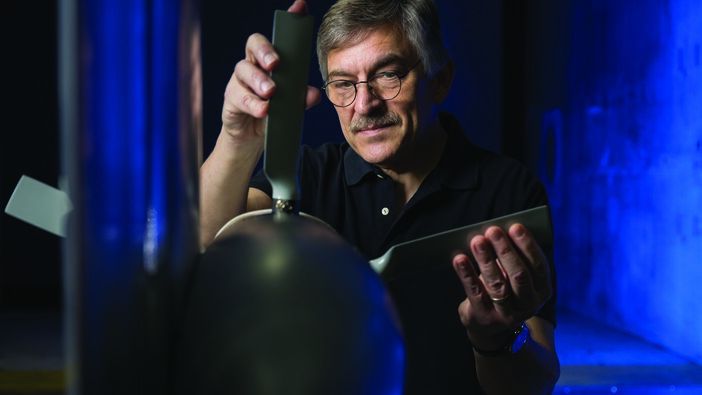
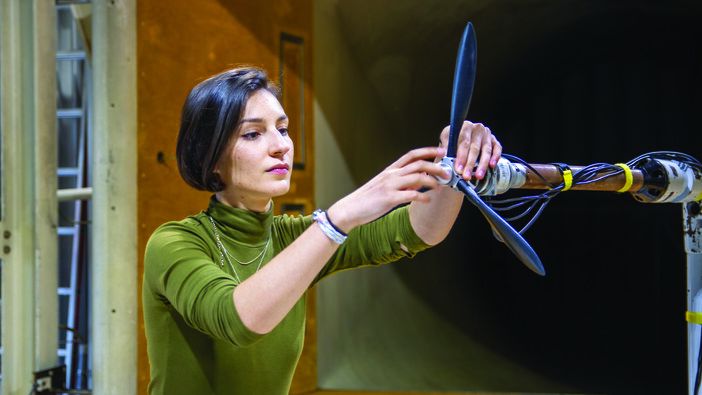
As part of the research, Moreira and her colleagues wanted to characterize the aerodynamic interaction effects during this transition, and how they change with parameters such as the tilt angle. The five-year research program involved designing an eVTOL wing-propeller model that was tested in the Technical University of Munich’s low-speed wind tunnel.
“The model was built in stages, starting from isolated components – a propeller and a wing – moving to a single propeller mounted on the wing, then multi-propeller configurations,” says Moreira.
The testing has thrown up some surprising results, says Moreira. The first is that a two-propeller front and rear configuration was “more tightly coupled than expected,” she says.
“Once a rear propeller was added, performance changed across the whole system, and that propeller experienced an aerodynamic penalty even under near-hover conditions, behaving differently from the front one in the same conditions. A second propeller did not just add its own effect on top of the first; it changed the interaction for the whole configuration.”
She also noted that the propeller’s forces were more complicated than expected. “Another surprising result was that the propeller loads did not just vary at the expected blade-passage frequency [the rate at which each blade sweeps past a fixed point]. Additional harmonics showed up too, and how strong they were depended on the configuration.”
The researchers also found that in certain test positions the propeller did not always produce its greatest lift in the hover configuration (at a 90° tilt angle), “which went against the intuitive assumption that redirecting more thrust vertically should always produce more lift“.
Large tunnels
At the DNW wind tunnel complex at Marknesse in the Netherlands, eVTOL testing has been underway since 2023. A joint venture of the national aerospace centers of Germany and the Netherlands, DNW has done full model and component testing for eVTOL developers including the now-defunct Lilium Jet and the Brazilian aerospace startup Eve Air Mobility. DNW’s best-known tunnel is the Large Low-Speed Facility (LLF), one of Europe’s largest low-speed aerodynamic testing facilities.
According to Henri Vos, head of business development at DNW, one of the drivers behind the LLF’s construction 50 years ago was the “foreseen development of vertical and short take-off and landing aircraft, both military and civil” and helicopters.
“These developments led to the need for a wind tunnel with a large test section, so that interactions with the test-section walls would minimally interfere with the flow simulation around the test object,” says Vos.
With this background in testing VTOL aircraft, when eVTOL emerged, the LLF “turned out to be still highly suited to accurate simulations of those concepts“. He adds: “One could say we went back to the future.”
Vos says the eVTOL tests carried out at the site generally validate performance, stability and control. “Low-speed aerodynamics in the take-off/landing condition are very difficult to calculate with CFD and need to be validated with experimental data – wind tunnel data,” he says.
He identifies several differences in the way eVTOLs are tested compared with more conventional aircraft at the site.
“Clearly, more complex models with the risk of system failures during the test and less aerodynamic predictability make more sophisticated methodologies necessary,” says Vos. “Also, wall corrections are not standard, given the variety of eVTOL concepts, so the corrections have to be determined a priori.
“The interpretation of the results during the test also requires more effort, from our side and from the customers’ side, who are present during the test. These types of test require very intensive cooperation with the customer and model supplier during the specification and design phase of the model.”
The noise question
With noise central to public acceptance of advanced air mobility, wind tunnel testing offers a good environment for understanding the aeroacoustics of eVTOLs in flight.
Vos says, “Aeroacoustic testing in a wind tunnel can give more accurate results for noise source localization, near- and far-field noise behavior and good absolute levels in decibels.
“DNW-LLF has been conducting aeroacoustic testing since 1981, and testing at the LLF’s scale has been shown to produce results highly comparable with full-scale measurements. One needs a large enough wind tunnel for realistic results.”