


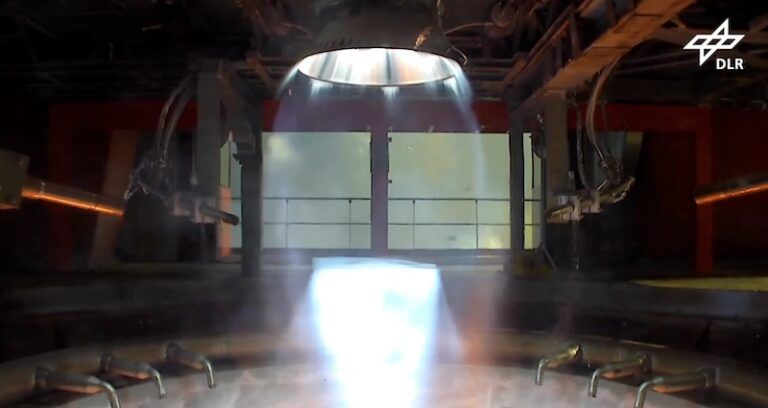
A methane-oxygen Prometheus rocket engine has been ignited several times in a single test day on the modernized P5 test stand in Lampoldshausen, Germany, holding stable operating points within one continuous test sequence.
The German Aerospace Center (DLR) said it was the first time in the stand’s history that an engine had been run this way. The Prometheus engine, developed by ArianeGroup on behalf of the European Space Agency (ESA), burns liquid methane and liquid oxygen, and the campaign builds on earlier trials at ArianeGroup’s site in Vernon, France.
Modernized stand enables repeat firings
The P5 stand, which is part of ESA’s test infrastructure and operated by DLR, has been upgraded for liquid methane and multiple consecutive ignitions. This allows operating sequences of the kind that can occur during the flight of a reusable rocket stage to be investigated.
During trials the stand supplies the engine with propellants and gases and maintains the required pressure and temperature conditions. Measurement systems record variables including thrust, propellant flow, pressure ratios and temperatures, allowing engine behavior and test-stand processes to be analyzed in detail.
Anja Frank, head of the DLR Institute of Space Propulsion, said, “With the modernized P5, we can test high-thrust methane-fuelled rocket engines reliably and comprehensively. In doing so, we investigate not only individual operating states but also the interplay of different phases, from longer hot-fire tests through large changes in thrust to the re-ignition of the engine.”
“This means we have created an important prerequisite for the development of future reusable rocket propulsion systems,” Frank added.
Testing engine transitions and configurations
Reusable engines must be capable of re-ignition in flight, for example to restart for a return or landing maneuver. After each hot run, the engine and supply systems must be safely shut down and prepared for the next start, including draining and purging the supply systems and re-establishing the required pressure and temperature conditions.
Frank said, “Up to five ignitions in a single test day place high demands on the coordination of the test stand systems. The fact that we can carry out these procedures automatically, safely and in a reproducible manner is an important step towards testing reusable propulsion systems.”
The upgraded stand also allows different thrust levels, and the transitions between them, to be examined under controlled conditions. Researchers can determine engine stability at various power levels, its reaction to rapid thrust changes and the thermal and mechanical stresses involved, and the results will inform further development of the engine.
Prometheus is a 100-tonne thrust-class engine, equivalent to about 220,000lbf (980kN). Compared with liquid hydrogen, liquid methane has a considerably higher density and can be stored at higher temperatures, which DLR said simplifies the design and handling of tanks and supply systems.
Development is funded through ESA’s Future Launchers Preparatory Programme.