

A demonstration at Cranfield Airport that tested drones in simulated mixed airspace has advanced UK regulation, while the Civil Aviation Authority has also authorised Amazon to deliver to thousands more addresses by drone.
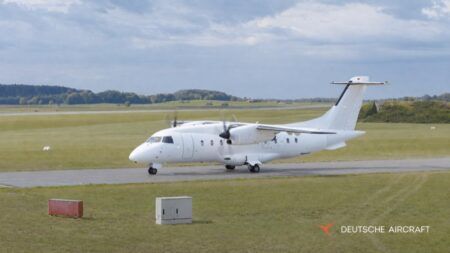
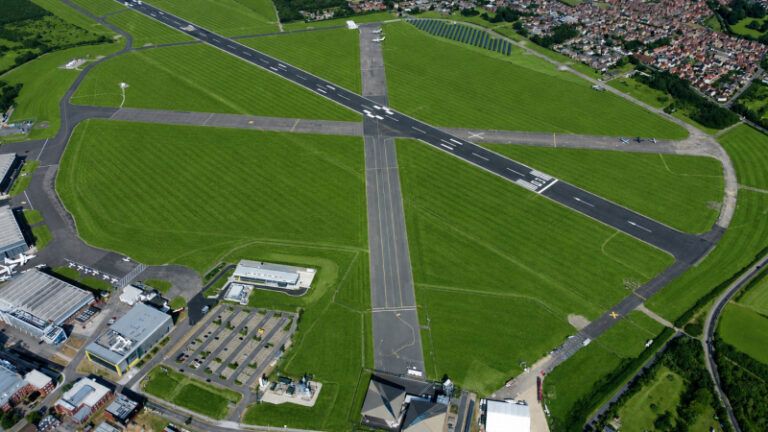
Cranfield University, Boeing, Insitu Pacific and the UK Civil Aviation Authority (CAA) ran the field demonstration at London Cranfield Airport, simulating a mixed-airspace environment of crewed and uncrewed operations. Observed by the CAA, it is intended as a first step towards advancing uncrewed aviation and informing future regulatory policy.
The test integrated the uncrewed system into the airport’s data environment using live traffic feeds and a virtual aircraft to trial detect-and-avoid technologies. It included a full ground-based setup of the aircraft and ground control station, with all operational procedures and safety checks carried out before the virtual launch.
Sandbox approach to regulation generation
The demonstration is the latest step in a multi-year collaboration between Boeing and the CAA, run through the regulator’s Innovation Sandbox project, which helps regulators and industry understand emerging technologies early in policy development.
Ed Clay, head of remotely piloted aerial systems at the CAA, said, “Through demonstrations like this, we can better understand how uncrewed aircraft can be integrated safely into the wider aviation system, while supporting innovation. The project has provided valuable insights to help inform the development of Detect and Avoid policy and support the safe integration of uncrewed aircraft into UK airspace.”
Amazon Primed for dreone delivery in Darlington
Separately, the CAA has granted Amazon’s Prime Air the world’s first SAIL 4 (Specific Assurance and Integrity Level 4) operating authorisation and flightworthiness validation, one of the most demanding levels in the UK’s drone safety framework. The approval lets Prime Air fly over more of Darlington, increasing the number of eligible households from around 600 to roughly 8,000.
SAIL is a risk-scoring system for advanced drone operations under the UK Specific Operational Risk Assessment (SORA). A SAIL 4 operation is considered medium-to-high-risk, requiring operators to demonstrate robust technical controls, system integrity and safety management.
Prime Air has operated in Darlington since early 2026 under authorisation for beyond-visual-line-of-sight flights in less densely populated areas. The SAIL 4 approval raises the level of safety assurance, allowing flights over more densely populated communities and laying a foundation for expansion across the UK.
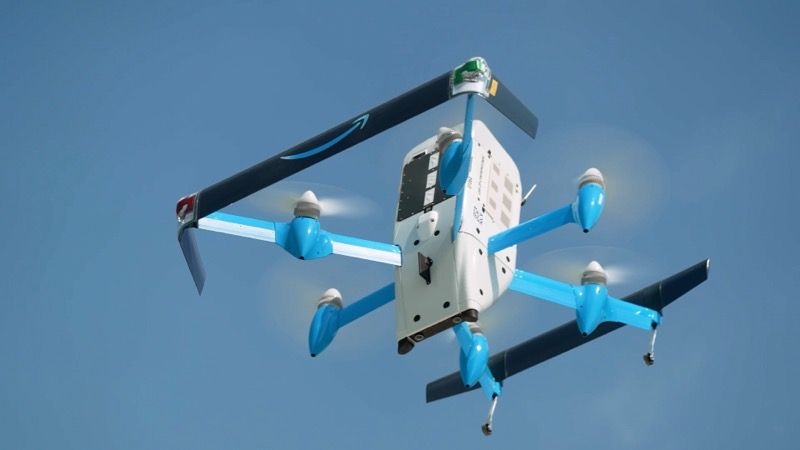
Prime Air’s MK30 drone uses an advanced detect-and-avoid system that continuously monitors the airspace, using machine-learning models to recognise other aircraft, people, animals and obstacles and decide whether corrective action is needed. On descent, the same systems avoid hazards such as clotheslines or trampolines that would not appear on a satellite map.
An independent monitoring computer oversees the main flight-control system and, if it detects an irregularity, can hand control to a secondary system and trigger an automated return to base or a controlled landing. The drone’s redundant systems also include six motors and a three-cell battery.
Theunis Scheepers, director of Prime Air Europe, said, “Prime Air is the first in the world to receive a SAIL 4 approval from the UK Civil Aviation Authority. Earning it took years of disciplined engineering and a commitment to safety from day one.”
Prime Air serves customers with a garden or driveway within 12km (7.5 miles) of the Darlington fulfilment centre, carrying items of 2.2kg (5lb) or less.