

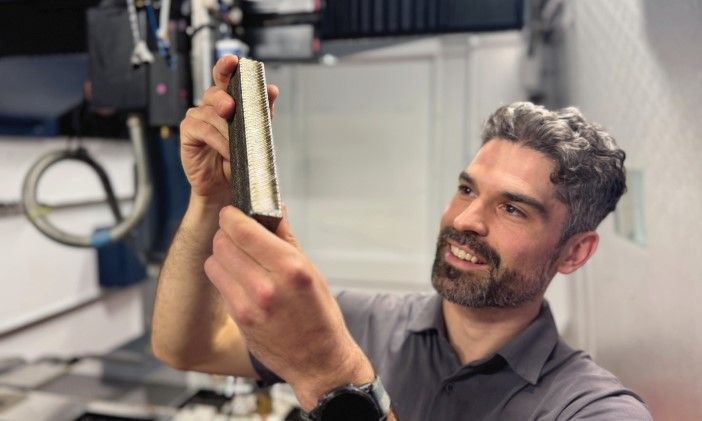
Researchers from Australia have produced a new type of 3D-printed titanium almost a third cheaper than commonly used titanium alloys, which is also stronger.
The team from the Royal Melbourne Institute of Technology (RMIT) used readily available and cheaper alternative materials to replace the increasingly expensive vanadium, producing alloys that are up to 29.5% cheaper than standard 3D-printed titanium alloys (Ti-6Al-4V).
Crucially, the alloys have a higher specific strength and modulus compared to similarly produced Ti-6Al-4V. “It has high strength while maintaining great ductility,” said research lead Ryan Brooke.
“3D printing allows for faster, less wasteful and more tailorable production, yet we’re still relying on legacy alloys like Ti-6Al-4V that don’t allow full capitalisation of this potential. It’s like we’ve created an aircraft and are just driving it around the streets.”
The alloys were produced using direct energy deposition at the RMIT centre for additive manufacturing (RCAM) using the Trumpf Trulaser cell 7020 platform. Tensile testing has been done to understand the static tensile properties, and the researchers are now undertaking fracture and impact toughness testing to further benchmark for aerospace applications.
RMIT has filed a provisional patent for the approach, and the team is considering commercial opportunities to develop the new low-cost approach for aerospace applications.
The study outlines a time- and cost-saving method to select elements for alloying and take advantage of 3D-printing, by providing a framework for predicting the printed grain structure of metallic alloys in additive manufacturing. Using the design framework, the metal prints more evenly, avoiding the column-shaped microstructures that lead to uneven mechanical properties in some 3D printed alloys.
“By developing a more cost-effective formula that avoids this columnar microstructure, we have solved two key challenges preventing widespread adoption of 3D printing,” said Brooke, who has completed market validation as part of an industry outreach program.
“What I heard loud and clear from end users was that to bring new alloys to market, the benefits have to not just be minor incremental steps but a full leap forward, and that’s what we have achieved here,” he said.
“These alloys have been designed for direct energy deposition methods, therefore favouring larger parts. We can see this alloy being used for airframes or structural brackets in the future. Similarly there would be space applications also, like satellite parts,” said Brooke.
“We are currently working at validating our alloy technology, by building a larger scale validation piece. We are actively seeking partners in aerospace to benchmark against current components. Depending on the application we would then hope to work towards certification with industry.”
The study ‘Compositional criteria to predict columnar to equiaxed transitions in metal additive manufacturing’ was published last month in the journal Nature Communications. The alloy is not presented in the study for commercial reasons.