

Engine testing is a critical part of aerospace development and maintenance. OEMs invest billions in building and upgrading engine testing facilities globally to ensure that safety, reliability, and regulatory goals are met.
Most modern engine testing facilities have two main functions. Engineers and technicians routinely inspect and test in-service engines as part of MRO services offered at these sites. They also test engines for R&D and as part of development and certification programs.
At these sites engines are subjected to conditions beyond those they will encounter in service – from bird strikes and hailstorms to extreme temperatures and crosswinds – using specialist equipment in massive halls and workshops. Most facilities have built up expertise and capabilities over several decades – generations of engineers working diligently to provide propulsion to the aviation industry.
Today, engine testing facilities are being shaped by industrial trends and new technologies, from composite materials, new fuels and designs, to AI, automation and digitalization. The five profiled in this article represent the leading facilities in the world and have all been built or extensively upgraded in the past 15 years.
They are used for commercial jet engine testing and also support military programs. But above all else, they keep aircraft and passengers in the air safely.
Pratt & Whitney
West Palm Beach, Florida
Pratt & Whitney opened its West Palm Beach site in Florida, USA in 1958 to perform R&D and testing on advanced jet and rocket engines. One of the site’s first roles was the development of a pioneering hydrogen jet engine, intended for the top-secret Skunk Works Project Suntan, a prototype reconnaissance aircraft.
The facility spans 7,000 acres and serves as a key center for both commercial and military engine testing. West Palm Beach (WPB), which employs around 600 people, is a critical node in P&W’s commercial Geared Turbofan (GTF) MRO network. It also assembles and tests F135 engines for the F-35 Lightning II, of which it has delivered hundreds since 2013.
The facility is equipped to be capable of testing an F135 engine in full STOVL (short takeoff vertical landing) mode with full system architecture – engine, lift fan and roll nozzles.
In mid-2021 WPB was transformed into a full-capability GTF maintenance shop, with 175,000ft² (16,250m²) converted to host maintenance operations. This included an automated system that assembles the high-pressure compressor (HPC) rotor of jet engines, which WPB was the first P&W facility to adopt, and a refined overhead engine handling system. According to P&W, the upgrade means 25% more rotors can be produced in half of the time.
As well as the GTF family – PW1100G-JM for the Airbus A320neo, PW1500G for Airbus A220 – WPB also tests auxiliary power units and turbojets. GTF Advantage engine certification testing was conducted here, including 100% SAF testing in 2022. The site can accommodate all of the work for FAA noise and crosswind testing for commercial engines.
Last year WPB received a further US$20 million upgrade that increased GTF MRO capacity by 40%. The workforce is expected to increase by 25% in the coming years with new equipment for the machining, testing, cleaning and warehousing functions.
WPB is a prime example of how OEM facilities are evolving into integrated production/MRO operations. However, military engine R&D still forms a vital part of the work done at WPB, including testing on effector propulsion with the TJ150 small jet engine for drones, munitions and missiles. Engineers at WPB are especially active in the testing and development of additive manufacturing processes for the TJ150.
P&W also expects the site to play a key role in the F135’s Engine Core Upgrade program, including development testing. The company plans to add robotics and automation to processes at WPB in the future. The site will continue to support the GTF flying fleet and will be the first MRO in the world to service the GTF Advantage engine, which is expected to enter service later this year.
Safran Aircraft Engines
Villaroche, France
This production and testing facility at Villaroche, France covers all phases of an engine’s lifecycle, from design through to production and maintenance. Its capabilities ensure the performance, reliability, and safety of commercial and military engines.
There has been engine development and testing activity at Villaroche since 1947, after the site was acquired from the US Air Force. By the 1950s, it was one of the best-equipped testing centers in Europe.
Villaroche has five indoor test cells for development, certification, and production testing, and is equipped with advanced data acquisition systems able to provide real-time monitoring. Safran performs engine validation on the ground in these indoor and open-air bench installations before any flight testing.
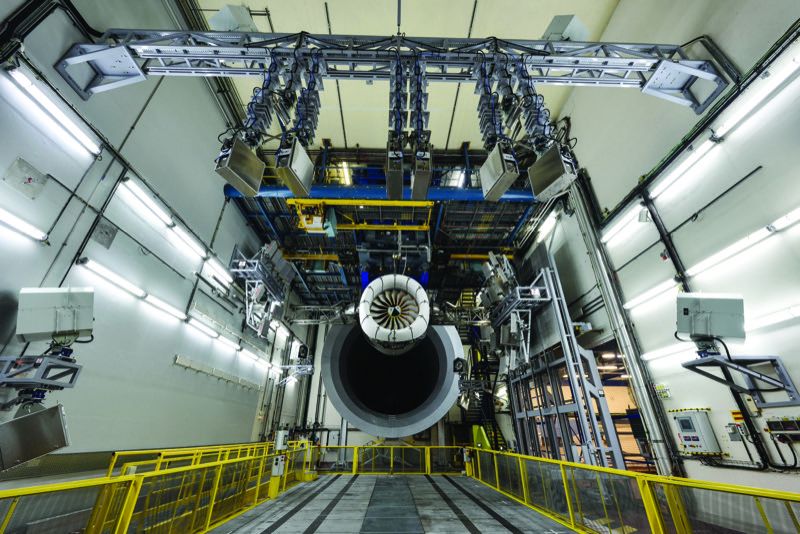
Commercial engines tested at the site include the LEAP-1A (Airbus A320neo family), LEAP-1B (Boeing 737 MAX) and the CFM56 (MRO and upgrades). Many activities are part of CFM International, Safran’s joint venture with GE Aerospace, for which Villaroche is the European test center.
The M88 military engine, which is used by Dassault Aviation’s Rafale multi-role fighter, is also produced and tested at Villaroche.
There are around 20 test benches at the Villaroche site for engine components and systems testing. Capabilities for part testing include static, vibration, ingestion, and permeability tests on rotating and static parts, among others.
The facility’s test stands also enable independent testing of the different modules of an engine, such as the fan, compressor, turbine and high-pressure core. Engineers at Villaroche do mechanical tests, blade-off tests, bird ingestion tests, overspeed, and endurance tests to guarantee the reliability of each subassembly. This equipment is integrated with Safran’s digital transformation initiatives, including digital twins and predictive analytics. The site now also has SAF compatibility testing capabilities.
The component testing capabilities at Villaroche are essential for Safran’s engine development programs. For instance, the site is hosting major parts of the Revolutionary Innovation for Sustainable Engines (RISE) technology program.
RISE, which was launched by CFM International in 2021, is one of the largest technology demonstration programs in the company’s history. The program aims to create a next-generation open-fan jet engine that provides 20% better fuel burn compared to engines currently in use.
Last year, engineers at Villaroche tested three fan blade configurations to demonstrate the mechanical integrity of an unducted architecture and validate improvements in aerodynamic and acoustic performance. Over 175 ingestion and endurance tests have been carried out in the test facilities at Safran’s Villaroche center, which were specially configured to accommodate the large-scale components.
Other recent improvements at Villaroche include an 8m (26ft) wide wind tunnel chamber and a new test stand to carry out development and certification tests
for RISE.
Delta TechOps
Atlanta, Georgia
Delta’s Technical Operations Center sits next to Hartsfield-Jackson Atlanta International Airport and is the largest airline MRO facility in North America. With a workforce of over 10,000 technicians and engineers, Delta TechOps provides maintenance to more than 850 Delta aircraft and their engines, as well as MRO services for more than 150 external operators, cargo carriers and military and government customers.
The original Delta TechOps Technical Operations Center opened in 1960 at the airport with subsequent major expansions in 1968 and 1972.
The facility’s engine testing capabilities support more than 20 models spanning a broad range of architectures and thrust classes. Engines tested include the Rolls-Royce Trent 1000, Trent 7000 and Trent XWB, Pratt & Whitney GTF variants including the PW1100G-JM and PW1500G, and GE Aerospace powerplants.
Delta TechOps holds 25-year contracts with both Rolls-Royce and Pratt & Whitney as an authorized maintenance center.
The centerpiece of the engine testing operation is Test Cell 5 (TC5), which opened in February 2019 following a US$100 million investment.
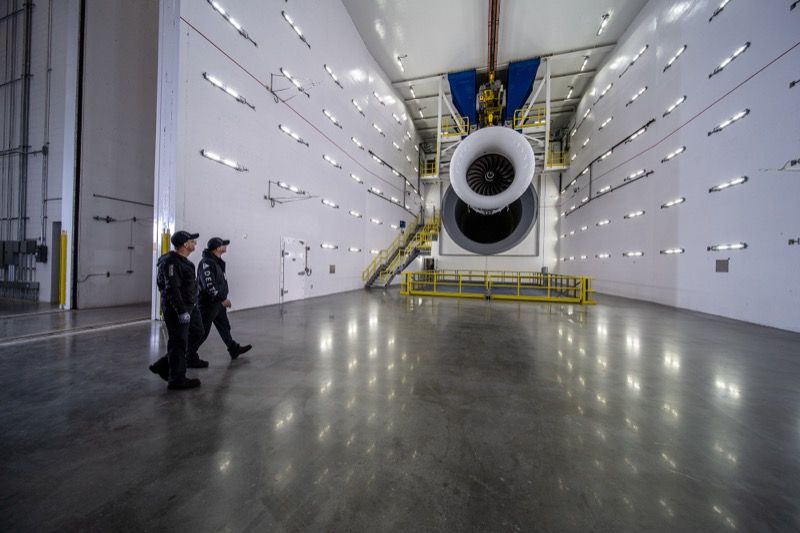
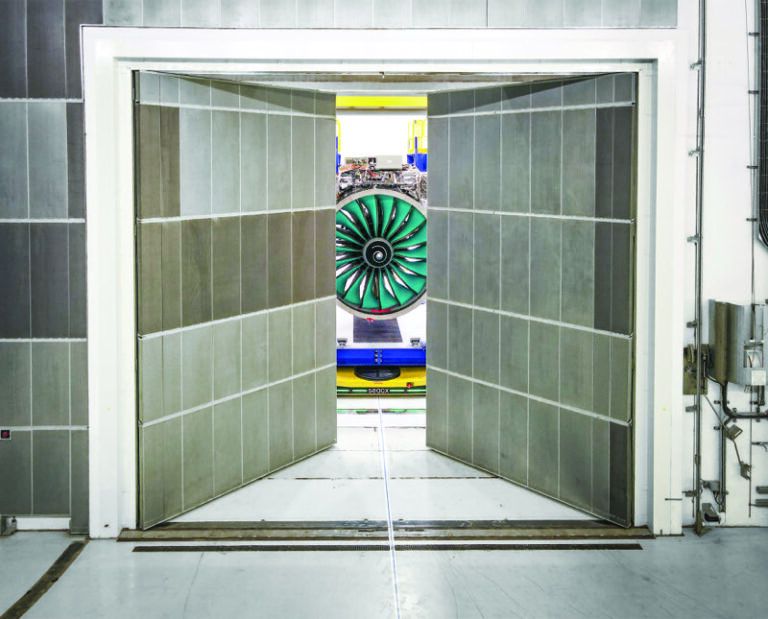
TC5 was the first engine test cell built by a US airline in more than 20 years when it opened, and is the world’s largest engine test cell at an MRO facility. The chamber measures 48 x 48ft (14.6 x 14.6m), with inlet and exhaust sections of 66ft (20m) and 78ft (24m). The cell’s solid concrete entry doors are 26ft (8m) wide and 48ft (14.6m) tall, each weighing over 300,000 lbs (136,000kg).
TC5 is rated to 150,000lbf of thrust – 35,000lbf more than the most powerful turbofan in service – and was designed to test engines not yet built. Specialized inlet and exhaust structures provide acoustic attenuation and crosswind mitigation, allowing engines to be tested across a wide range of ambient conditions while supporting around-the-clock operations with minimal noise impact on the surrounding communities.
Coupled with TC5 is a 127,000ft² (11,800m²) engine repair shop, creating an integrated overhaul and testing operation.
“This diverse capability portfolio allows Delta TechOps to meet the needs of our own fleet, as well as those of a global customer base, while also remaining well-positioned to support emerging engine technologies,” says Dustin Thales, manager, propulsion engineering at Delta TechOps.
According to Delta TechOps, digitalization is reshaping operations across the facility. Next-generation engine families generate more data at higher acquisition rates than their predecessors, and a single engine test in TC5 produces multiple gigabytes of data that must be retained well beyond the test event.
Recent investments have focused on enhancing data acquisition, processing capability and infrastructure resilience to handle the increasing complexity of test data across hundreds of annual engine tests.
Looking ahead, DeltaTechOps says the scalability and modularity of its testing facilities position them to support future propulsion technologies as they mature, including higher-thrust engines, open rotor architectures, sustainable aviation fuels and potential hybrid-electric configurations.
Rolls-Royce
Derby, UK
Rolls-Royce’s site in Derby has been the home of large civil aero engine development since the late 1960s, when the RB211 three-shaft turbofan was tested there. Today, the site houses one of the most advanced civil aerospace production and testing complexes in the world, incorporating multiple testbed facilities, a Production Test Facility and dedicated demonstration workshops.
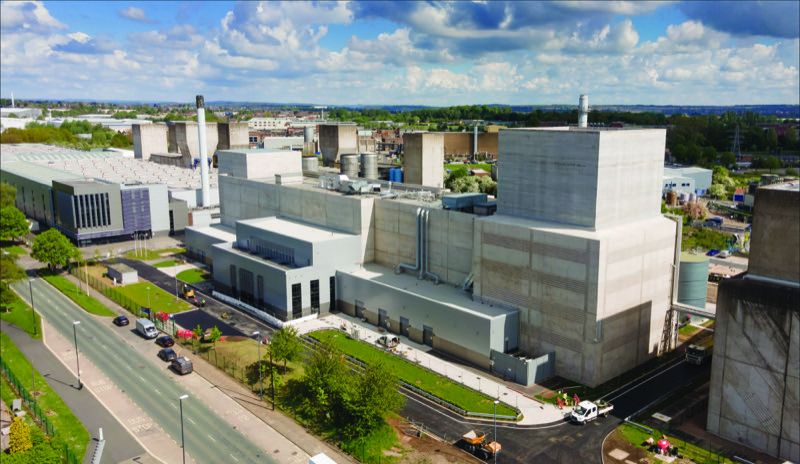
The Production Test Facility (PTF) is where Rolls-Royce kits, assembles and tests its Trent engine family – the Trent XWB, Trent 1000, Trent 7000 and Trent 700 – for delivery to Airbus and Boeing. More than 1,000 people provide direct and indirect support to engine build, test and dispatch operations within the PTF.
The centerpiece of the Derby testing operation is Testbed 80, which officially opened in May 2021 following a £90 million (US$123 million) investment and three years of construction. Designed in partnership with MDS Aero Support Corporation of Canada, it is the world’s largest indoor aerospace testbed, and according to Rolls-Royce, the smartest.
Testbed 80’s internal area spans 80,000ft² (7,500m²), built using 3,128 tonnes of steel and 950,000ft³ (27,000m³) of concrete. Its walls are 1.7m (5.5ft) thick to contain noise and radiation from the facility’s x-ray systems.
The facility can accommodate engines up to 155,000lbf of thrust and features the most advanced data acquisition system ever deployed by Rolls-Royce, monitoring over 10,000 parameters with sampling rates of up to 200,000 per second. Data systems are cloud-connected and linked in real-time to analytical models and engineering offices worldwide.
A particularly innovative capability of Testbed 80 is the onboard x-ray machine, which can capture up to 30 frames per second while an engine is running and sends images to a secure cloud for analysis. Rolls-Royce is the only engine manufacturer in the world that can x-ray aero engines while they are running.
The facility is equipped with a 140,000-liter fuel tank capable of handling different fuel types including SAF. Testbed 80 has already hosted milestone SAF testing on Trent engines. It was the site of the first-ever test of the UltraFan demonstrator in May 2023 – the world’s largest civil aviation turbofan, with a 11.6ft (3.5m) fan diameter – which ran on 100% SAF and achieved over 85,000lbf of thrust.
The Derby campus also includes the Power Gearbox Test Center, which tests the world’s most powerful aerospace gearbox at 70,000hp, and Testbed 108, which has been renovated to support testing of a 2.5MW hybrid-electric power generation system.
Looking ahead, Testbed 80 is designed for future hybrid-electric propulsion testing and will continue to support the UltraFan program, which targets 25% better fuel efficiency than the first-generation Trent.
GE Aerospace
Peebles, Ohio
GE Aerospace’s Peebles Test Operation is located on nearly 7,000 acres in the Appalachian foothills of rural Adams County, Ohio. The site was opened in 1954 as a rocket engine test facility, then mothballed after a year. It was reactivated in 1965 for certification testing of the TF39 engine for the Lockheed C-5 Galaxy military transport. Over the six decades since, Peebles has grown into one of the world’s most advanced and comprehensive jet engine test complexes.
The site today comprises 11 test stands – seven outdoor and four indoor – and employs around 400 people. Four of the stands are capable of testing engines of up to 150,000lbf of thrust.
Peebles also serves as a final assembly facility, building and shipping over 500 GE90 and GEnx engines per year. Each year engineers and technicians run final acceptance testing on around 1,250 production engines.
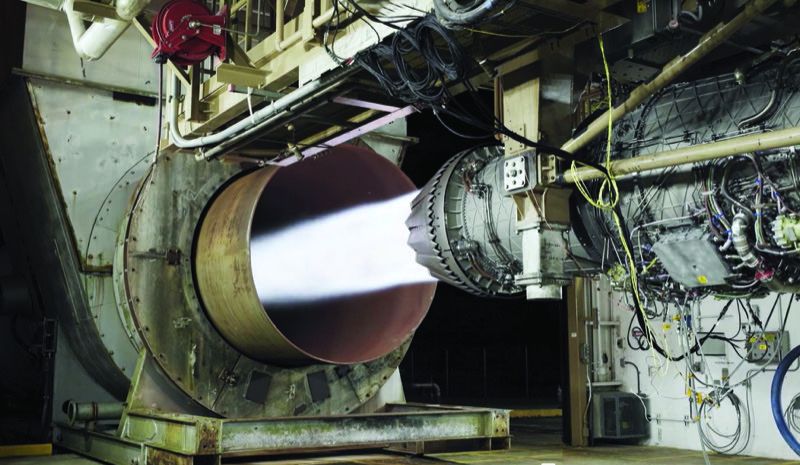
Engines are subjected to extreme conditions at Peebles. Tests done there include bird strikes, hail ingestion, ice storms, typhoon-force crosswinds at nearly 100mph (160km/h), dust ingestion, including simulated Middle Eastern conditions for GE9X certification and blade-out structural failure tests.
Peebles includes Site 7, which according to GE Aerospace is a one-of-a-kind outdoor stand capable of testing both conventional takeoff and landing and short takeoff, as well as vertical landing engine configurations for military programs.
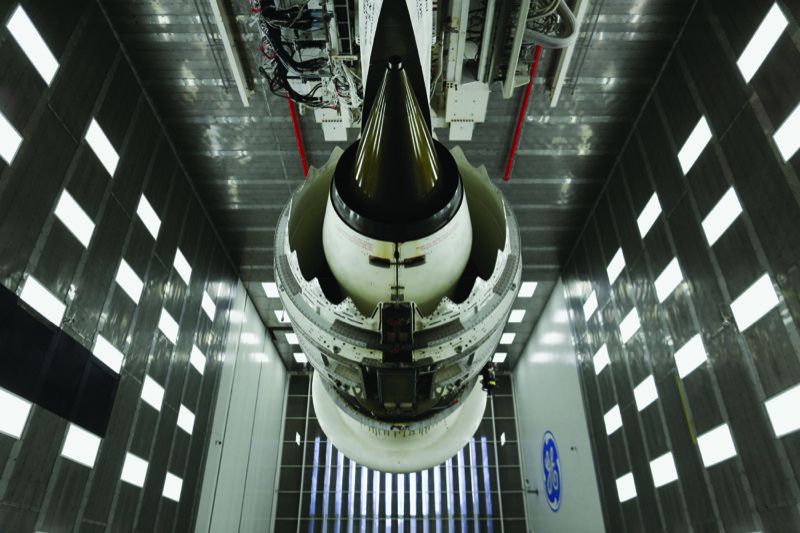
One of the latest indoor test cells to open, Site 5D, was commissioned in 2014 as part of a US$40 million investment. Site 5D was built with the GE9X engine in mind. To accommodate the world’s largest commercial engine, with its 11ft (3.4m) fan diameter, GE invested a further US$10 million in 2016, including in the design and manufacture of the largest bellmouth inlet duct ever used by the company, 18ft (5.5m) in diameter and 12ft (3.7m) in length. A fourth fuel tank was also added to support the demands of GE9X certification testing alongside growing GE90 and GEnx production volumes.
In total since 2006, GE Aerospace has invested more than US$200 million in expanding and upgrading the Peebles facility. In 2025 the company announced a further US$39 million for facility and test cell upgrades to support the growth of production engine testing and development work for next-generation engines and current commercial and military powerplants.
Peebles is also playing a role in future propulsion research. In late 2025, a modified GE Passport engine completed baseline testing at the facility as part of NASA’s Hybrid Thermally Efficient Core (HyTEC) project. The integrated hybrid-electric ground test successfully demonstrated power transfer, extraction and injection on a commercial turbofan for the first time.
The results will feed into CFM International’s RISE program, which GE Aerospace is participating in through its partnership with Safran and its Villaroche site.
Read this article in its original format in our digital magazine and view subscription options (free to industry professionals) here