

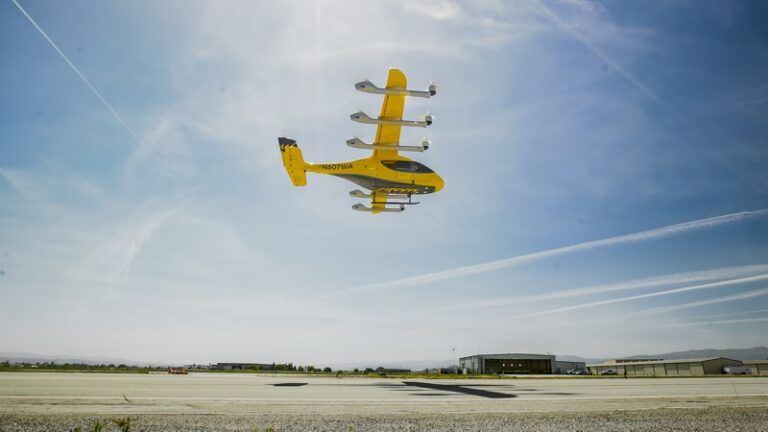
Wisk Aero has completed the first flight of its second Generation 6 eVTOL aircraft at its flight test facility in Hollister, California, bringing its active certification test fleet to two aircraft.
The inaugural sortie of the second airframe covered vertical take-off, hover, and chirp maneuvers — frequency-sweep inputs that inject controlled oscillations into the flight control system to map aircraft response across a range of dynamic conditions. The test followed the same initial profile flown by the first Generation 6 aircraft, which completed its maiden hover flight on December 16, 2025, also at Hollister.
The addition of a second flight test aircraft four and a half months after the first means Wisk can now generate certification evidence from two aircraft simultaneously, accelerating data collection on control laws, structural loads, and system performance said the company. Both airframes will be used to expand the flight envelope, including transitions from hover to wing-borne flight.
“Seeing the second Gen 6 aircraft take to the skies is a proud moment for Wisk,” said Sebastien Vigneron, CEO of Wisk. “Having multiple aircraft in flight testing allows us to move faster, learn quicker, and stay on the leading edge of autonomous aviation. Every flight provides crucial data that matures our aircraft and autonomous system, bringing us one step closer to delivering a certified, autonomous air taxi service.”
The Generation 6 is an all-electric, autonomous four-passenger aircraft with a 50ft (15.2m) wingspan and 12 rotors — six dedicated to lift and six convertible lift/cruise rotors that allow transition from hover to forward flight. The aircraft is designed to cruise at up to 138mph (222km/h) at service altitudes between 2,500ft and 4,000ft (762m and 1,219m), with a projected range of 90 miles (145km). Unlike crewed eVTOL designs, it carries no flight controls; instead, a ground-based operator oversees up to three aircraft simultaneously using the company’s Multi-Vehicle Supervisor system.
The Generation 6 is the subject of a Federal Aviation Administration (FAA) type certification application and draws on lessons from more than 1,750 test flights conducted across Wisk’s five previous aircraft generations. Wisk said it is the only company to have designed, built, and flown six generations of eVTOL.
Wisk aims for its eVTOL to enter commercial service in 2030.
The expanded test fleet supports Wisk’s broader program timeline, which includes participation in the US Department of Transportation and the FAA’s eVTOL and advanced air mobility (AAM) Integration Pilot Program (eIPP).
The Texas Department of Transportation (TxDOT) was selected for the eIPP in March 2026, with Wisk as the primary private-sector eVTOL partner. The three-year program allows pre-certified aircraft to conduct operations in live US National Airspace and generate data to inform FAA policy and rulemaking.
Wisk has also said it will continue to collaborate with the FAA and NASA on the broader development of US autonomous aviation standards.