

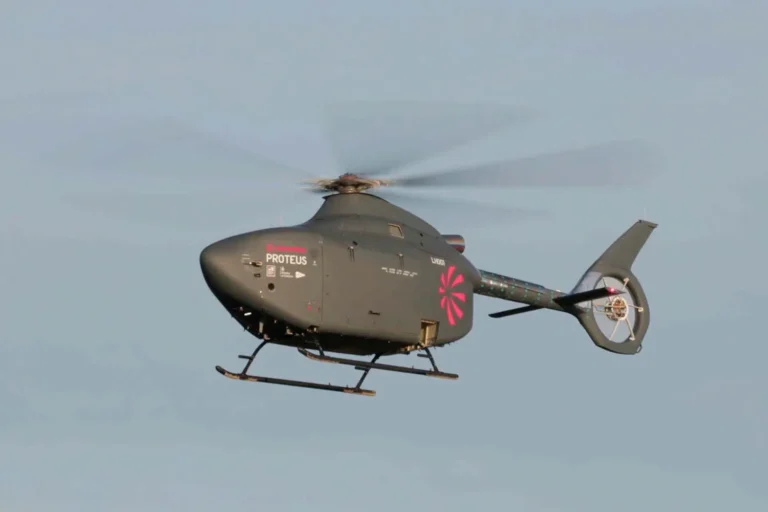
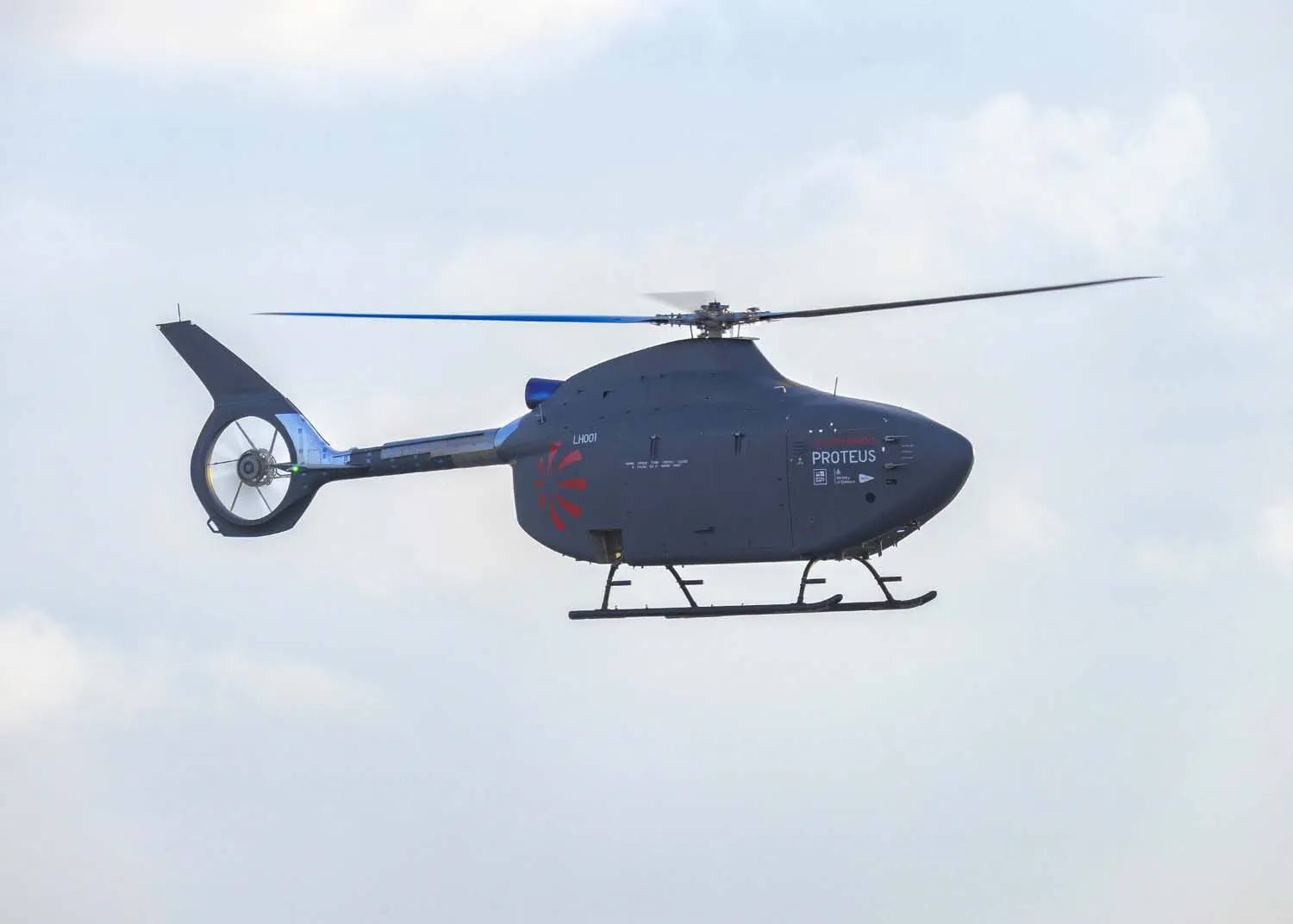
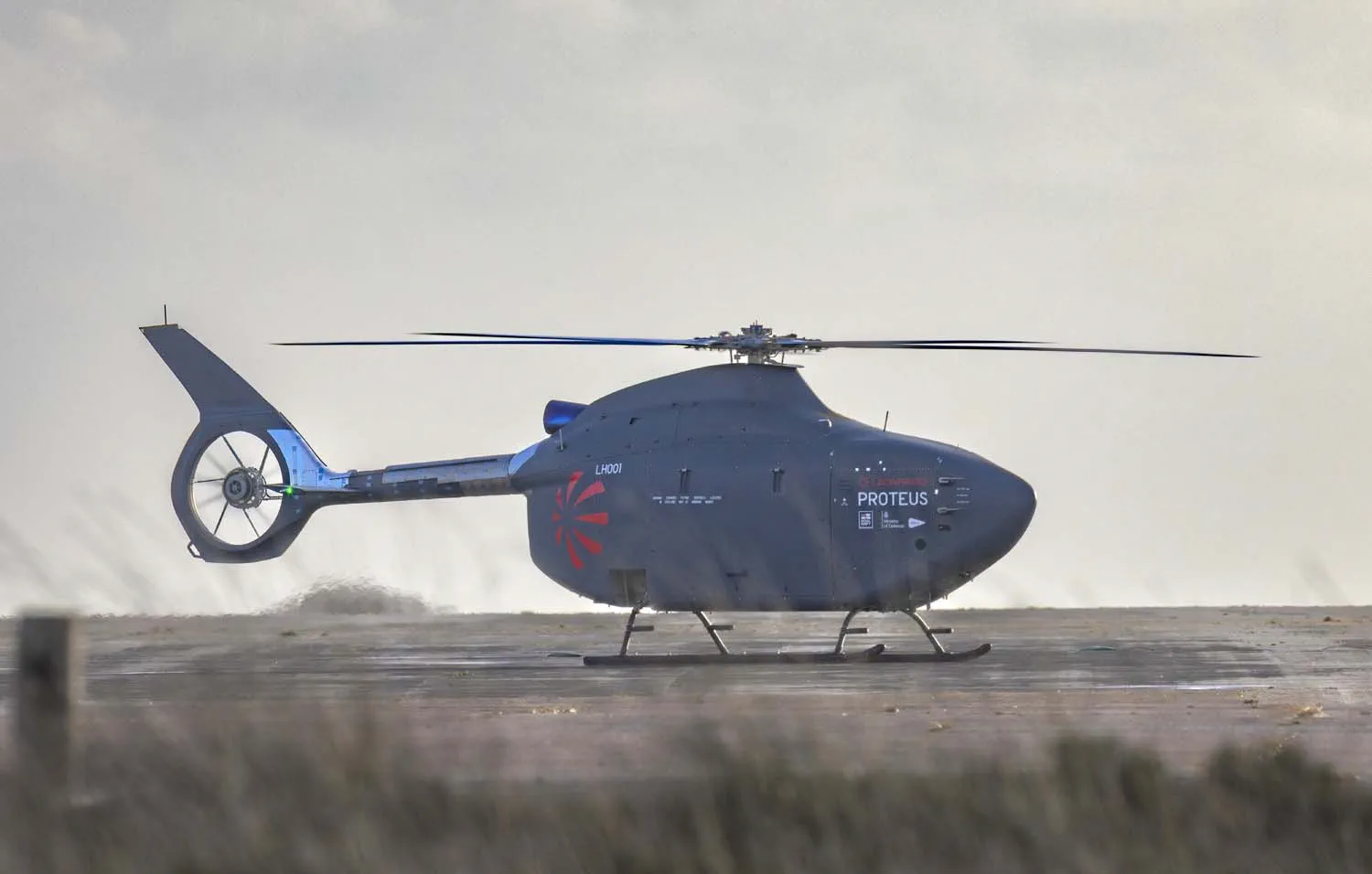
The UK’s first autonomous full-size helicopter has completed its maiden flight, operating from Predannack airfield in Cornwall.
The Proteus technology demonstrator has been designed and built by Leonardo as a demonstrator for the Royal Navy. It is intended to unlock the potential of uncrewed aerial systems, operating them alongside crewed aircraft in a future hybrid air wing and potentially for future anti-submarine operations.
The first flight happened just weeks after ground testing was completed at Leonardo’s Yeovil site to validate the helicopter’s systems, sensors and engines.
During its first flight, Proteus was tasked with a short test routine which saw the aircraft operate its own flying controls independently of any human operator, while under constant supervision and monitoring by test pilots on the ground to ensure flight safety.
The successful flight delivers on key commitments in the UK Government’s last Strategic Defence Review, which set out plans to create a new hybrid navy that uses autonomous helicopters in so-called hybrid air wings and in the Atlantic Bastion program to secure the North Atlantic.
The Royal Navy already operates several drones, including Malloy octocopters and Peregrine, a scaled-down helicopter that conducts surveillance duties. Proteus is larger, more complex and autonomous.
Designed and manufactured in Yeovil, the Proteus technology demonstrator is being developed by Leonardo under a £60 million (US$73 million) program supporting 100 jobs and is believed to be one of the world’s first full-size autonomous helicopters.
With a payload capacity greater than one tonne (2,205 lb), Proteus can carry a range of equipment to conduct tasks in challenging weather conditions such as high sea and wind states, and also frees up crewed aircraft to conduct other sorties.
Nigel Colman, managing director helicopters UK at Leonardo, said, “Proteus represents a step-change in how maritime aviation can deliver persistence, adaptability and reach – conducting the dull, dirty and dangerous missions in challenging environments without putting human operators at risk.”
Commodore Steve Bolton, Royal Navy deputy director aviation future programs, said, “The successful first flight of Proteus is a significant step in delivering the Royal Navy’s maritime aviation transformation vision, and to demonstrating our steadfast commitment to investing in autonomy as part of a hybrid air wing.”
Luke Pollard, UK Minister for Defence Readiness and Industry, said, “Designed and built in Yeovil, Proteus supports skilled UK jobs while helping deliver the hybrid navy outlined in our Strategic Defence Review. Autonomous systems like this will be vital in protecting our seas without putting personnel in harm’s way.”
Development of Proteus started in 2022 under a four year program which will end in July this year.
The helicopter has been designed to conduct a range of missions including anti-submarine warfare, patrolling the seas and drawing on information provided by a network of allied ships, helicopters, submarines and detection systems to hunt vessels beneath the waves.