

NASA’s X-59 quiet supersonic research aircraft has exceeded the speed of sound for the first time, reaching Mach 1.1 during an 81-minute test flight from Edwards Air Force Base in California.
NASA test pilot Jim “Clue” Less flew the Lockheed Martin Skunk Works-built aircraft to a top speed of approximately 713mph (1,147km/h) and an altitude of 43,400ft on June 5. The test focused on evaluating flying qualities at both subsonic and supersonic speeds.
The flight marks a major step in the X-59’s ongoing envelope expansion campaign, during which the aircraft has completed 16 flights in 90 days. An F-15 chase plane flew alongside to monitor the aircraft, and NASA noted that sonic booms from the F-15 obscured any sound made by the X-59.
Jared Isaacman, NASA Administrator, said, “X-59 is getting ready for its quiet supersonic debut. Since the aircraft’s first flight on October 28, 2025, the team has made tremendous progress, flying 16 times in the last 90 days and getting into a steady test rhythm.
“In the coming days, we expect to take the next step and push to Mach 1.4. I’m grateful to the NASA team and Lockheed Martin Skunk Works for their help getting us to this point, and I hope this is the first of many collaborations as we rebuild NASA’s X-plane portfolio.”
The next critical milestone is the X-59’s first “mission conditions” flight, expected within days. The aircraft will target a cruising speed of Mach 1.4 (925mph/1,489km/h) at approximately 55,000ft, the baseline conditions for its eventual community overflight campaign, and will again be accompanied by a chase plane.
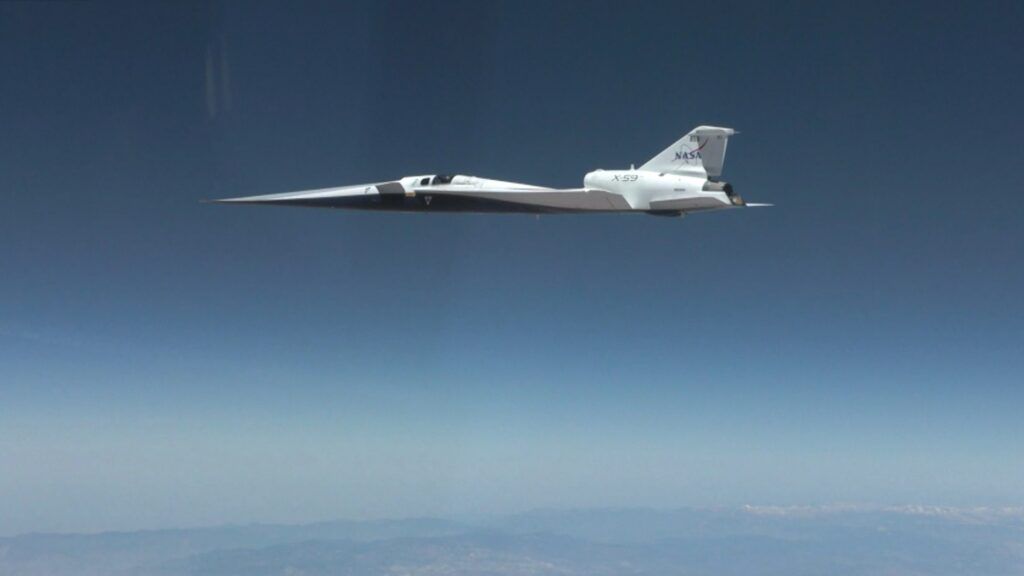
The 99.7ft (30.4m) aircraft, developed under a US$248 million contract awarded to Lockheed Martin in 2018, is designed to fly at supersonic speeds while producing a quiet thump instead of a conventional sonic boom. The aircraft’s 38ft (11.6m) needle-shaped nose, carefully shaped fuselage and top-mounted General Electric F414-GE-100 engine work together to prevent shockwaves from merging, reducing ground-level noise to an estimated 75 perceived decibels, roughly equivalent to a car door closing.
NASA plans to fly the X-59 over several communities across the USA to gather data on public perception of the reduced-noise sonic thumps. The agency will share the results with regulators in the USA and internationally to help establish new noise standards that could enable commercial supersonic flight over land.
TheX-59 program’s current envelope expansion phase focuses on aircraft performance with chase plane monitoring, and once complete, testing will transition to an acoustic validation phase to verify the aircraft’s quiet thump capability before community overflights begin.