

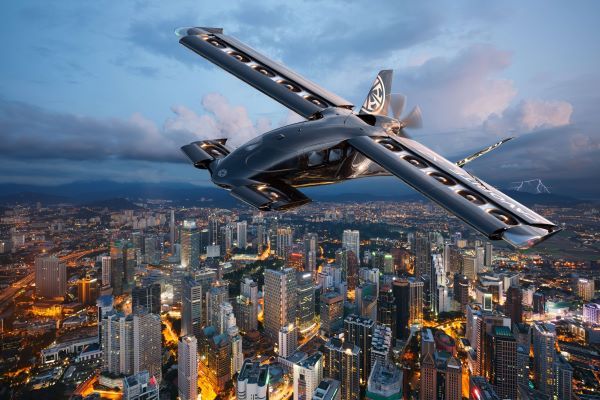
Horizon Aircraft has announced design changes to its full-scale Cavorite X7 hybrid-electric vertical take-off and landing aircraft that standardize the lift fan array and improve aerodynamic efficiency.
The Canadian company completed transition flight testing of a large-scale prototype in May 2025, validating its patented fan-in-wing technology that enables the aircraft to take off vertically before transitioning to conventional wing-borne flight. The vertical take-off and landing (VTOL) aircraft now features 12 lift fans distributed across the wings and canards, with five fans in each wing and one in each forward canard.
The revised configuration replaces four smaller canard-mounted fans with two wing-size units, standardizing all 12 fans to simplify manufacturing and maintenance while improving performance. Each fan is powered by a dual-motor redundant architecture that maintains safety margins despite the reduction in total fan count, said the company.
The canard and tail surfaces have been reprofiled to reduce drag and enhance cruise efficiency and stability. The design refinements were developed in collaboration with mobility designer Andrea Mocellin.
“These technical updates are a result of our engineering team’s ability to enhance the performance of our aircraft,” said Brandon Robinson, co-founder and CEO of Horizon Aircraft. “We remain committed to building one of the safest, toughest, and most performant modern VTOL aircraft.”
The Cavorite X7 is designed to cruise at 290mph (463km/h) with a range of 575 miles (926km), carrying a pilot and six passengers or 1,500 lbs (680kg) of cargo in VTOL mode. Payload capacity increases to 1,800lb (816kg) for conventional runway operations, with a maximum gross weight of 5,500lb (2,495kg).
The fan-in-wing architecture conceals the electrically driven lift fans within the wing structure during forward flight. Sliding panels cover the fan apertures once the aircraft transitions to wing-borne flight, eliminating the drag penalties associated with exposed rotors on conventional multicopter designs.
A Pratt & Whitney Canada PT6A turboprop engine drives a rear-mounted pusher propeller for cruise flight and generates electricity to recharge the batteries powering the lift fans. The hybrid-electric architecture addresses range limitations that constrain pure battery-electric VTOL designs.
Horizon expects to complete assembly of the first full-scale prototype by the end of 2026, with ground testing planned for early 2027. The company has expanded its engineering team by 50% and secured CA$24 million in capital to fund development through the current phase.
The aircraft is being developed to achieve instrument flight rules (IFR) certification and flight into known icing (FIKI) approval, capabilities that would distinguish it from competing eVTOL designs currently limited to visual flight rules operations. Horizon has initiated testing of ice-phobic coatings and electrothermal de-icing systems under a grant from Canada’s Initiative for Sustainable Aviation Technology program.
Certification and service entry are targeted for the end of the decade. The company sees applications in medical evacuation, search and rescue, cargo delivery, and military operations.