
Aerospace Testing InternationalAerospace Testing International
  • News
    • A-E
      • Acoustic & Vibration
      • Avionics
      • Data Acquisition
      • Defense
      • Drones & Air Taxis
      • Electric & Hybrid
      • EMC
      • Engine Testing
      • Environmental Testing
    • F-L
      • Fatigue Testing
      • Flight Testing
      • Helicopters & Rotorcraft
      • High Speed Imaging
      • Industry News
    • M-S
      • Materials Testing
      • NDT
      • Simulation & Training
      • Software
      • Space
      • Structural Testing
      • Supplier News
    • T-Z
      • Technology
      • Telemetry & Communications
      • Weapons Testing
      • Wind Tunnels
  • Features
  • Magazines
    • June 2026
    • March 2026
    • Dec 2025 / Jan 2026
    • Showcase 2026
    • August / September 2025
    • June 2025
    • Archive Issues
    • Subscribe Free!
  • Opinion
  • Webinars
  • Events
    • All Events
    • Aerospace Test & Development Show
  • Podcasts
  • Videos
  • Suppliers
    • Supplier Spotlights
    • Press Releases
    • Technical Papers
LinkedIn YouTube X (Twitter)
Subscribe to magazine Subscribe to email newsletter Media Pack
Aerospace Testing InternationalAerospace Testing International
  • News
      • Acoustic & Vibration
      • Avionics
      • Data Acquisition
      • Defense
      • Drones & Air Taxis
      • Electric & Hybrid
      • EMC
      • Engine Testing
      • Environmental Testing
      • Fatigue Testing
      • Flight Testing
      • Helicopters & Rotorcraft
      • High Speed Imaging
      • Industry News
      • Materials Testing
      • NDT
      • Simulation & Training
      • Software
      • Space
      • Structural Testing
      • Supplier News
      • Technology
      • Telemetry & Communications
      • Weapons Testing
      • Wind Tunnels
  • Features
  • Magazines
    1. June 2026
    2. March 2026
    3. Dec 2025 / Jan 2026
    4. Showcase 2026
    5. August / September 2025
    6. June 2025
    7. Archive Issues
    8. Subscribe Free!
    Featured
    16th June 2026

    In this issue: June 2026

    Online Magazines By Ben Sampson
    Recent

    In this issue: June 2026

    16th June 2026

    In this issue: March 2026

    24th March 2026

    In this issue: December 2025/January 2026

    23rd December 2025
  • Opinion
  • Webinars
  • Events
    • All Events
    • Aerospace Test & Development Show
  • Podcasts
  • Videos
  • Suppliers
    • Supplier Spotlights
    • Press Releases
    • Technical Papers
LinkedIn YouTube X (Twitter)
Aerospace Testing InternationalAerospace Testing International
Drones & Air Taxis Flight Testing News

First in-flight measurements of hydrogen aircraft contrails completed

Ben SampsonBy Ben Sampson15th April 20253 Mins Read
Share LinkedIn Twitter Facebook Email
three aircraft in flight
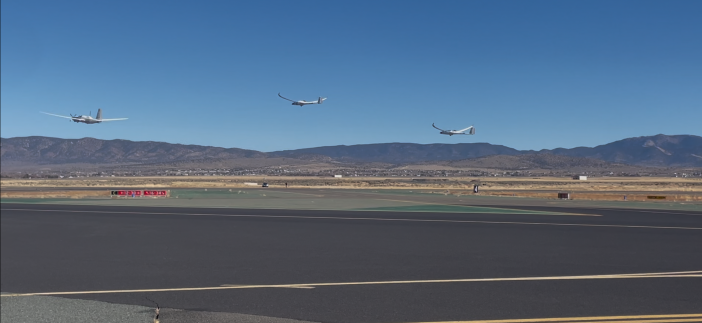
For the contrails test the Blue Condor and the Arcus Gliders were towed by the Egrett to altitudes above 9.000m, where contrails form (Image: DLR / CC BY-NC-ND 3.0)

Researchers have conducted the world’s first measurements of contrails from a hydrogen-powered turbojet engine during flight, providing new insights into their potential climate impact.

The project between Airbus, the Perlan team and the German Aerospace Center (DLR) has completed the first-ever in-flight measurements of contrails formed by hydrogen combustion. The three-week flight test campaign took place in December 2024 in Minden, Nevada.

DLR instruments collected data on ice crystal formation, trace gases and aerosols in the exhaust plume of a hydrogen-powered aircraft. The measurements will help researchers understand how hydrogen propulsion could reduce aviation’s climate impact beyond carbon dioxide emissions.

“These world-first measurements of condensation trails from a hydrogen-powered aircraft are a major milestone in our quest to gain a complete understanding of the climate compatibility of hydrogen propulsion in aviation,” said Markus Fischer, DLR’s divisional board member for aeronautics.

The Blue Condor mission used a modified Arcus glider equipped with a gaseous hydrogen tank and hydrogen-powered turbojet engine developed by AeroDesignWorks and Germany’s RWTH Aachen University. A second Arcus glider with a conventional kerosene engine provided comparison data.

Both gliders were towed simultaneously by a Grob Egrett high-altitude research aircraft to over 9,000m altitude where contrail formation was predicted. After release, the Blue Condor ignited its hydrogen engine while the DLR-equipped chase plane measured its emissions and contrail properties.

To ensure comparability of the emission data, the respective chase formations were carried out one after the other in quick succession, under the same meteorological conditions. The actual measurement phase lasted around five to ten minutes for each engine.

Four of the seven test flights successfully produced contrails from the hydrogen engine. The tests aimed to measure the microphysical properties of hydrogen combustion contrails under real atmospheric conditions.
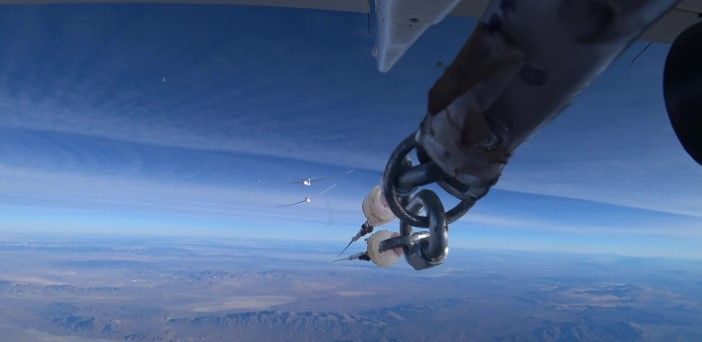
Image from the tail camera of the Egrett as it released the Blue Condor Arcus glider from its tow. The Blue Condor, with a hydrogen engine and an optically very thin contrail, is at the front
(Image: AV Experts LLC)

Contrails from hydrogen engines form differently than those from conventional ones. They develop at higher temperatures and lower altitudes due to increased water vapor emissions and theoretically contain fewer particulate emissions.

Model simulations suggest hydrogen combustion could produce fewer but larger ice crystals, potentially reducing contrail lifetime and warming effects. The comprehensive flight data will help validate these models.

The DLR instruments aboard the Egrett included ice crystal, aerosol and trace gas sensors to detect carbon dioxide, nitrogen oxides and water vapor. All equipment was modified for the unpressurized cabin and operated autonomously with data transmitted via satellite.

“We measured trace gases and aerosols from a long mast at the top of the aircraft, to avoid any interference from the propeller and the Egrett’s own exhaust gases,” said Tina Jurkat-Witschas, project lead at the Institute of Atmospheric Physics.

The data will enable global modeling of the climate impact from potential future fleets of hydrogen-powered aircraft. The Blue Condor project was recognized as a finalist for the National Aeronautic Association’s Collier Trophy.

Share. Twitter LinkedIn Facebook Email
Previous ArticleUK and Australia to partner on ‘plug-and-launch’ weapons technology
Next Article Giving green thrusters a boost
Ben Sampson

Ben has worked as a journalist and editor, covering technology, engineering and industry for the last 20 years. Initially writing about subjects from nuclear submarines to autonomous cars to future design and manufacturing technologies, he was editor of a leading UK-based engineering magazine before becoming editor of Aerospace Testing in 2017.

Related Posts

Defense

UK tests low-cost deep-strike missiles for Ukraine

22nd June 20263 Mins Read
Flight Testing

Dassault Falcon 10X completes maiden flight from Bordeaux

19th June 20262 Mins Read
Defense

US Airforce test center ramps up to meet urgent request

18th June 20267 Mins Read
Latest Posts

Lunar landings: How NASA’s testing infrastructure is adapting to Artemis

22nd June 2026

UK tests low-cost deep-strike missiles for Ukraine

22nd June 2026

Dassault Falcon 10X completes maiden flight from Bordeaux

19th June 2026
Supplier Spotlights
  • Precision Filters, Inc. (PFI)
  • Evolution Measurement
  • CALCULEX
  • Hottinger Brüel & Kjær
  • AVL List GmbH
  • Tekna
  • InnovMetric
  • CGM CIGIEMME S.p.A.
  • SET GmbH
  • Tyto Robotics
    Tyto Robotics Inc.
  • Bartington Instruments
    Bartington Instruments
  • Ametek
    AMETEK Programmable Power
  • Delta Information Systems logo
    Delta Information Systems
  • Helling GmbH
    Helling GmbH
  • Matec Instrument Companies, Inc.
    Matec Instrument Companies, Inc.
  • Endevco
  • Ipetronik
    IPETRONIK GmbH & Co. KG
  • VJ Technologies
  • Durr NDT
    DÜRR NDT GmbH & Co. KG
  • Dewesoft
  • Bruker Alicona Dimensional metrology & surface roughness measurement
    Bruker Alicona
  • Vzlu
    VZLU – Czech Aerospace Research Centre
  • ATG Advanced Technology Group
    ATG – Advanced Technology Group
  • Dytran Instruments, Inc.
  • Kistler Group
    Kistler Group
  • Diversified Technical Systems (DTS)
  • Scanivalve Corporation
  • G Systems
  • CEC Vibration Products LLC.
  • dSPACE
  • Safran Data Systems
  • Photron
  • YXLON International
  • Telspan Data
  • TotalTemp Technologies, Inc.
  • Vector Informatik GmbH
  • Vibration Research
  • TEST-FUCHS
  • Siemens Digital Industries Software
    Siemens Digital Industries Software
  • PCB Piezotronics, Inc.
  • Testia
  • Treo – Labor für Umweltsimulation GmbH
  • W5 Engineering
  • National Institute for Aviation Research
  • North Star Imaging
  • MK Test Systems Ltd.
  • Intertek
  • I.N.C.A.S. – NATIONAL INSTITUTE FOR AEROSPACE RESEARCH “ELIE CARAFOLI”
  • FMV Test & Evaluation
  • Glenn L Martin Wind Tunnel
  • GRAS Sound & Vibration
  • Elsys AG
  • EMCCons DR. RAŠEK GmbH & Co.KG
  • European Test Services (ETS) B.V.
  • Chemetall GmbH logo
    Chemetall GmbH
  • Curtiss-Wright
  • Data Physics Corporation
  • AOS Technologies AG
  • Airmo Inc. Pressure Technologies
    Airmo Inc.® Pressure Technologies
Our Social Channels
  • Twitter
  • YouTube
  • LinkedIn
Getting in Touch
  • Subscribe To Magazine
  • Contact Us
  • Meet the Team
  • Media Pack
Related Topics
  • Aircraft Interiors
  • Business Jet Interiors
FREE WEEKLY NEWS EMAIL!

Get the 'best of the week' from this website direct to your inbox every Wednesday

© Copyright 2026 Mark Allen Group. All rights are reserved, including those for text and data mining, AI training, and similar technologies.
  • Cookie Policy
  • Privacy Policy
  • Terms & Conditions

Type above and press Enter to search. Press Esc to cancel.