

“It’s a good time to be in the testing business,” says NASA’s Human Landing System acting program manager, Steve Creech. The space agency has a busy schedule based around its return to the Moon – the Artemis program. Spawned from a 2017 presidential space exploration directive and named by NASA in 2019, Artemis is an agency-wide endeavor that involves the test facilities across 10 space centers.
“The capabilities we’ve built up over the years in the agency are really being exploited to enable a lot of the development,” Creech says. “We did the Arc jet testing and wind tunnel testing and other tests at the Ames Research Center. The Jet Propulsion Laboratory has done component testing. The White Sands Test Facility handles a lot of the flammability testing for materials for Orion and HLS [Human Landing System].”
Creech also served as the Artemis development division’s assistant deputy associate administrator, and as the Moon to Mars program office assistant deputy associate administrator. NASA created the Moon to Mars program office because Artemis is viewed as a precursor project to sending people to Mars. But the primary goal of Artemis is to establish a Moon base at the lunar South Pole from 2030.
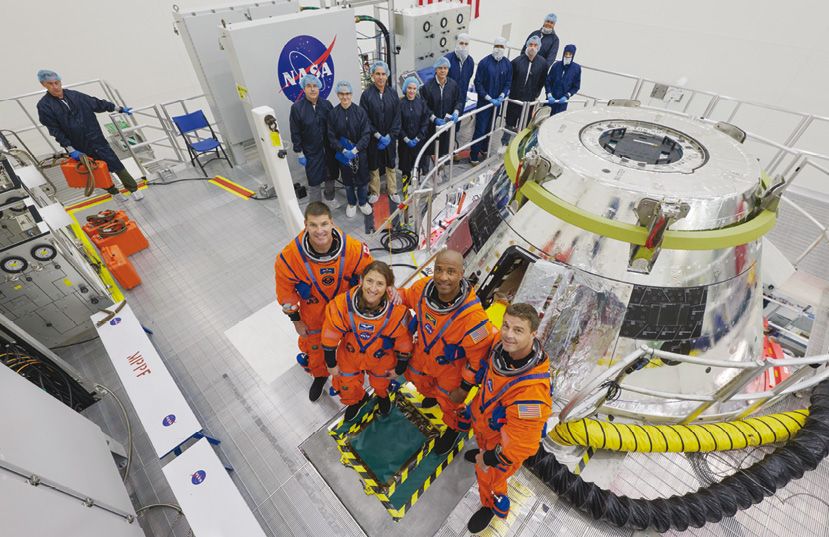
NASA is calling all the Artemis missions test flights. The first Artemis mission to the Moon was in late 2022. The 2022 Artemis I test flight saw an uncrewed Lockheed Martin Orion spacecraft, launched by the Boeing-built Space Launch System (SLS) from NASA Kennedy Space Center, fly around the Moon. In April this year, a crewed version, Artemis II, saw four astronauts sent around the Moon and back. The Orion spacecraft’s heat shield, also called the thermal protection system (TPS), became a key focus point for testing. “There has been TPS testing for the different rockets, the base heat shields, because of the different kinds of thermal protection. And you’ll see a lot more testing there,” says Creech.
“The re-entry system for Orion looked great coming back from Artemis II. They did a lot of testing at the Arc jet facility at Ames and other places across the country to demonstrate the re-entry conditions and profile we were planning to fly on Artemis II.”
Artemis I saw chunks of the base heat shield break off from the underside of the Orion crew module. The heat shield is supposed to see even erosion across its surface from the 3,000°F (1,650°C) it experiences on re-entry into Earth’s atmosphere. The uneven erosion of the Artemis I heat shield was a concern, so NASA tested the heat shield thoroughly and changed the spacecraft’s re-entry approach for Artemis II.
In photos released after the crew module’s splashdown in the Pacific Ocean, even erosion across the TPS was visible. According to Creech, the agency is now testing the heat shield again to certify it for the Artemis III and Artemis IV missions.
Artemis is rearranged
In February this year NASA Administrator Jared Isaacman reorganized the Artemis mission plan. The key change is that Artemis III is now an Earth orbit rendezvous and docking test mission, to demonstrate the HLS that SpaceX and Blue Origin are developing.
Previously, Artemis III was to be a lunar landing happening in 2028 or 2029. Artemis IV was to be another lunar landing in 2029 or later. Artemis IV has been brought forward to 2028. Artemis V, another lunar landing, will also occur in 2028. “We’re going to be busy in our test facilities over the next few years,” Creech says.
The mission architecture for Artemis launches Orion and the HLS separately. Once at the Moon, an orbital rendezvous docks the two vehicles. The crew transfer to the HLS and go to the surface, leaving Orion in orbit. For the return trip they launch from the Moon in the HLS, redock with Orion and use the spacecraft to return to Earth. Unlike the Apollo program’s expendable two-stage landers, the Artemis HLS is single-stage and reusable.
Before the two 2028 Artemis missions, SpaceX and Blue Origin have to fly uncrewed test missions of their HLS vehicles next year. These missions are key. They must demonstrate landings and launches from the lunar surface before Artemis IV and Artemis V take place.
Partners with benefits
A big difference with testing for Artemis compared to the Apollo program is that private companies are doing a lot of their own testing. “We’ve benefited from the investment from both companies and the kind of test capabilities they now have. They also leverage our facilities when it makes sense,” Creech says.
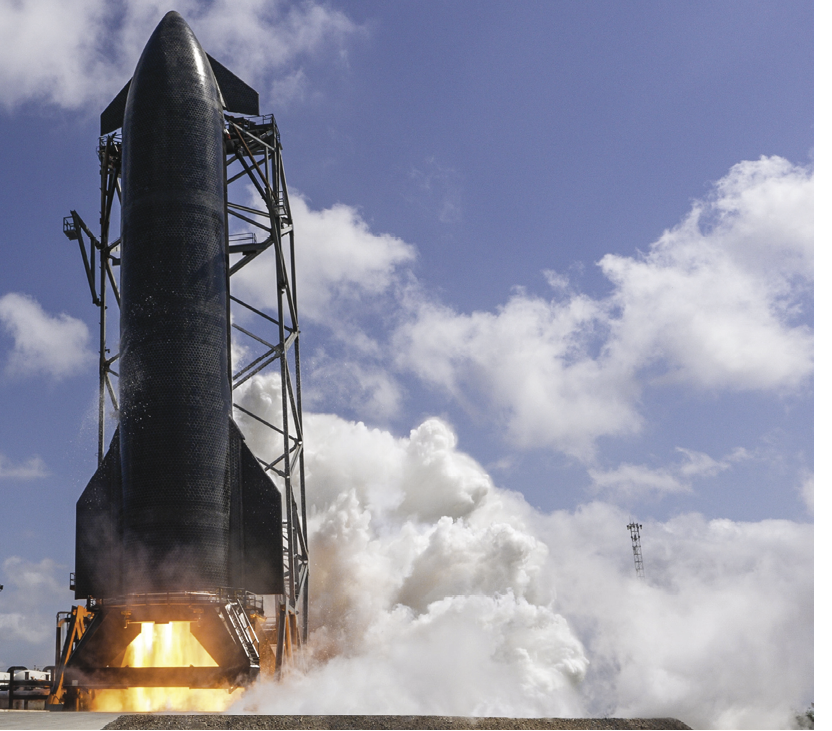
The SpaceX HLS is a version of the company’s Starship upper stage that is being repurposed to deliver cargo and people to Mars. “The infrastructure at SpaceX’s Starbase includes cryogenic testing capabilities, hot fire testing and other engine test facilities for the Raptor rocket engines. We did not have to pay for all of that or capitalize an investment for it,” Creech says.
He adds that NASA has also benefited from Blue Origin’s testing infrastructure, developed for the New Glenn launch vehicle. The firm’s test stands have been used for the development and qualification of the Blue Moon Mark 2 crew lander’s BE-7 engine, for example.
The Blue Moon cargo and crew landers will be launched by Blue Origin’s New Glenn rocket, which flew for the third time from Cape Canaveral, Florida on April 19. Although Blue Origin has engine test facilities, the New Glenn upper stage liquid oxygen and hydrogen BE-3U engine was fired on a test stand at NASA’s Marshall Space Flight Center in Huntsville, Alabama.
“We have made our test facilities available when they need them,” says Creech. “Before we started the HLS program for New Glenn, Blue Origin tested their BE-3U engine on a test stand here at Marshall.”
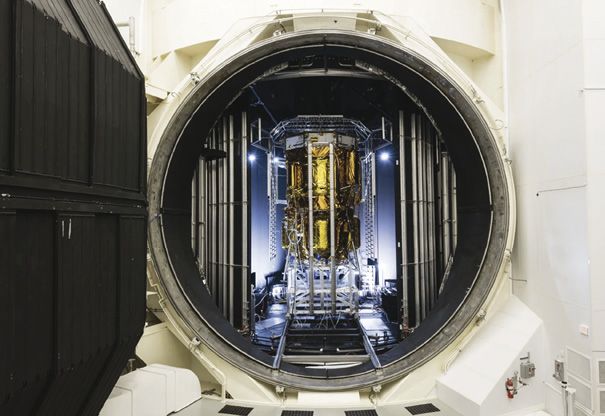
The Marshall center has facilities for propulsion and large structural testing. NASA Stennis Space Center in southern Mississippi is another of the space agency’s engine test facilities. By the beginning of May this year, the Blue Origin Blue Moon Mark 1 cargo-only lander, named Endurance, had completed testing inside NASA’s Johnson Space Center’s (JSC) Thermal Vacuum Chamber A.
The chamber recreates the vacuum and extreme temperature conditions of space that the spacecraft will experience. Endurance is to deliver scientific and technology payloads to the Moon this year under NASA’s Commercial Lunar Payloads Services (CLPS) program. It is through CLPS that Isaacman wants to deliver dozens of payloads to the lunar South Pole, as part of his three-phase architecture for establishing the Moon base. Despite Blue Origin’s own test facilities, some pre-flight testing still requires NASA infrastructure.
Creech welcomes Isaacman’s emphasis on more lunar launches but recognizes there could be test capacity challenges for NASA. “We benefit when there’s more flights, more learning and reliability. We leverage those. As we get into it further, maybe the booking of some of our vacuum chambers or flammability testing will drive some bottlenecks, but I’m not seeing big conflicts yet.”
The CLPS Blue Moon Mark 1 lunar landing will also be a test for the Mark 2 crew lander Creech explains: “There’s a lot of commonality. It has the same BE-7 engine as the Mark 2 and a lot of the component technologies are similar.”
Flammability
Initially, for the Artemis landings, until the base’s permanent habitation modules are delivered, or built on the lunar surface, the crewed landers will be home for the astronauts. They will need to stay in them for at least a week. The cabins of these landers will be outfitted with material that has been certified to be flame resistant.
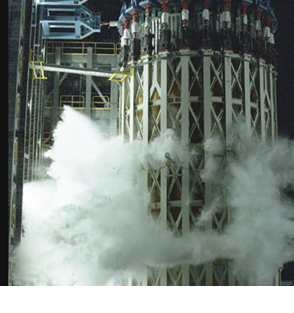
“The flammability testing we do at White Sands is to ensure the crew cabin material meets our flammability needs. Particularly for landing systems, there could be ignition sources and a flammability risk. So we are testing and mitigating for any potential short, for example, that could happen in the crew cabin,” explains Creech.
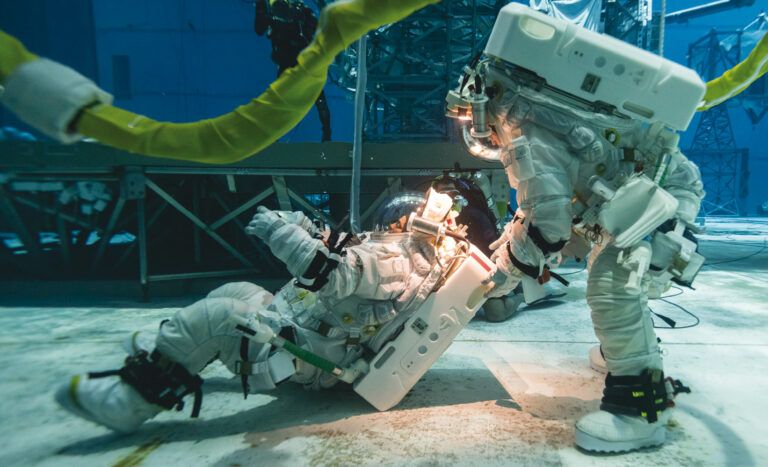
The spacesuits the astronauts will use on the surface are also being developed on a commercial basis. Human spaceflight specialist Axiom Space, which has flown private missions to the International Space Station, is developing the Axiom Extravehicular Mobility Unit (AxEMU) for NASA. In February engineers concluded a series of sand-pit-style lunar surface simulations and underwater tests with the AxEMU spacesuit, demonstrating its safety and mobility. The underwater testing made use of the JSC’s famous Neutral Buoyancy Laboratory – a huge swimming pool that has had mock-ups of the landers placed in it.
“At JSC they do a lot of crew interaction testing in the Neutral Buoyancy Lab. They have chambers for testing suits and pre-breathe protocols,” Creech says.
Like the HLS, Axiom has private test facilities. These are owned by engineering firm KBR. Late last year, the AxEMU was vacuum tested, without an occupant, in KBR’s Aerospace Environment Protection Laboratory (AEPL) thermal vacuum chamber in San Antonio, Texas.
Although spacesuits and landers are for the destination, the point of departure is also seeing changes that require more testing. The SLS has two solid rocket boosters (SRB) either side of the core first stage, known as the core stage. The SRBs and the core stage’s four L3Harris RS-25 engines lift the upper stage and the Orion spacecraft to space.
For Artemis I and II, the upper stage has been the Interim Cryogenic Propulsion Stage (ICPS) and was to be replaced by the Exploration Upper Stage (EUS). In February the upper stage was changed. “The ICPS was really a Delta IV Heavy rocket upper stage that United Launch Alliance built,” says Creech.
The United Launch Alliance (ULA) Delta IV is no longer operated. The plan now is to use the new Centaur V upper stage, from the ULA Vulcan. This has flown four times, the first time on August 1, 2024. “This version of the Centaur stage will fly several times before we fly it on SLS,” says Creech. The Centaur V has undergone structural testing “to verify it meets the loads of SLS,” he adds. “We tested it to higher load cases. That was a big test.”
The SLS core stage has previously been structurally tested to loads equivalent to the Block 1B which would have used the larger EUS. Creech says, “We also tested different components. We have to certify that it meets the environmental requirements. So we retested several things at the component level.”
For Creech, the impact of re-ordering the Artemis missions is the biggest test itself: “We are in the process of defining the new Artemis III mission right now, and what we saw is that we have a big jump from Artemis II to III,” he says.
“We also have the development of the landing mission that’s going to be in 2028. So from a tempo standpoint we are not only testing the hardware, but our people and the operations and expanding the test envelope, the flight tempo and the industrial team.”