

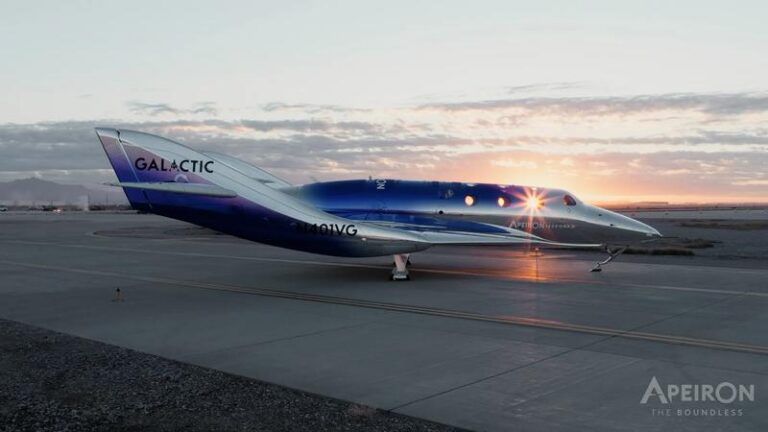
Virgin Galactic has flown Apeiron, the lead spaceplane in its Delta-class fleet, from its factory in Arizona to its operations base at Spaceport America in New Mexico ahead of flight tests.
The spaceplane, whose name is ancient Greek for “boundless”, was named and shown in its completed livery earlier the same day at the company’s Spaceship Factory in Mesa, Arizona, following a public vote in which people from more than 80 countries took part.
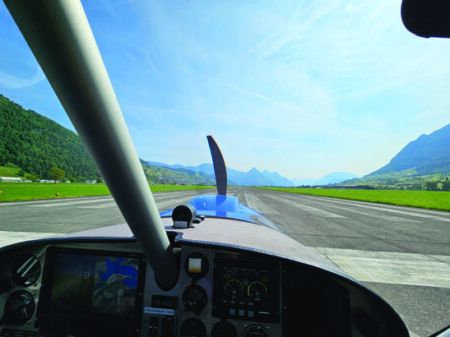
Apeiron flew mated to the company’s launch vehicle, Eve, departing Phoenix-Mesa Gateway Airport and landing about 90 minutes later. Pilot in command Michael Masucci and pilot Dan Alix flew Eve, with flight test engineer Tori Crichton on board.
At Spaceport America, engineers plan to complete avionics software integration and validation while conducting flight test preparations. Commercial spaceflights are expected to begin early in the second quarter of 2027 once flight testing is successfully completed.
Michael Colglazier, CEO of Virgin Galactic, said, “This morning, we gave Apeiron a name. This afternoon, Apeiron came home.
“Seeing the ship fly beneath Eve to Spaceport America was a moment years in the making.”
Each next-generation Delta-class is designed to fly twice per week with a lifetime of more than 500 missions. Assembly of the second spaceship and a static test article is underway.
Designed as a modular, mass-produced suborbital spaceplane to replace the legacy prototype VSS Unity, Virgin wants Apeiron to scale operations and increase flight frequency to 2 per week per vehicle.
The air-launched spaceplane carries two pilots and up to six passengers. It uses a hybrid rocket motor propulsion system to hit top speeds of Mach 3+ (>2,300 mph / 3,700 km/h) and an altitude of up to 300,000ft.
Like the Unity prototype, Apeiron features a feathered tail-boom which rotates upward to stabilize and provide aerodynamic drag braking during re-entry.