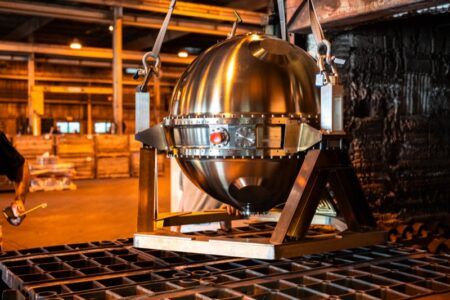



In his 1865 novel, De la Terre à la Lune, Jules Verne imagined a giant gun designed to launch humans to the moon. A century and a half later, a California startup, Longshot Space, is adapting its own space guns to serve as hypersonic launchers – and is aiming to provide high-frequency hypersonic testing-as-a-service.
Longshot was founded during the 2020 Covid pandemic by Mike Grace, a former molecular biologist at NASA’s Ames Research Center. He had read about a large cannon called the V-3, developed by Germany during World War II, which used multiple blank-round charges to accelerate long-range projectiles to high supersonic speeds. Grace wanted to see if he could make a giant potato cannon using the basic V-3 design.
With help from friend and Longshot co-founder Nathan Saichek, a manufacturing engineer with rocket maker Astra, he successfully built the launcher in his garage in San Jose. It used 6in-diameter PVC pipe and multiple gas injection. According to Longshot’s vice president of defense, Mark Bigham, it fired a projectile at over Mach 1.
The success led Grace and Saichek to establish Longshot Space. Bigham says they started with answering the question: “‘What is the absolute cheapest and fastest way we can put stuff into space?’ They thought that if they basically built a giant potato gun that was totally reusable, they could reduce space launch cost and increase launch cadence.”
Under pressure
Grace and Saichek had essentially built a distributed injection ballistic launcher. In the late 1980s, a trio of researchers led by Harold Gilreath, a propulsion engineer at Johns Hopkins University’s Applied Physics Laboratory, authored a paper on affordable access to space and long-range artillery, describing the potential and challenges of distributed injection ballistic launchers.
Distributed gas injection was developed to increase the speed at which a projectile can be fired. Standard guns and artillery employ a detonated gas mixture to push a projectile down a barrel from behind. But there’s a speed limit, often described as two-times the speed of sound of the working fluid (gas) in a vacuum. Going faster – up to and beyond hypersonic speeds, generally Mach 5-plus – requires a different approach.
In simple terms, distributed gas injection sees a pressurized gas injected behind a projectile at successive points along the launch tube in which a near vacuum has been created, accelerating the projectile with each injection. Vacuum is typically maintained by a membrane-like burst-disc at the muzzle end of the launcher. The projectile pierces the disc on its way out to free-flight.
Very high projectile speeds can be achieved with distributed gas injection. Researchers like Gilreath realized these could be increased even further by shaping the rear of a projectile like a boat tail. The shape effectively makes a projectile moving down a launcher at Mach 5 appear as if it is receding at Mach 1, allowing progressive injection to impart further thrust, pushing it to hypersonic velocities theoretically up to Mach 38.
Hypersonic speed allows a projectile to reach atmospheric escape velocity when vertically launched, or it can allow projectiles to fly free in horizontal or parabolic flight – very useful if you are trying to get to orbit or do hypersonic vehicle or weapons testing. Longshot Space is marketing its distributed injection launchers, also known as accelerators or space guns, as capable of doing both.
From launch to hypersonic test
Longshot’s long-term goal is to provide affordable, even daily, space launch services. The company’s founders see their ballistic approach to getting satellites and other payloads to orbit as comparatively simple.
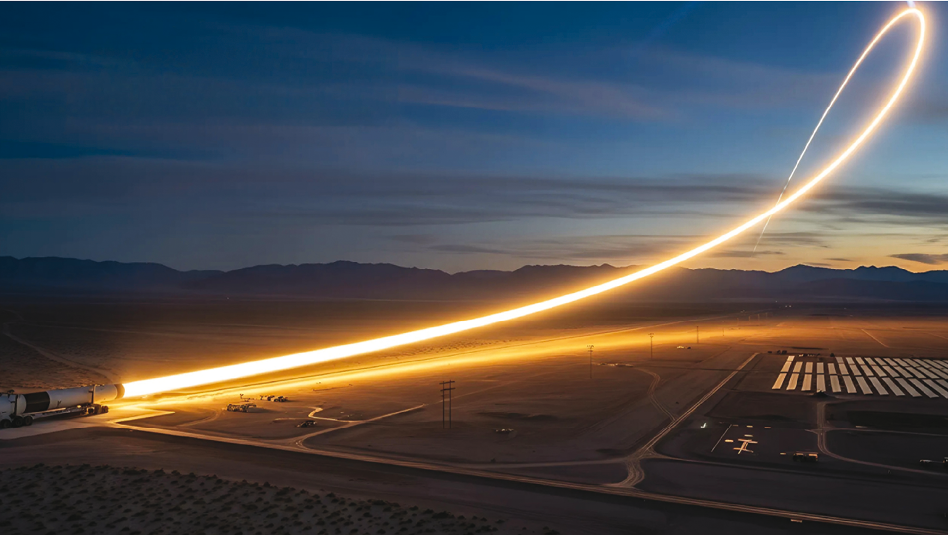
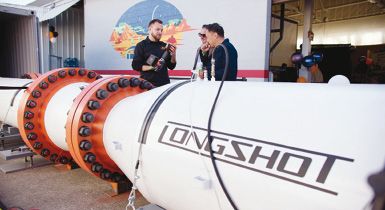
Longshot currently has two launchers: a 6in (15cm) diameter, 75ft (23m) long accelerator currently being installed at Space Gun Ranch in Barstow, California and a 29in (73.5cm) diameter, 1,600-2,000ft (488-610m) long launcher called Big Iron which is under construction. Bigham says Big Iron will be able to accelerate a 220lb (100kg) payload to Mach 5 or 44lb (20kg) to Mach 7. Projectiles ride on a rail-mounted platform within these launchers, propelled by multiple side-injected shots of high-pressure hydrogen.
Space-bound payloads will be launched within an aeroshell that looks somewhat like a hypersonic lifting body. They’ll coast up to about 300,000ft, where the payload will be ejected out the back of the aeroshell. The payload will then be boosted by a solid rocket kick-motor to low Earth orbit (LEO). Meanwhile, the shell deploys parachutes and is recovered for reuse.
Although the pair of launchers is not yet at space-launch scale, their successors – Longshot is ultimately planning a 78in (2m) diameter, 3 mile (4.8km)-long launcher lying horizontal on the ground – will offer a cheaper long-term route to space, the company contends. Once built, they consume only electrical power, high-pressure hydrogen gas, burst-discs and few other items.
The company firmly believes that space launch is in the future. “As we were building our tech tree out to get to orbit, we realized that there’s a need and demand for affordable high-cadence hypersonic testing,” Bigham says.
Aerospace Testing International has previously detailed high global demand for hypersonic test infrastructure and the kinds of assets, from wind tunnels to ballistic ranges, needed to meet it. Longshot’s launchers could be a for-profit part of the solution.
Before the space-launch activities start, Longshot plans to use its guns to offer a cheaper free-flight alternative to air or rocket-launched hypersonic payload testing. Test projectiles will be fired into short, low-altitude (500-1,000ft) hypersonic free-flight for a few hundred meters before impacting a catch-box. The company expects to formally initiate its service with Big Iron during Spring 2027.
Eventually, Longshot plans to launch high-altitude hypersonic test payloads into Federal Aviation Administration (FAA) -designated corridors (around 150,000ft) from White Sands Missile Range in the USA and from other global locations. The company is confident it will be able to offer fixed-price launch for around US$150,000 per shot, according to Bigham.
That price is “in the ballpark” with pricing at government- and university-owned ballistic ranges, Nathan Tichenor says. Tichenor is the director of one of the USA’s most advanced ballistic test ranges, Texas A&M University System’s newly opened Ballistic, Aero-Optics and Materials Range (BAM) in Bryan, Texas.
A cheap bus ride
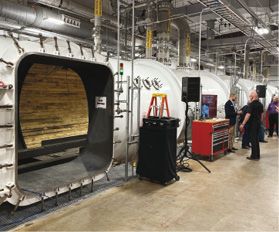
BAM is a fully enclosed ballistic range that uses a 37-megajoule two-stage light gas gun that allows for shooting 4in (10cm) projectiles at 11,500fps (3,500m/s) – Mach 10. Its 843ft (257m) hypersonic guided-flight length allows for hypersonic testing in a chamber that can simulate free-flight weather effects.
Tichenor refers to BAM’s capability as “effectively a flight test on the ground” and emphasizes that ballistic ranges complement static wind tunnels. He agrees that there is a likely market for Longshot’s hypersonic test-as-a-service as a kind of “low-cost bus ride.”
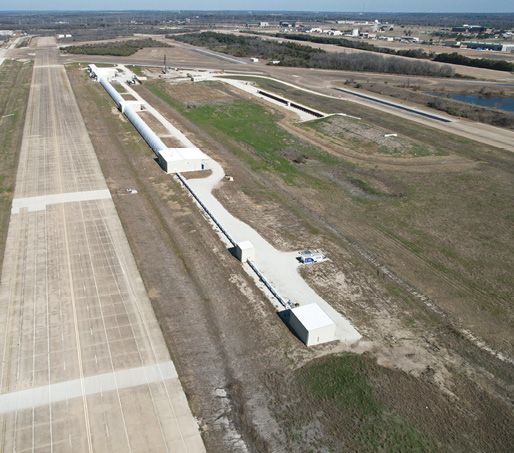
Longshot’s effort and that of another California startup, Auriga Space, which is pursuing electromagnetic launch, are potentially cheaper methods of repeatedly accelerating larger and heavier mass at lower g -loading than existing ballistic ranges. BAM, for example, can accelerate payloads at up to 100,000 g .
Such fierce acceleration and high speed make it difficult to place survivable sensors onboard hypersonic projectiles. Accordingly, BAM uses sophisticated external sensors placed on and within its tunnel, including high-speed digital cameras, infrared thermometry, color pyrometry and flash x-ray systems to measure variables from projectile surface temperatures to flow characteristics. As a result, BAM gets “great data” off Mach 10 projectiles, Tichenor says.
Longshot claims accelerative loads in the region of 500 g with its guns, similar to the amount of force imparted to a cell phone when dropped, according to Bigham. This could lower the hurdle for placing sensors onboard the free-flight projectiles the firm expects to launch.
However, recording data from free-flying hypersonic projectiles is still difficult. Notably, Longshot emphasizes that it largely plans to use external sensors during and post-launch.
“We encourage our customers to place sensors inside of the systems they want to test,” Bigham says.
Reliable, quality test information matters, Tichenor affirms: “Nobody cares about what you can do, they only care about what data you can get them.”
Data capture is just one of the challenges Longshot will face. The company’s business proposition hinges on launch frequency to overcome the high initial cost of building its accelerators. Tichenor observes that although the company’s ballistic launchers offer lower acceleration, they do so over a much longer distance for large payloads.
“This turns into a very large capital-intensive project. They’re expensive to build but there’s a potential crossover in economics depending on high-cadence use,” Tichenor says.
Although Longshot launch sites won’t require the buildings, gantry structures and launch pads of rocket facilities, they will require even greater real estate to accommodate guns more than a mile long that make thunderous noise when fired. Bigham compares building a Longshot facility to the investment in building a train track – expensive initially but “after that, every load that you send down it is very cheap”.
The company is assessing sites like old military airfields with abandoned runways in the USA, Canada and Australia. Once built, each will have to pay for itself with many launches, demonstrating that hypersonic testing-as-a-service can turn a profit as well as lower the cost of test and ultimately space launch.
If institutional confidence is any guide, Longshot has a reasonable chance. It has been awarded a spot on the Arnold Engineering Development Complex (AEDC) Velocity Alliance, a new US Air Force consortium dedicated to modernizing the USA’s test infrastructure, including hypersonics. The firm has also been invited to join the Defense Advanced Research Projects Agency’s (DARPA) ERIS (Expedited Research Innovation System) marketplace, signifying DARPA vetting of the project.
“We have a motto that we want to ‘test fast and learn fast’,” Bigham enthuses.