

GE Aerospace has signed a memorandum of understanding with the Military University of Technology in Warsaw (Wojskowa Akademia Techniczna or WAT) to expand F110 engine training capabilities and establish an additive manufacturing laboratory.
The agreement explores opportunities for engine training programs focused on the F110-GE-129 engine that powers the F-15EX fighter jet. GE Aerospace will provide course materials and collaborate on training curriculum development as Poland evaluates next-generation fighter aircraft options.
“As Poland determines its next-generation fighter jets and their engines, GE Aerospace wants to be ready to help train the technicians and military personnel on our F110 engines that power the F-15EX fighter jet,” said Scott Keating, regional vice president and general manager sales, business development Europe at GE Aerospace. “This agreement with WAT will ensure our training readiness as well as enable WAT to benefit from GE Aerospace’s domain experience with additive manufacturing as they work to grow these capabilities in Poland.”
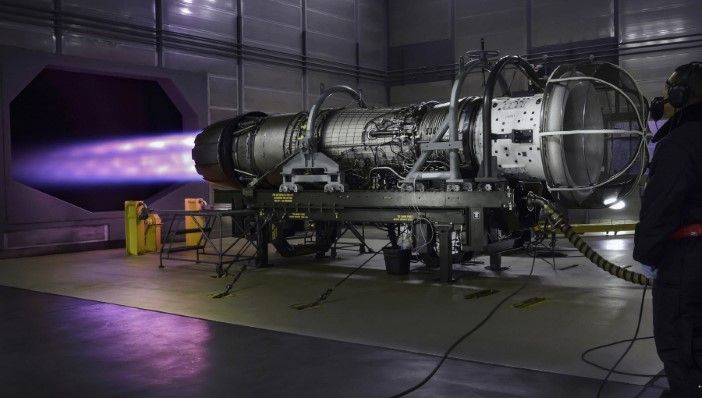
The F110-GE-129 engine delivers 29,500 pounds (13,381kg) of thrust and serves as the integrated powerplant for the F-15EX Eagle II. The engine currently operates with the US Air Force’s F-15EX fleet and represents four decades of continuous production development.
WAT and GE Aerospace already collaborate on the AH-64E Apache offset program. The new agreement aims to expand this partnership through engine maintenance training programs and advanced manufacturing capabilities.
“We aim to build on our existing experience in collaborating with the national defense industry, supporting the development of local capabilities in the production of selected components, maintenance, and overhaul of this engine that powers the F-15EX fighter jet,” said WAT Rector-Commandant Brig. Gen. Prof. Dr. Eng. Przemysław Wachulak.
The training school will focus on maintenance procedures for the F110-GE-129E engine. According to GE Aerospace, 90 percent of engine maintenance can be performed on wing or at on-site facilities, reducing aircraft downtime.
The F110 engine powers F-15 and F-16 aircraft for US military and 16 allied nations, accumulating more than 11 million flight hours. The engine family has undergone continuous improvement with more than 90 percent of components upgraded to enhance performance and reduce lifecycle costs.
GE Aerospace and WAT will also develop an Aircraft Engines Additive Manufacturing Laboratory focusing on equipment and training capabilities. GE Aerospace has been involved in additive manufacturing research since the 1980s and acquired Morris Technologies in 2012. The company’s Colibrium Additive division provides industrial-scale metal additive manufacturing systems, powders, and services.