

New Zealand is renowned for its stunning scenery, adventure tourism and The Lord of the Rings movies, but increasingly it is becoming known as an ideal location for aerospace testing thanks to its favorable geographical and regulatory environment.
The New Zealand (NZ) government isn’t shy about its aerospace ambitions, aiming to double the size of the country’s space and advanced aviation sectors by 2030 through fostering areas such as unmanned aircraft, alternative fuels, infrastructure as well as uncrewed traffic management.
Since 2019, the country’s space sector has grown by 53%, contributing nearly NZ$2.5 billion (US$1.5 billion) to the economy in 2023/2024, while the advanced aviation sector contributed close to NZ$500 million (US$300 million), according to Deloitte research commissioned by the government. Advanced aviation can help lift productivity, create high-value jobs, attract investment and support exports, the government believes.
The New Zealand Space and Advanced Aviation Strategy 2024–2030 and Going for Growth strategy aim to support innovation and commercialization, including enabling rapid iteration and testing of vehicles and technology.
The government has also established the Tāwhaki National Aerospace Centre, in Kaitorete, near Christchurch, and special use airspace (SUA) to enable testing and evaluation of advanced aerospace technologies.
“Companies can access a credible testing environment, strong public sector engagement and opportunities to apply technology to the real world. This support is about helping businesses move from research and testing into commercial deployment and export markets,” says the Ministry of Transport (MoT) spokesperson.
Regulatory enablers
New Zealand’s advantages for aerospace testing include a varied geography and weather, established aviation expertise and an international reputation for pragmatic, risk-based regulation.
Recent regulatory changes make it easier for innovators to test new technologies safely. In late December 2025, a risk-based refresh of Civil Aviation Rules (CAR) came into effect, updating Parts 101 and 102 covering drones, unmanned aerial systems (UAS) and small rockets. A new Part 107 allows approved research organizations to rapidly develop and test emerging aviation technologies within pre-defined areas.
“Its primary benefit is to reduce regulatory burden for those activities by no longer requiring regulatory approval every time an iteration is made,” explains Stuart Worden, manager of regulatory policy and international engagement at the Civil Aviation Authority (CAA) of New Zealand.
Feedback to Part 107 has been very positive, he says. “Stakeholders have expressed interest in the potential benefits of using it for iterative research and development activities,” he adds.
Jason Ashworth, head of the CAA’s Emerging Technologies Programme (ETP), says, “Compared with many countries, NZ has lower levels of airspace congestion, making it easier to accommodate innovative aviation activities.
“Our Part 107 performance-based regulatory framework supports safe innovation by allowing operators to demonstrate how they can achieve safety outcomes, rather than prescribing a single way of operating. This flexibility makes New Zealand an attractive destination for aviation R&D and testing,” Ashworth adds.
Essential services
Firms already in the country agree. For USA-based Merlin, New Zealand was an obvious choice to develop its autonomous flight technology. “New Zealand offers the most challenging real-world conditions,” explains Grant Crenfeldt, CEO of Merlin NZ. “Its maritime domain is roughly the same size as the continental USA, it has some of the most isolated communities in the world, diverse terrain and rapidly changing weather.
“Aviation there is essential infrastructure connecting people, businesses and communities. That operational reality is exactly the kind of environment we need to prove our technology,” Crenfeldt explains. “The CAA has engaged seriously with us and held us to a high standard. Working with the CAA also puts us on a concurrent validation pathway with the US FAA.”
Merlin established a flight test and development center in Kerikeri in the north of the country in 2022. The facility is central to certification and commercial development activities and employs 19 staff.
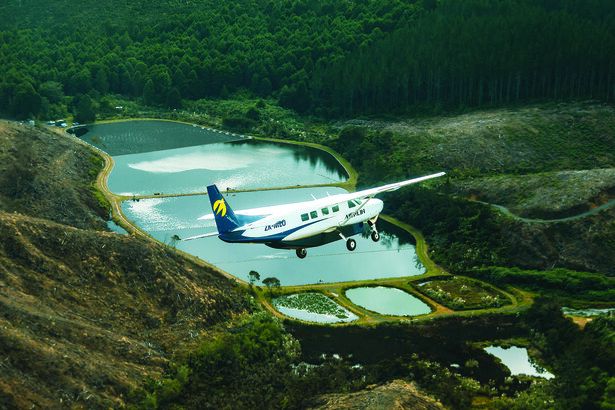
The Merlin Pilot autonomy system is installed on Cessna Caravans and has logged hundreds of test flights from Kerikeri. “We’ve passed meaningful markers on the certification path and are approaching its final phases. Flight testing is a core and active part of what we’re doing in New Zealand,” says Crenfeldt.
“We see our New Zealand operation as proof of a core thesis – that autonomy built from first principles, shaped by certification requirements from day one, and validated in genuine, operational environments can produce a system that regulators can certify, operators can deploy and communities can rely on.”
The country’s “deep aviation culture” means aviation is treated as genuine infrastructure, shaping how regulators, operators and communities think about innovation, believes Crenfeldt.
Merlin has also run real freight operations alongside its test program, allowing it to build autonomy in the context of genuine commercial activity. By 2027 the company hopes to have run the first commercial, autonomous, revenue flight of a traditionally crewed fixed-wing aircraft, flying real routes under full regulatory oversight.
“We’re in the final phases of our certification pathway with the CAA and running a concurrent validation process with the US FAA,” he says.
Out of sight
Merlin isn’t the first autonomous aerospace pioneer to test in New Zealand. Wisk Aero has been in Wellington and Canterbury since 2017, flight testing its autonomous eVTOL aircraft.
Wisk was the first industry participant in the NZ government’s four-year Airspace Integration Trial Programme (AITP), which was launched in 2019. In December 2023, the AITP culminated in successful test flights operating uncrewed aircraft flying beyond visual line of sight (BVLOS) in controlled airspace. Instead of its Cora prototype, an Insitu Pacific fixed-wing remotely piloted aircraft was flown from Tāwhaki, in uncontrolled and controlled airspace using Airways New Zealand’s AirShare UTM (uncrewed traffic management) system.
“The partnership established a safe process for uncrewed aircraft to access controlled airspace and created a significant new understanding and capability for commercial autonomous flight operations,” says Wisk.
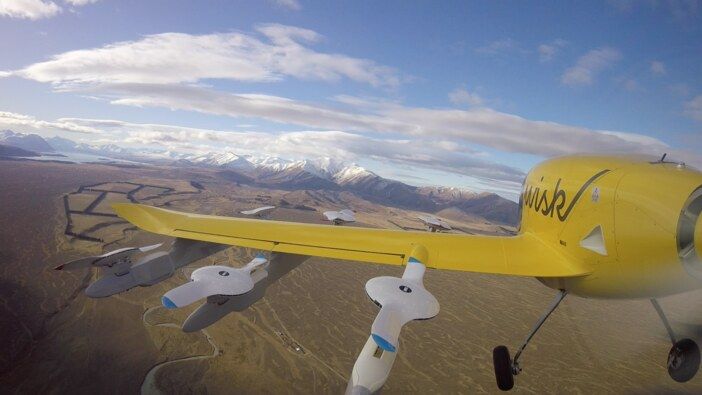
Learnings from AITP have fed into NZ’s advanced aviation regulatory reforms, says the MoT spokesperson. In particular, the AITP contributed to development of Part 107, as well as Part 71, which created special use airspace for advanced aviation activities.
Wisk switched its flight testing to California in 2024, although New Zealand employees remain working on other areas of the aircraft’s development. Wisk also has a presence across the Tasman in Australia, with southeast Queensland being a priority for the establishment of a network after the USA, around the time of the Brisbane Olympic Games in 2032.
Its work there focuses on market development and airspace integration with Airservices Australia. Dan Parsons, Wisk’s Brisbane-based manager of APAC market development, says aircraft integration testing in Queensland with a surrogate aircraft, similar to the AITP, followed by airspace integration validation with a Wisk Gen 6 aircraft is possible in the future. “It would be a great opportunity for us to fully validate the aircraft integration,” he says.
Tāwhaki testing
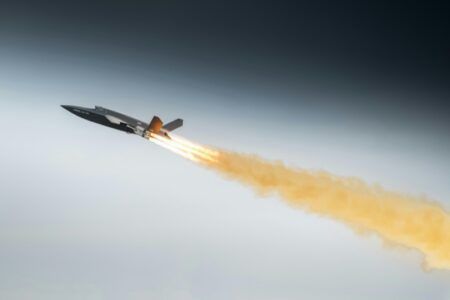
Dawn Aerospace is testing its reusable space launch vehicles that can take off and land from a conventional runway without the need for specialized space launch infrastructure ( see ATI June 2026 ).
Dawn is developing Aurora, an uncrewed rocket-powered aircraft designed to provide routine, affordable access to suborbital space. The company was established in 2017 by four people, two of whom have an NZ background. The speed of business and test flight capabilities in the country make it ideal for Aurora testing, they believe.
“It’s the best place in the world to build a spaceplane and do test flights. Europe and the US both have too much air traffic for this kind of novel technology development,” says Annelies Powell, brand and spaceplane marketing lead. “NZ is one of the very few places in the world where a company can design, build, test, certify and operate a rocket-powered aircraft from a conventional runway. That combination of airspace access, regulatory agility, technical talent and geography is rare,” explains Powell.
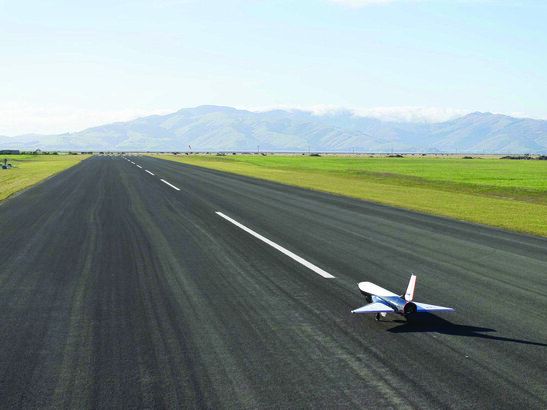
Last year, the company received approval from the CAA for rocket-powered flight testing and commercial operation of the Mk-II Aurora spaceplane at Tāwhaki. On the east coast of South Island, Tāwhaki National Aerospace Centre offers a vast, unpopulated landscape with clear skies, a 3,280ft (1km) sealed runway, taxiway, vertiport, hangar facilities, grass airstrips and drone areas. A permanent SUA was established at Tāwhaki in August 2025, extending 110 nautical miles (204km) offshore.
The company has achieved supersonic flight from a civil runway just 656ft (200m) from publicly accessible space. “The CAA and NZ Space Agency can approve licensing and provide agile regulatory environments,” says Powell. “Many companies in the USA spend US$100 million plus before they see as much flight time and get the approvals from regulatory bodies that Dawn has.”
Kea Aerospace is also using Tāwhaki as a test base for its high-altitude, solar-powered aircraft and has performed more than 20 flights. In May, its Kea Atmos Mk1b, with a 41ft (12.5m) wingspan and weighing less than 88lb (40kg), successfully captured high-resolution imagery of the Earth’s surface from 42,000ft (12,800m) in a test flight, showcasing the Atmos’ ability to deliver detailed imaging from the edge of the stratosphere.
Kea is designing a larger Atmos Mk2, with a 98ft (30m) wingspan, for multi-month endurance missions.
“The diversity of aircraft being tested at Tāwhaki means we need flexibility, but we also need a safe and robustly managed system that allows for rapid iteration and testing of advanced aviation and aerospace technologies,” says Stan Topping, Tāwhaki’s head of aerospace. “This approach enables operators to more efficiently prepare for testing and launching,” he adds.
Hydrogen and electric testing
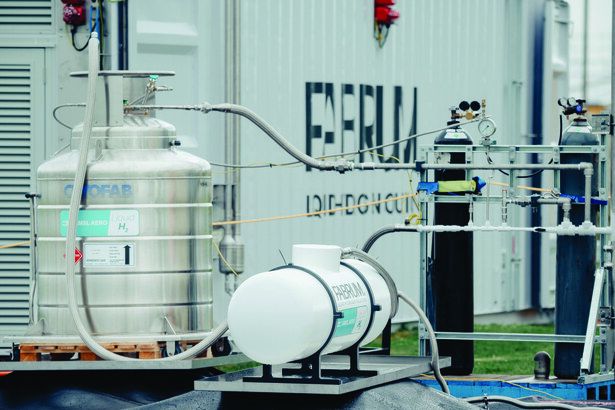
Australian companies are also testing in New Zealand. Hydrogen-electric aircraft developers AMSL Aero and Stralis Aircraft have partnered with Christchurch-based cryogenic technology specialist Fabrum.
Last year, Fabrum established a hydrogen testing facility at Christchurch Airport in New Zealand. In late 2025, working with AMSL Aero and Stralis, the company successfully filled fuel tanks at the facility with liquid hydrogen, which was produced on-site – the first time this had been done at an international airport.
Stralis has also been testing its high-temperature proton-exchange membrane fuel cell technology at Air New Zealand’s engine test facility in Auckland, to understand degradation and determine its potential lifespan. Meanwhile, Air New Zealand recently completed four-months of demonstration flights with BETA Technologies’ ALIA CX300 battery-electric aircraft. The aircraft conducted more than 100 flights, over 8,000 miles (13,000km), and visited 12 airports/aerodromes in the North and South Islands of New Zealand during a variety of conditions.
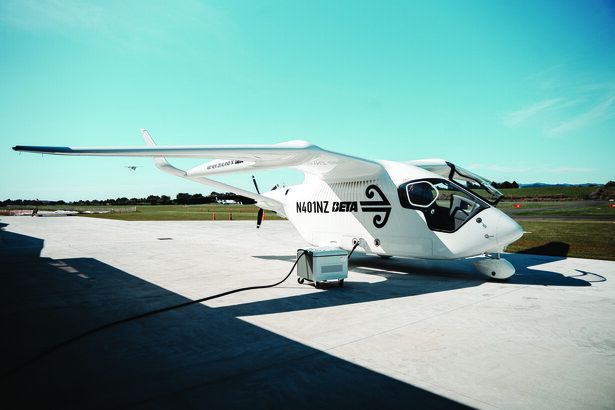
The program provided insight into how electric aircraft integrate with airspace, airports and airline workflows. Simon Newitt, BETA’s head of sales and support, says, “New Zealand’s geography and regional connectivity needs make it a powerful proving ground.”
Catherine MacGowan, the CAA’s deputy chief executive of aviation safety oversight, says it worked closely with BETA, Air New Zealand and the FAA to ensure that the aircraft was able to operate safely, an approach it plans to maintain going forward.
“We were able to test approvals of battery-electric aircraft operating from commercial airports, maintenance and operations, and integration into our airspace,” says MacGowan. “The CAA NZ team is small, but we are focused on good regulatory capability and have a long history of working with aerospace innovators, designers and manufacturers.”
New Zealand is likely to host more aerospace companies in the future, with Part 107 generating interest from several aerospace companies, according to the CAA’s Ashworth. He says Part 107 is “prompting discussions with organizations that are keen to understand how the rule could support their research and development programs. We are engaging with potential applicants to help them understand the purpose of the rule and the application process.”