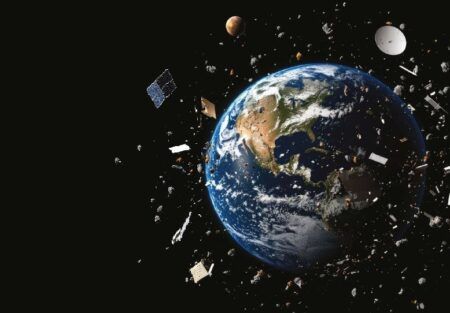


Wherever humanity goes, we trash the environment. Space is no exception. Earth today is encircled by a hazardous nimbus of junk sent into orbit since the 1950s – failed satellites, whole or smashed into shards by collisions. Traveling at 17,500mph (28,200km/h) in low Earth orbit (LEO), even untrackable fragments obliterate whatever they hit. Debris avoidance adds risk, complexity and cost to LEO space missions.
In 2026, the European Space Agency (ESA) reported 54,000 artificial space objects over 4in (10cm), 1.2 million 0.4-3.9in (1-10cm) splinters and 140 million 0.04-0.4in (1-10mm) specks of debris. “10,000 orbiting tonnes of junk include millions of 1cm-category fragments traveling at 10 times the speed of a bullet,” says Jason Forshaw, head of business development and product strategy at on-orbit servicing company Astroscale.
“Since the Cold War, we have launched thousands of satellites with no plan of how to remove them,” Forshaw continues. “Some naturally fall and burn up, but objects in higher orbits could persist for hundreds or thousands of years. We’re in the business of sending up servicers to capture larger objects before they hit other debris and turn into smaller, deadlier fragments.”
Market impact
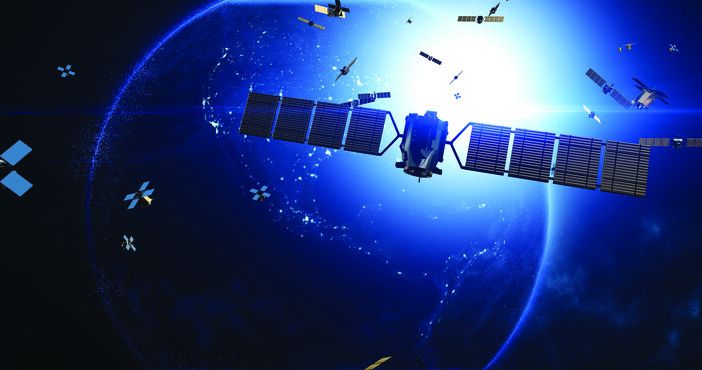
Aerospace and defense firm Redwire sees increasing demand for satellite servicing and debris removal in near-term markets.
“We have thousands of satellites in space and send up thousands more each year,” says a senior executive from Redwire Luxembourg. “This can’t continue forever. Leaving debris in space reduces the lifetime of other satellites, which expend fuel maneuvering to avoid it.”
Either we must remove debris or extend satellite lifespans to avoid creating it. Emerging technology may create an in-orbit economy of debris removal and satellite refurbishment services. These all aim to make space sustainable and involve spacecraft rendezvous and proximity operations (RPO) hard to emulate in Earthbound tests.
Service status
Leaders in satellite servicing include Northrop Grumman, whose Mission Extension Vehicle (MEV-1) successfully docked with Intelsat’s IS-901 satellite in the graveyard orbit just outside the geosynchronous orbit belt in 2020. MEV-1 performed servicing that extended IS-901’s life by five years and a successor, MEV-2, is now providing life-extension services in space.
Waiting in position to catch debris is futile, since no material exists to make nets capable of withstanding 17,500mph impacts. “What you must do is chase it,” the Redwire executive explains. “You must get close, slow down and emulate its potentially tumbling movement. When the difference in relative positions is close to zero, you grab it with a robotic arm.”
Dead satellites may present uncooperative targets, sometimes broken into irregular shapes. “You need vision and perception systems to determine what is seen and how to grab it. All this must be done using the minimum mass, power consumption and computational capacity,” he says.
It sounds unfeasibly difficult, but Astroscale has demonstrated elements of just such an operation. A 2024 Japan Aerospace Exploration Agency (JAXA) mission saw Astroscale’s ADRAS-J spacecraft conduct close-proximity inspection of a spent H-2A rocket casing, its final approach coming within 49ft (15m) of this bus-sized target orbiting at 4.7 miles per second (7.6km/s).
“ADRAS-J has propulsion, sensors, onboard processors and communications to the ground,” says Forshaw. “It didn’t have a capture system because it just did inspection but would use magnetic capture or a robotic arm. The follow-on mission will use a robotic arm to capture and bring down that rocket body to burn up in the atmosphere.”
Sensors and sight
ADRAS-J navigated toward the rocket casing’s location using GNSS, before picking it out as a single pixel with long-range cameras. As it edged closer, infrared sensors and lidars locked onto the target. Processors phased together data from multiple sensors to construct an optimal 3D image, enabling ADRAS-J to commence its parabolic approach.
“We use a walking safety ellipse, approaching in a spiral to avoid inadvertently colliding with the rocket body,” Forshaw explains. ADRAS-J made fly-around and fixed-point observations at 30-second intervals, characterizing the rocket body’s tumbling rotations and inspecting for damage which might complicate its capture, before executing a complex final approach sequence.
ADRAS-J underwent extensive preflight testing (see box, below). But the flight dynamics of RPO in microgravity cannot be fully recreated on Earth, where gravity permits no loosening of its shackles. “In space, the vision system must also operate in lighting conditions that vary between complete blackout and whiteout,” Forshaw adds.
Refueling missions
Orbit Fab’s RAFTI (Rapidly Attachable Fluid Transfer Interface) is the first space-qualified commercial interface for orbital refueling. An earlier iteration has flown in space, and customers are integrating RAFTI into mission-ready spacecraft. But Orbit Fab isn’t interested in simply becoming a valve manufacturer; rather, it wants RAFTI to proliferate and become a de facto standard enabling its ultimate vision of operating gas stations in space.
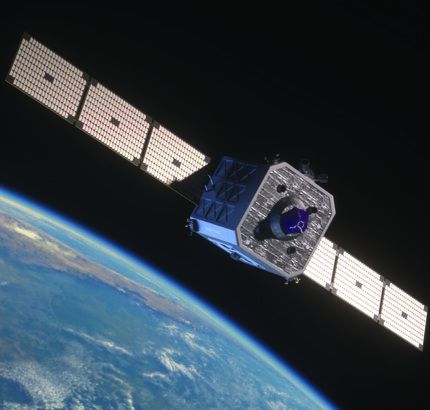
“Space permanence – serious exploration where we stay there and expand our civilization into space – will require logistical chains,” says Sebastian Hill, head of engineering at Orbit Fab UK. “Often, geostationary satellites worth £200 million could keep going but for lack of fuel. In-space refueling is a key stepping stone to next-generation space architectures with a business case today in terms of asset value versus service cost.”
Orbital gas stations could also enable satellite services like swapping out electronics, batteries or processors outmoded by newer, better components on Earth. Orbit Fab envisages a system of depots and shuttles supplying fuel to RAFTI-equipped spacecraft.
“Depots are single-use tanks designed to get the right propellants to the right orbits,” explains Hill. “Our reusable shuttles are equipped with the single-axis robotic mechanisms used to open RAFTI, and a guidance-navigation-control stack for docking with depots and customer spacecraft.”
Although routine robotic RPO has scarcely been done beyond the International Space Station, refueling presents fewer theoretical challenges than stalking uncooperative junk.
“Fundamentally, we’re dealing with prepared and cooperative clients with fiducial markers to help our vision system, who won’t be crazily tumbling,” says Hill. “Our whole risk profile is focused on not disrupting customer missions.”
Orbit Fab designs against situations where two engineering teams must recover from a failure of conjoined spacecraft, employing passive failsafes and gradual maneuvers in painstaking increments.
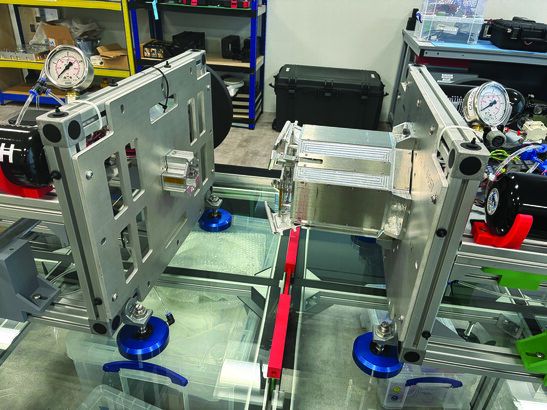
Refueling means safely and efficiently handling transfer of the numerous propellants used in space. “We have controls around not contaminating or over-pressuring customer systems or creating water-hammer effects,” says Hill. “We don’t want anything to evaporate then condense on someone’s cameras or freeze into an explosive popsicle.”
In space, how fluids settle is dictated not by gravity but by surface tension. “That’s a problem in tanks, where we use surface tension management devices,” Hill adds.
Where liquid fuels are pressurized by gas, diaphragms can prevent gas bubbles from entering customer systems. Fuel cannot be weighed in space, so accurately metering customer deliveries relies on modeling from ground-test data. But testing in microgravity is impossible on the ground.
Engineers might get seconds of microgravity in a drop tower or a few prohibitively expensive minutes in a chartered rocket, but these are not nearly enough. “Our docking maneuvers take much longer than that,” says Hill. “They’re slow, controlled and undramatic by design, buying time for failure recovery if we suffer an anomaly. The spacecraft has too little momentum to click the button on a pen.”
Robot rules
Originally designed for building structures in space, Redwire’s STAARK (Space Technology Arm for Advanced Robotic Knowledge) robotic arm has broadened its market orientation to various missions requiring precise automation, including debris removal, satellite servicing, payload handling and satellite deployment. STAARK is modular and mission-agnostic, with degrees of freedom corresponding to the number of elbows and interchangeable end-effectors providing task-specific fingers.
“STAARK includes a vision system and processing unit to detect obstacles and compute the best route to execute a mission,” says the senior executive from Redwire. “It offers different degrees of perception and autonomy. It can be partially or fully controlled by an operator or programmed to work independently. We claim qualification based on testing all hardware to defined parameters and continue to invest in our AI suite.”
Ground testing aspires to emulate exposure to space radiation, thermal extremes, low pressure, microgravity and launch-associated vibration. Environmental test standards are well defined and enable progressive testing of system limits. Components undergo vibration, radiation and thermal vacuum tests, often at supply-chain level, and electronics are proven in electromagnetic tests prior to testing whole-system performance.
“Systems must not only survive, but operate precisely in a range of extremes,” he says. “We can put equipment in a thermal vacuum chamber, but gravity remains a problem and tumbling targets with high velocities and accelerations are hard to emulate on Earth.” Whole-system performance tests are designed to validate flight behavior as plausibly as possible under Earthly constraints.
“We do a lot of multibody dynamic simulation of flight performance scenarios,” he adds. “We then start testing an engineering model of STAARK in our dark room, moving it around and feeding it information to see how it performs and interacts with other bodies in different parts of the mission. We teach the AI how to deal with different mission profiles.”
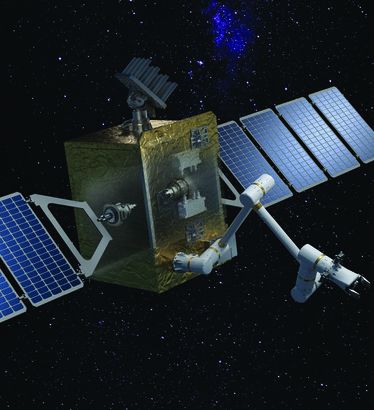
Although gravity can’t be suspended, air-bearing tables provide some capacity for testing in weightless conditions. “We can’t simulate the physical dynamics of docking in 3D, so we simulate it in 2D on the frictionless surface of a reverse air-hockey table,” explains Hill. “We can then reconcile 3D dynamics models against those physical air-table tests.”
Orbit Fab conducts hardware-in-the-loop tests in dark room facilities like the In-orbit Servicing Assembly and Manufacturing (ISAM) Yard at the UK’s Westcott Space Cluster. Here, two robot arms – one carrying Orbit Fab’s servicer, the other a target spacecraft – physically enact their final approach. “We can run the flight software and camera system in that simulated physical rendezvous,” says Hill.
“We’ll inject scenarios like a worst-case tumble of the target spacecraft,” he continues. “We can see whether the whole guidance, navigation and control system can work in concert to navigate to the target and successfully dock.”
STAARK underwent similar dark room tests with a secondary robot arm holding a mock satellite, mimicking its movements and inertia in different mission profiles.
“STAARK identifies, then tracks and goes in to grab the mock satellite,” says the senior executive. “If we change its trajectory, STAARK reorients and goes in from a more optimal angle.”
Dark rooms enable vision system testing in optical conditions from complete darkness to blinding sunlight. “Our AI makes decisions based on a catalog of known objects. Dark room tests teach it to continuously upgrade in the optical extremes it will encounter.”
Because robotic RPO is unproven in routine operations and has scant flight heritage, developers expect a fair quota of unknown unknowns to manifest. Orbit Fab prioritizes end-to-end functional tests which replicate its operational sequence and subsystem handoffs in the relevant ways. But no ground test can accurately combine every facet of physical dynamics and system performance in space.
“We use many lenses and pick our battles,” says Hill. “Taking enough looks through the kaleidoscope buys down risk to the point where you understand your operations and your in-orbit tests are successful.” Orbit Fab’s US and UK arms focus on high-pressure and low-pressure propellants respectively and both are preparing for in-orbit demonstrations.
“Our test campaign builds toward the orbital tests that ultimately give us faith in our services before we start selling them to customers,” says Hill.
“We’re launching two spacecraft to demonstrate docking, coupling and fluidic transfer and de-risk those proximity operations. In parallel, we work with customers to understand what it means for them to carry RAFTI and conduct refueling operations, to shape future in-orbit campaigns.”