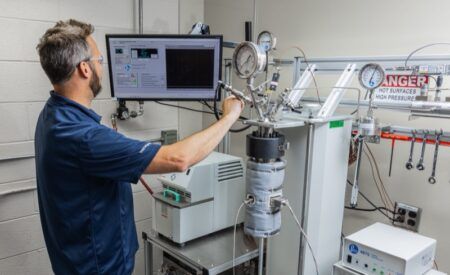



Astral Materials has selected Dawn Aerospace’s Aurora spaceplane as a high-cadence testbed to accelerate development of its microgravity furnace for materials and semiconductor manufacturing.
The agreement covers an initial campaign of Aurora microgravity flight missions, with up to 100 flights over two years flown from the Infinity One Spaceport operations site in Oklahoma, USA. A four-hour turnaround allows Astral Materials to test and refine its hardware several times within a single day.
The missions will fly from Dawn Aerospace’s US commercial operations facilities, where the company is scaling up services for high-cadence microgravity research. Astral Materials joins a growing group of organizations using Aurora, including the Johns Hopkins University Applied Physics Laboratory.
Astral Materials will use Aurora’s suborbital flights to mature its furnace technologies before progressing to long-duration missions in orbit. The company aims to reduce the development cycles for its manufacturing processes from the multiple years that would be needed in orbital laboratories to weeks.
Jiya Janowitz, chief technology officer at Astral Materials, said, “We can test an idea, recover it in around 45 minutes, make an adjustment on the ground and test it again later that same day.
“That kind of rapid iteration has never existed for microgravity manufacturing, and it fundamentally changes how quickly we can develop our technology.”
Reducing gravity-driven effects such as convection and sedimentation can allow semiconductor crystals to be grown with fewer defects and greater consistency, according to Astral Materials. Potential applications include photonics, quantum computing, advanced computing and high-power electronics.
The Aurora space plane is designed for an operational cadence of up to 100 flights per vehicle each year and fast turnarounds on the ground to enable rapid testing.
Dawn Aerospace has been flight testing the Aurora in New Zealand since August 2021. Will Austin, flight operations lead and senior flight test engineer told ATI in an in depth interview earlier this year a key milestone in its testing was when they switched from jet engine to rocket propulsion.
“The performance of the aircraft went through the roof,” he said. “We went from a speed limit of 200 knots to unlimited, with the ability to go supersonic vertically.”
Jessica Frick, CEO of Astral Materials, said, “To realize our mission, we need engineering platforms that let us test often, learn quickly, and continuously improve our technology. Aurora gives us a practical pathway to rapidly validate our manufacturing systems as we scale toward commercial production in orbit where longer duration microgravity can be unlocked.”
Dawn Aerospace plans to begin commercial flight operations from the Infinity One Spaceport in 2028, where it is building a US operational base in partnership with the state of Oklahoma. The site is designed to support high-cadence commercial suborbital flights, giving companies routine access to rapid testing.