

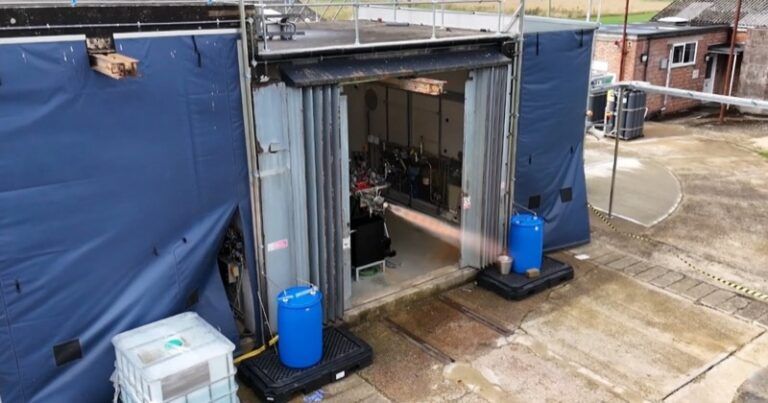
Nammo UK has completed the hot-fire test campaign for the prototype engine that will land Europe’s first Moon lander, the Argonaut.
The spacecraft propulsion specialist, which is based at Westcott Venture Park in Buckinghamshire, has been testing the first prototype of Reliance, the main landing engine for the European Space Agency’s (ESA) Argonaut lunar lander. It announced the milestone at Space Tech Expo Europe in Bremen this week.
Reliance is a 6kN bi-propellant engine that, during the test campaign, throttled from 50% to 100% thrust while maintaining combustion efficiency and stability. That deep-throttling capability is intended to let Argonaut land precisely and safely on the Moon.
The engine achieves deep throttling using a pintle injector, electrically driven centrifugal pumps and an integrated controller, running on the hypergolic propellants monomethylhydrazine (MMH) and mixed oxides of nitrogen (MON).
Nammo says it is the first electrically pump-fed, dual-propellant, regeneratively cooled MMH/MON in-space engine to demonstrate deep throttling in hot-fire testing.
The program has also passed its preliminary design review. Reliance draws on the heritage of Nammo’s LEROS engine family.
Robert Selby, vice president of Nammo Space, said, “The successful completion of the Reliance prototype hot-fire test campaign represents a major development milestone for both the program and European lunar exploration.”
Ludovic Duvet, ESA Argonaut team leader, said, “Reliance is a key technology step for Europe, delivering the high-performance and throttleable propulsion capability at the heart of Argonaut. Developed for the Argonaut Lunar Descent Element, Reliance also opens the door to wider applications, including future lunar return missions and other exploration scenarios.”
Europe targeting 2030 for lunar landing
Argonaut is Europe’s first lunar lander, intended to give the continent independent access to the Moon while supporting NASA’s Artemis program. Led by Thales Alenia Space, it is designed to deliver cargo, infrastructure and scientific payloads – up to about 3,300lb (1,500kg) – to the lunar surface.
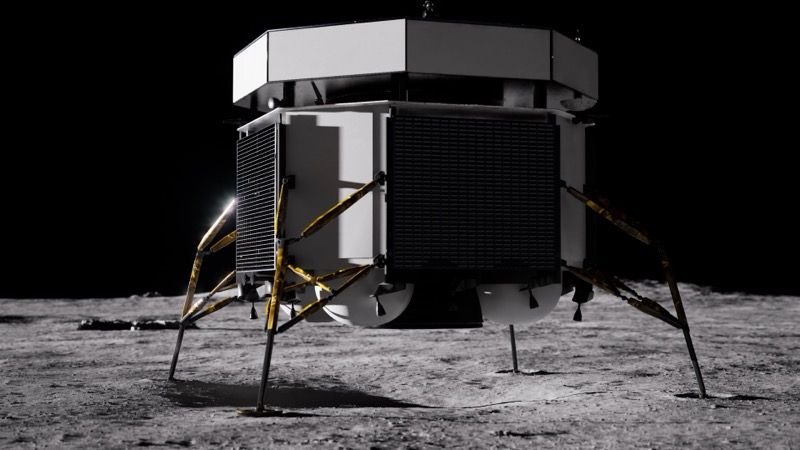
ESA is targeting the first Argonaut mission for around 2030, launching on an Ariane 6, with landing accuracy expected to improve from roughly 820ft (250m) on the first flight to about 160ft (50m) by the third. Further missions are expected every two to three years.
Reliance builds on Nammo engines used on lunar and deep-space missions, including the LEROS 4 that powered Firefly Aerospace’s Blue Ghost commercial Moon landing in March 2025 and the LEROS 1b that served as the main engine on NASA’s Juno mission to Jupiter.
Nammo is now preparing the engineering model build and test campaign, scheduled for 2027, supported by risk-reduction work including further hot-fire testing to validate the engine control logic. The company plans to complete qualification and bring RELIANCE into service over the next three years.