

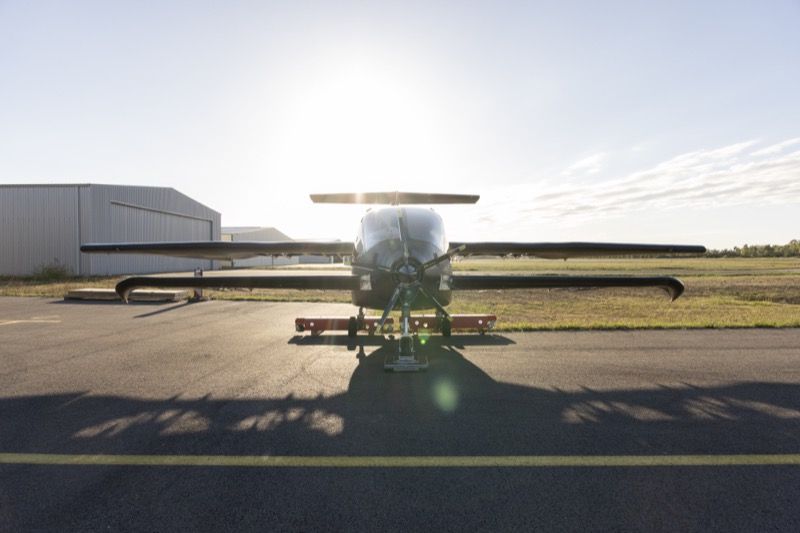
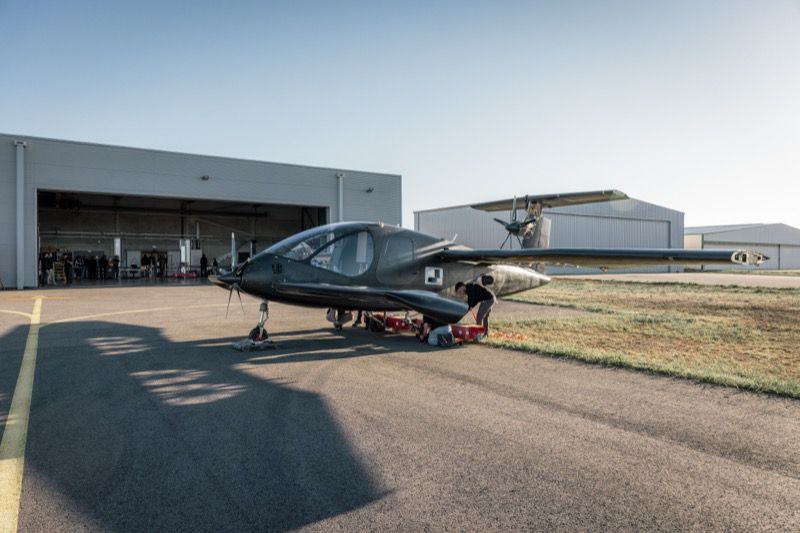
French company Ascendance has revealed the first full-scale prototype of Atea, a hybrid-electric vertical take-off and landing aircraft, and has begun ground testing it toward a first piloted flight.
Atea was unveiled at the company’s base near Toulouse and is the first full-scale prototype to fly its proprietary Sterna hybrid-electric propulsion system. Ascendance said the rollout brings eight years of development to life in a fully assembled aircraft.
The vertical take-off and landing (VTOL) aircraft carries four to six passengers and uses eight rotors embedded in its wings for vertical take-off and landing, with two propellers for forward flight. The aircraft has a target range of up to 560 miles (900km) and a cruise speed of more than 155mph (250km/h).
Ascendance said it has more than 630 letters of intent to purchase Atea, and that the design targets up to 80% lower carbon dioxide emissions, a 75% lower noise footprint and 50% lower direct operating costs than conventional aircraft.
Ascendance and Atea’s hybrid-electric core
Unlike aircraft adapted to take electric propulsion, Atea was designed from the outset around a hybrid-electric architecture, following five years of technology maturation and three years to design, produce and integrate the aircraft using AI, cloud computing and a digital twin. The company recently completed integration of the propulsion and avionics systems.
At the heart of the aircraft is Sterna, a modular hybrid-electric platform combining battery storage, onboard electrical generation and intelligent power management, which has undergone more than 1,000 hours of full-scale bench testing. Ascendance is also offering Sterna for other aircraft, from drones to regional aircraft, across civil and defense markets.
Jean-Christophe Lambert, co-founder and CEO of Ascendance, said, “Our ambition extends beyond a single aircraft. With Sterna, we want to make hybrid-electric propulsion a new standard for aviation performance, improving efficiency while reducing fuel consumption and emissions.”
Founded in 2018 by four engineers from Airbus’s E-Fan electric aircraft program, Ascendance has raised more than €60 million (US$66 million), holds more than 140 patents and employs over 100 people. It plans to expand Sterna production at its Muret-Lherm facility in 2027.
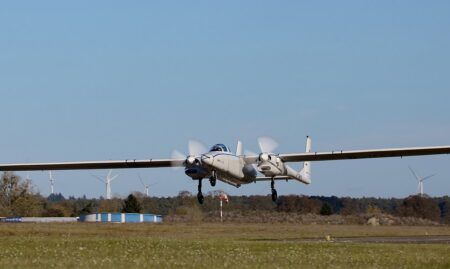
The powertrain is also intended for fixed-wing aircraft and drones, including Delair’s DT46, developed with backing from the French DGA defense procurement agency. In 2025, Daher, Safran and Collins Aerospace joined Ascendance to advance hybrid-electric propulsion for general aviation aircraft, and the company is also working with Airbus to develop and certify Sterna.
Following the rollout, Ascendance said it will continue ground testing and system validation as it works toward an EASA permit to fly for Atea’s first piloted flight.