

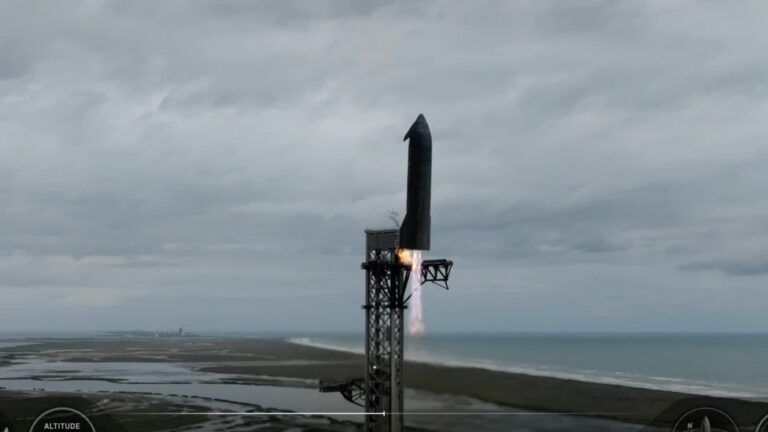
Ship 42 was caught by two steel arms at its Boca Chica, South Texas site on November 14, 2026. The test was a modern technical marvel that captured the attention of millions of people around the world. The Starship had been launched from the same location 22 and a half hours earlier, circled the Earth about 14 times, then fired its engines to control its descent back to the tower.
It was the first time an upper stage had been returned from orbit to its launch site and been caught. “We caught a Starship, and now everything changes,” said Dan Huot of SpaceX on the company webcast.
SpaceX is building the largest rocket ever flown, and making it rapidly reusable, by flying full-scale prototypes until it works. Driven by Elon Musk’s vision to make humanity a multiplanetary, spacefaring civilization, it is arguably the most technically ambitious development program in commercial aerospace.
Although November’s test Starship was caught, the same flight lost its Super Heavy booster rocket (number 22). Nevertheless, the sight was staggering and hints at the progress being made by Musk’s company.
Twice the thrust
The version 3 (V3) vehicle that flew on Flight 15 stands about 408ft (124m) tall. Its Super Heavy booster carries 33 Raptor 3 engines burning methane and liquid oxygen, which SpaceX said produce more than 18,000,000 lbf (80MN) at liftoff. That is about twice the 8,800,000 lbf (39MN) NASA quotes for its Space Launch System. The Starship carries six more Raptors. The engine uses a full-flow staged combustion cycle that no other flown rocket engine has used.
The launch system’s incredible size does not diminish the scale of the ambition to recover and refly both the Super Heavy and Starship for each launch. SpaceX’s Falcon 9 already lands its booster, but discards its upper stage. Starship is designed to reuse both parts with no refurbishment, which is why neither stage has landing legs. Catching them on the tower removes the mass of legs and leaves each vehicle at the launch mount.
“Version 3 is basically a clean-sheet design of the ship,” Charlie Cox, SpaceX director of Starship engineering, told Reuters before the V3 debut in May 2026.
The booster has three enlarged grid fins in place of four and a hot-staging ring that stays attached. The ship features four docking ports and a system for managing cryogenic propellant in microgravity.
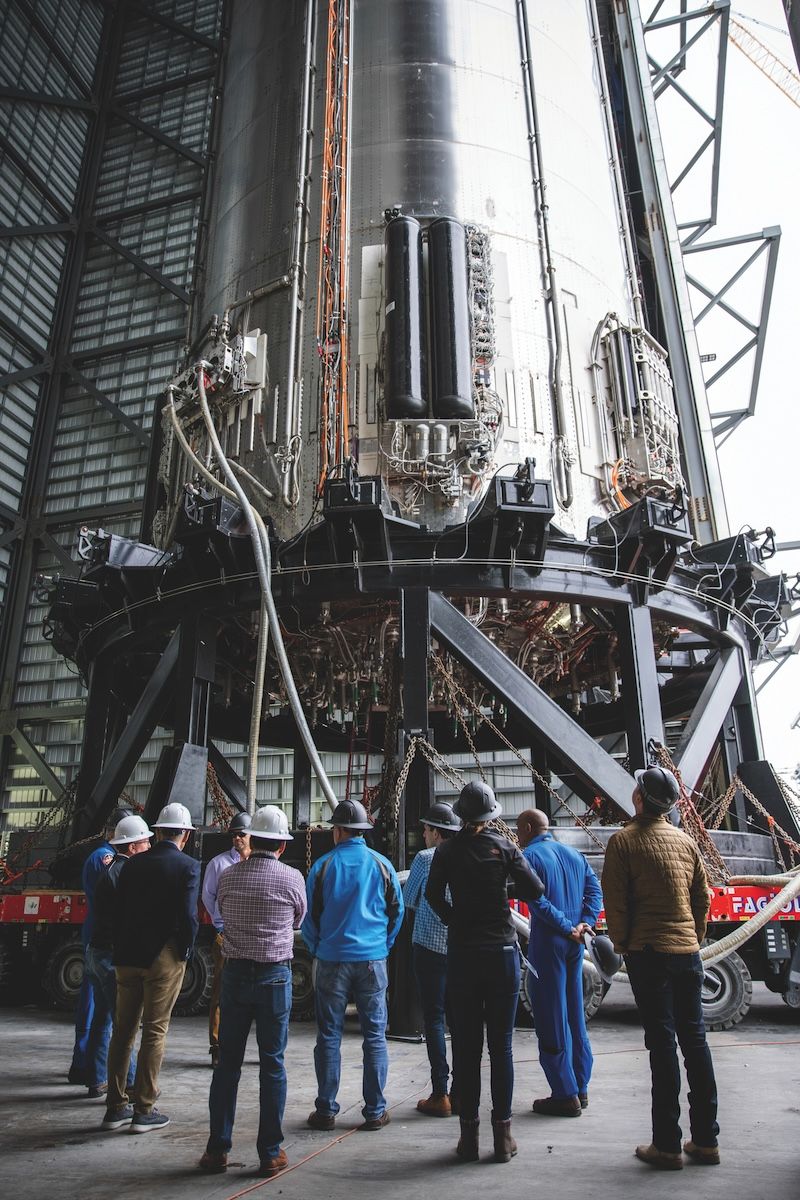
How the tower works
The launch tower is more than 400ft (122m) tall and carries two arms, which SpaceX calls chopsticks, on a carriage that travels up and down its face. The same arms lift and stack the vehicles before launch.
A returning booster separates about two and a half minutes into flight, flips and relights its engines for a boostback burn toward the coast. Its landing burn starts on 13 engines.
On the first catch, on Flight 5 on October 13, 2024, that burn began 6 minutes 30 seconds after liftoff. The booster slowed to a near hover, slid sideways to line up with the open arms, and the arms closed around it before the engines shut down 24 seconds later. The booster hangs from load points near its grid fins.
Currently the catch is conditional on the vehicle and tower passing a series of automated mission health checks. If they fail, the booster diverts to splashdown in the Gulf of Mexico.
SpaceX has caught three boosters, on Flights 5, 7 and 8, all of the earlier generation. Before the recent Flight 15, the arms gripped Booster 22 at catch height in a squeeze test on November 10.
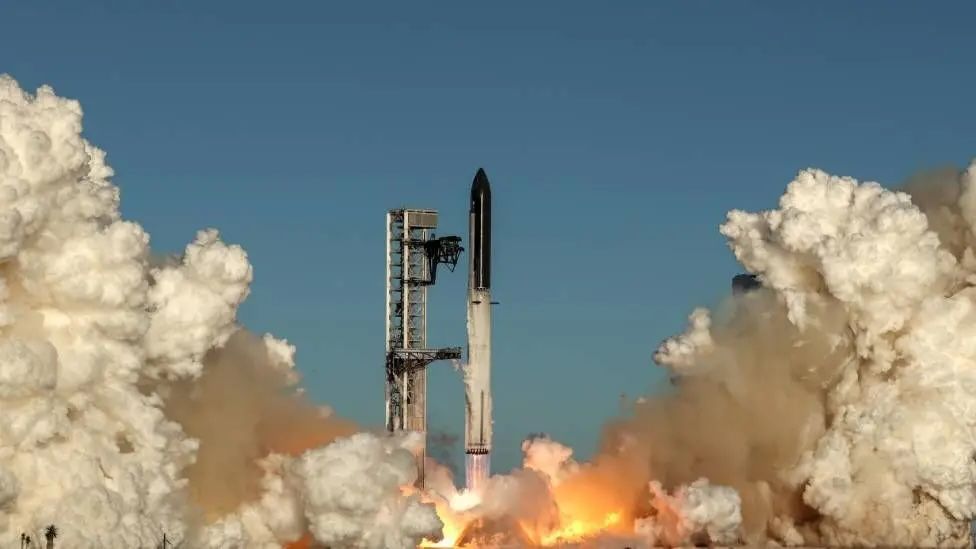
Catching a Starship
The ship is a more difficult target for the arms to catch. Unlike the booster, it arrives from a mission at orbital velocity and must survive re-entry behind a heat shield of about 18,000 ceramic tiles before it can fly itself to the tower. A single Raptor performs the deorbit burn.
The ship re-enters over the Pacific well uprange of SpaceX’s Starbase and steers with four flaps across northern Mexico and southern Texas, on a route drawn around cities, before passing out over the Gulf and turning back toward Pad 2.
In the final seconds Starship falls horizontally toward the tower, ignites three sea-level Raptors, stows its flaps and flips vertical. It drops to two engines and then one as it nears a hover and moves between the arms, which close on two catch fittings just below the forward flaps.
The last engine shuts down only when contact registers. SpaceX’s timeline allowed 18 seconds from ignition to catch.
“It requires incredible precision to ensure the vehicle reaches exactly the right position,” Niharika Patel, technical program manager at satellite company Loft Orbital, told Al Jazeera shortly after the successful November 2026 test.
The state of the heat shield tiles, which are rated to about 2,600°F (1,400°C), was a key test parameter. Their condition decided whether a return happened at all. If a tile is lost, damage to the ship could cause issues with steering and propulsion. Earlier ships came down over open ocean, where a failure endangered only the vehicle. Ship 42’s route crossed land.
Three of the 26 Starlink V3 satellites deployed on Flight 15 carried cameras to photograph the heat shield in orbit, and SpaceX said the imagery showed the tiles were fit for re-entry. Controllers passed three go/no-go checkpoints, with splashdown zones off Hawaii and Chile in reserve. The FAA issued the license modification for the overland return on launch day.
Fly, fail, rebuild
SpaceX has launched the integrated Starship vehicle 15 times since April 20, 2023, through three generations: six flights with V1 ships, five with V2 and four with V3. The first 13 were suborbital by design. Starship first reached orbit on Flight 14 on September 28, 2026, at about 170 miles (275km), and deployed 26 Starlink V3 satellites.
The development approach voraciously and publicly consumes hardware. Flight 1 wrecked its launch pad. All three V2 ships flown in the first half of 2025 were lost. Ship 36 exploded on the stand at the Massey’s test site on June 18, 2025, and Booster 18, the first V3 booster, was destroyed in pressure testing on November 21, 2025.
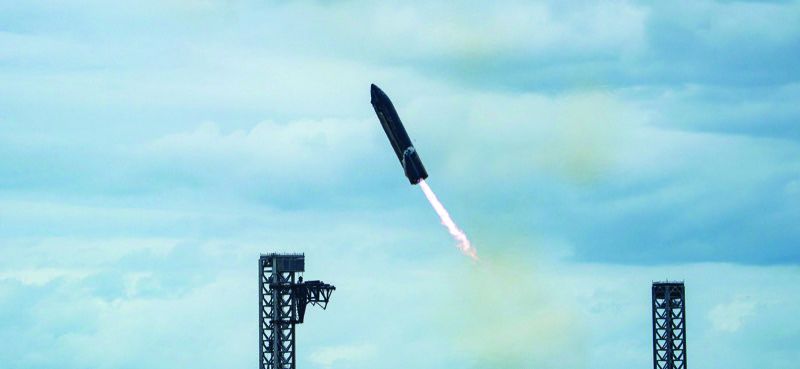
Each vehicle is built at Starbase and cryogenically tested at nearby Massey’s, where ships are also static fired. Boosters are static fired on the launch mount. Booster 22 fired all 33 engines at Pad 2 on October 25. Ship 42 was lifted by the tower arms on September 11-12 to rehearse post-catch handling, then completed a single-engine firing simulating the deorbit burn on October 26 and a six-engine firing of more than 60 seconds a day later.
The cost
SpaceX has spent more than US$15bn developing Starship, including US$3bn in 2025, according to its listing filing. The company said in October 2025 that it was funding more than 90% of the program itself. Falcon 9 development was roughly US$400m. Blue Origin had spent “on the order of $10 billion” on New Glenn by January 2025, a former employee told Forbes.
Airliners can provide another comparison. Airbus put A380 development at €15bn (US$16.6bn) in 2015 and analysts estimated as much as €20bn. Boeing has booked about US$15bn in charges on the delayed 777X, on top of its development budget. These are figures in the money of their day. They place Starship’s spending in the range of a new airliner and far above any other privately funded launcher. And Starship development is far from over.
SpaceX’s to-do list
Booster 22 abandoned its catch about six and a half minutes after liftoff and was destroyed just above the Gulf. Huot first blamed the guidance, navigation and control (GNC) system, then withdrew that. “Early indications are that the booster ended its boostback early due to a low fuel mass alarm,” said SpaceX’s Kate Tice. Elon Musk wrote on X that “slight underperformance of engines” was responsible.
The V3 booster is yet to be successfully recovered, after four flights. The FAA attributed the first loss, on Flight 12, to heat damage at stage separation and “erroneous engine alarm system settings”.
Rapid reuse is still a goal. Two earlier-version boosters have each flown a second time, while no ship has been reflown yet. Musk wrote on November 15 that Ship 42 “could probably be reflown with a few weeks of refurbishment” and that “many small fixes are needed to achieve immediate reusability”. A filing describes a vehicle designed to carry 100 metric tons (220,000 lb) and up to 60 Starlink V3 satellites. The most flown is 26. Musk told investors in October 2026 to expect about one flight a week in the first half of 2027. Starship has flown four times in 2026.
SpaceX’s spectacular flights and the unashamed disclosure of testing failures show that the program is one of the most ambitious in modern aerospace. The next milestone is in-orbit refueling, which every Starship mission beyond low Earth orbit requires, including NASA’s lunar lander. It has not been attempted between two ships. SpaceX has pointed to early 2027 for that test and for the first ship reflight. Until both happen, the November 14 catch remains an interesting spectacle.