

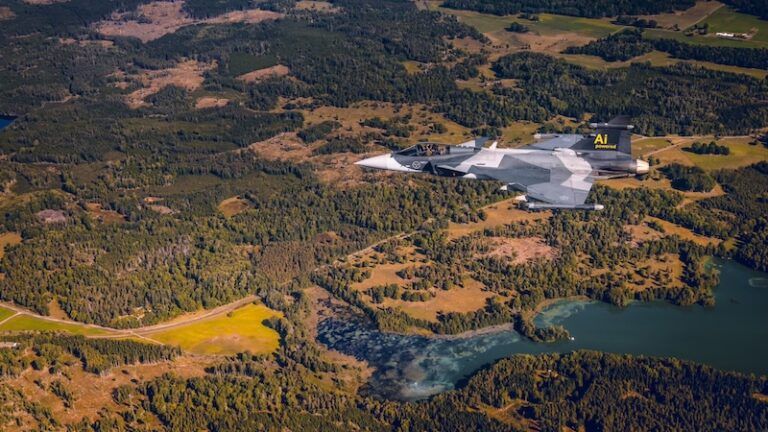
Saab has flight tested in-house AI agents that autonomously controlled a Gripen E fighter in beyond-visual-range combat scenarios, taking the technology from concept to an operational aircraft.
The AI agents, developed within Saab’s Advanced Programs unit, are designed to master tactical decision-making in complex operational environments, learning, adapting and collaborating with pilots across a range of mission tasks. They can support a pilot in the cockpit or operate alongside crewed jets in an uncrewed aircraft.
During the flight trials, an AI agent autonomously controlled the aircraft in beyond-visual-range (BVR) combat scenarios. Saab said the agents, their training environments and development tools were all built in-house, giving it full control over how they operate, are verified and evolve.
Peter Nilsson, head of Advanced Programs at Saab’s aeronautics business area, said, “The future of air combat will not be defined by individual platforms acting alone, but by networks of crewed and uncrewed systems working together as a coordinated force. Through our ownership of the entire technology stack, we are building the capabilities needed for that future.”
Central to the effort is Saab’s AI Fighter Pilot Academy, where agents are trained in simulation across multiple air combat capabilities. By accumulating millions of simulated flight hours, they can explore tactics and decision paths far beyond what any pilot could experience in a lifetime, improving through continuous evaluation against defined objectives.
Saab said Gripen E’s software-defined architecture lets new AI software be integrated and flown on an operational fighter without dedicated experimental platforms, even in civilian airspace, shortening development cycles. Beyond-visual-range combat is the first capability to be validated in real flight.
The work is supported by Sferical AI, a Swedish sovereign AI initiative providing secure, large-scale computing capacity, of which Saab is a founding partner. The company said safety and control are built into the development process from the outset, because AI for fighters must be trusted.
Saab is now expanding the agents’ capabilities and flying them in a wider range of scenarios, and said the academy’s infrastructure provides a foundation for uncrewed platforms. It expects future air combat to rely on crewed and uncrewed systems operating together, with sovereign, verified AI a critical capability.