
Aerospace Testing InternationalAerospace Testing International
  • News
    • A-E
      • Acoustic & Vibration
      • Avionics
      • Data Acquisition
      • Defense
      • Drones & Air Taxis
      • Electric & Hybrid
      • EMC
      • Engine Testing
      • Environmental Testing
    • F-L
      • Fatigue Testing
      • Flight Testing
      • Helicopters & Rotorcraft
      • High Speed Imaging
      • Industry News
    • M-S
      • Materials Testing
      • NDT
      • Simulation & Training
      • Software
      • Space
      • Structural Testing
      • Supplier News
    • T-Z
      • Technology
      • Telemetry & Communications
      • Weapons Testing
      • Wind Tunnels
  • Features
  • Magazines
    • June 2026
    • March 2026
    • Dec 2025 / Jan 2026
    • Showcase 2026
    • August / September 2025
    • June 2025
    • Archive Issues
    • Subscribe Free!
  • Opinion
  • Webinars
  • Events
    • All Events
    • Aerospace Test & Development Show
  • Podcasts
  • Videos
  • Suppliers
    • Supplier Spotlights
    • Press Releases
    • Technical Papers
LinkedIn YouTube X (Twitter)
Subscribe to magazine Subscribe to email newsletter Media Pack
Aerospace Testing InternationalAerospace Testing International
  • News
      • Acoustic & Vibration
      • Avionics
      • Data Acquisition
      • Defense
      • Drones & Air Taxis
      • Electric & Hybrid
      • EMC
      • Engine Testing
      • Environmental Testing
      • Fatigue Testing
      • Flight Testing
      • Helicopters & Rotorcraft
      • High Speed Imaging
      • Industry News
      • Materials Testing
      • NDT
      • Simulation & Training
      • Software
      • Space
      • Structural Testing
      • Supplier News
      • Technology
      • Telemetry & Communications
      • Weapons Testing
      • Wind Tunnels
  • Features
  • Magazines
    1. June 2026
    2. March 2026
    3. Dec 2025 / Jan 2026
    4. Showcase 2026
    5. August / September 2025
    6. June 2025
    7. Archive Issues
    8. Subscribe Free!
    Featured
    16th June 2026

    In this issue: June 2026

    Online Magazines By Ben Sampson
    Recent

    In this issue: June 2026

    16th June 2026

    In this issue: March 2026

    24th March 2026

    In this issue: December 2025/January 2026

    23rd December 2025
  • Opinion
  • Webinars
  • Events
    • All Events
    • Aerospace Test & Development Show
  • Podcasts
  • Videos
  • Suppliers
    • Supplier Spotlights
    • Press Releases
    • Technical Papers
LinkedIn YouTube X (Twitter)
Aerospace Testing InternationalAerospace Testing International
Features Flight Testing Simulation & Training

Airbus gearing up for first flight of A321XLR

Web TeamBy Web Team13th June 20226 Mins Read
Share LinkedIn Twitter Facebook Email
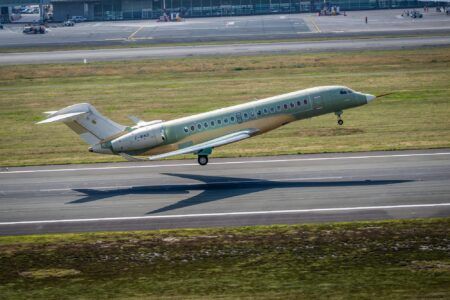
One Airbus' three A321XLR craft, the MSN11000 (pictured) is set to enter service in 2023 (Photo: Airbus)

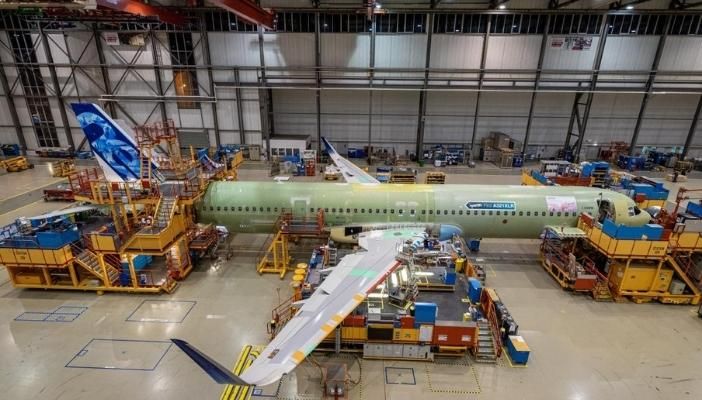
The construction and equipment installation phases for three A321XLR flight-test aircraft are nearing completion at Airbus’ final assembly line in Hamburg, Germany.

The first of these, the MSN11000, will soon be handed over to the flight-test team. Concurrently, ground-based testing campaigns are underway at various Airbus sites in preparation for incoming flight-test and certification programmes.

One of these is the Virtual First Flight (VFF) campaign to clear the aircraft’s new systems, flight control laws and the flight crew for commencing flight tests. This part of the A321XLR’s development focuses around a dedicated development simulator and a co-located avionics testing laboratory in Toulouse, France.
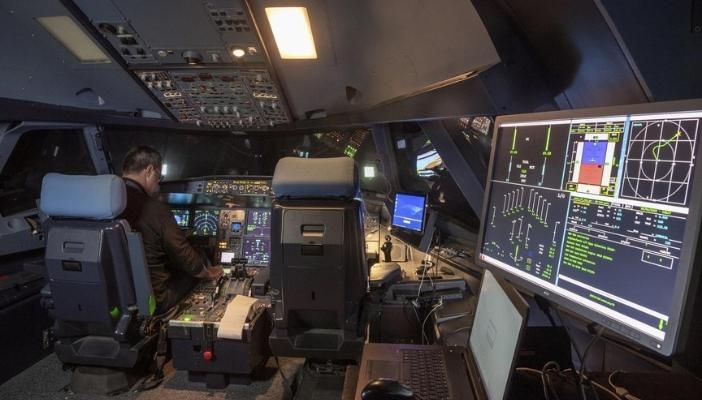
The Development Simulator “S22” where the A321XLR’s virtual flight-test campaign is being performed in Toulouse (Photo: Airbus)

Virtual flight-test campaign

In contrast to a full-flight simulator which moves on hydraulic jacks, the VFF is fixed to the floor. Featuring real pilot controls and displays, there are also dedicated workstations behind it which feature displays and user interfaces as used by flight test engineers (FTEs). These will be used to monitor the flight and adjust testing parameters in the real aircraft.

Adjacent to the development simulator’s entrance is a virtual flight testing laboratory room with numerous racks containing real avionics modules. These are identical to those being installed in the avionics bays of the three A321XLR flight-test aircraft. These modules can be connected directly to the simulator, virtually flown and evaluated by the Airbus test pilots while being monitored by the FTEs.

Linking the avionics in the lab directly to the simulator enables the engineering test pilots to validate the A321XLR’s modified flight control system laws and in specific conditions, such as during flare or high-speed flight. They are also able to evaluate and fine tune the aircraft’s handling od external disturbances typically encountered during normal flight.

Vincent Claudel, Team Leader Lab & Flight Tests, said: “The virtual flight test campaign which started in March will culminate with a Virtual First Flight  ‘rehearsal’ or dry-run. For this exercise all the flight crew, comprising the test pilots, the test-flight engineer and the flight-test engineers, who are already assigned for the first flight, will be seated in the simulator where they will run through all the phases which they will subsequently perform in the real aircraft.”
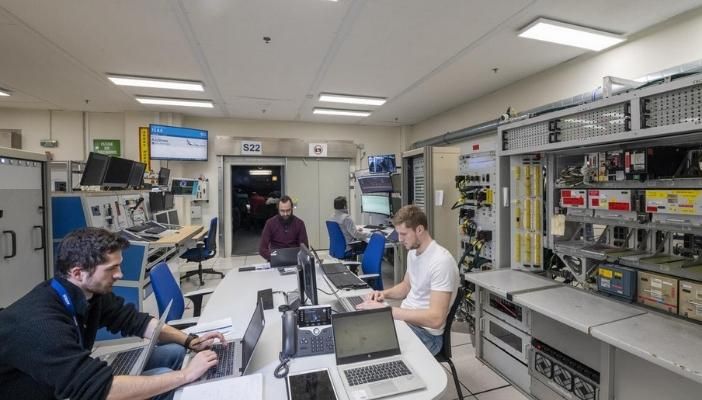
The virtual flight testing lab and the technicians’ test preparation area outside the development simulator – showing some of the A321XLR’s avionics modules which can be linked to the development simulator (Image: Airbus)

Vincent added: “The phases which they will rehearse during the VFF dry-run include, for example, the electrical and engine power-on, taxiing out, take-off, climb, the flight domain opening, all the way to landing, taxiing back, and powering down again. In fact, they will do everything they will do in the real flight, and in exactly the same order.”

Flight control system functional integration testing

In order to validate the flight control computers so they may be subsequently integrated with the main simulator, the avionics modules are first tested and fine-tuned by engineering specialists in a nearby laboratory using ‘Controller and Guidance Integration Benches’ (CGIBs).
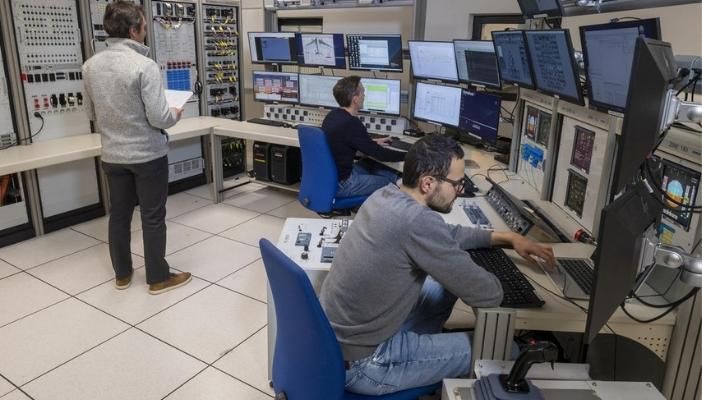
There are several ‘Controller and Guidance Integration Benches’ (CGIBs) in Toulouse where avionics experts can test and fine-tune the A321XLR’s flight control computers (Photo: Airbus)

“Before the avionics modules can be connected to the simulator, they undergo integration operational testing to validate them at system level to ensure the good behaviour of the aircraft’s flight control laws which they govern,” notes Vincent.

Partial ‘iron-bird’ ground test rig for the vertical-tail plane’s new eRudder

The simulator can also be directly connected to and control physical aircraft hardware such as hydraulically-actuated control surfaces on a test-rig. On a new programme, such as the A350, this test rig was called an iron bird. However, since the A321XLR is a development of the A321neo, it was sufficient to provide a physical test rig representing just the tail section, in this instance the the vertical tail-plane (VTP). This is to facilitate ground testing of a new ‘eRudder’, which is being introduced across the A320 family.
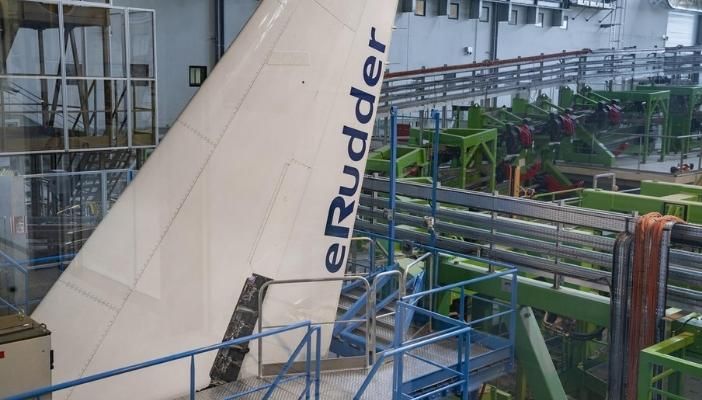
The eRudder test rig in Toulouse (Photo: Airbus)

Ground-based systems integration and testing

“The majority of the tests – such as for the flight control laws and autopilot – to prepare the  [A321] XLR for its first flight are being performed by the engineers and flight test crews in Toulouse, using the simulator plus the avionics benches. However, other test campaigns have been underway for more than a year already at the various Airbus sites to clear additional systems which are related to specific ATA Chapters,” notes Vincent.

To this end, the transnational development teams in Toulouse in France, Hamburg and Bremen in Germany and in Filton in the UK, have collaborated in the XLR’s test-means campaign and systems integration activities.
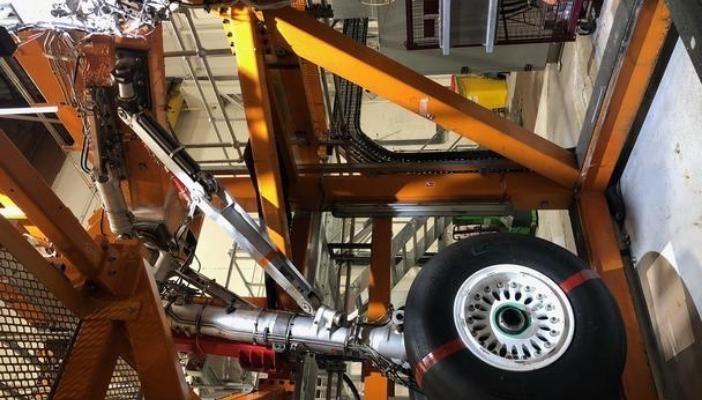
Part of the A321XLR’s “Landing Gear Zero” test bench in Filton, UK (Photo: Airbus)

Vincent continued: “In Filton, UK, we have two big benches for what we call ‘Landing Gear Zero’ for validating the XLR’s new uprated landing gear, wheels and brakes (ATA Chapter 32). Also in Filton is a ‘fuel integration bench’ to test the new fuel and inerting system (ATA Chapter 28) for the -XLR, and in particular to validate new modifications for the aircraft’s new Rear-Centre-Tank (RCT).”
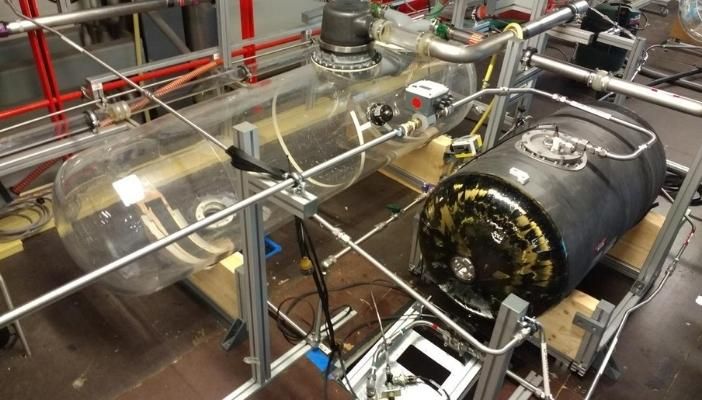
The A321XLR’s new high-capacity water and waste system is functionally tested in Hamburg (Photo: Airbus)

“Meanwhile in Bremen, Germany, we have the high-lift system bench to validate the new inboard single-slotted flap configuration which is specific to -XLR. Then in Hamburg, we have air conditioning benches (ATA Chapter 21), as well as a ‘water & waste’ bench (ATA Chapter 38). Also in Hamburg we have a multi-climatic chamber to optimise the comfort in the cabin and cockpit during the long flights at high cruise altitudes.”
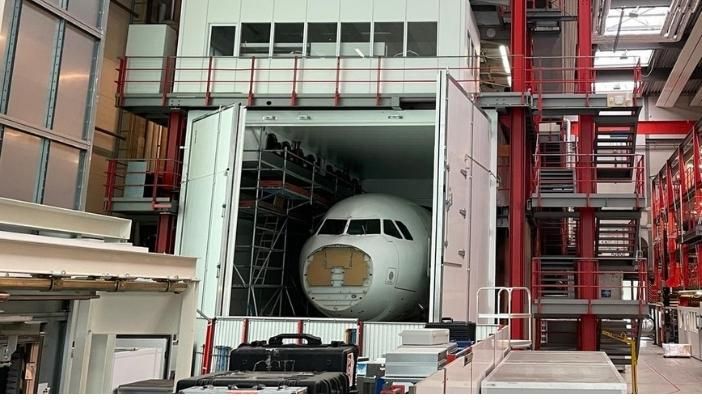
A “Multi-Climatic Chamber” in Hamburg is used to re-create the outside atmospheric conditions of a long range flight (Photo: Airbus)

“Even after the first flight is accomplished we will continue to perform our ground lab test means at all these sites as well as simulator tests in Toulouse, in parallel to support the year-long flight-test campaign, the Certification programme and beyond,” says Vincent.


This article was originally published by Airbus here.

Share. Twitter LinkedIn Facebook Email
Previous ArticleVenus Aerospace reveals Stargazer space plane design
Next Article Uncrewed Boeing Starliner flight returns from ISS
Web Team

Related Posts

Features

Solving the manufacturing challenge facing UAV developers

23rd June 20266 Mins Read
Features

Lunar landings: How NASA’s testing infrastructure is adapting to Artemis

22nd June 202611 Mins Read
Flight Testing

Dassault Falcon 10X completes maiden flight from Bordeaux

19th June 20262 Mins Read
Latest Posts
VoltAero

Aura Aero acquires hybrid-electric aircraft developer VoltAero

23rd June 2026

Solving the manufacturing challenge facing UAV developers

23rd June 2026

How new sensing technologies are combating ice accretion on aircraft wings

23rd June 2026
Supplier Spotlights
  • Precision Filters, Inc. (PFI)
  • Evolution Measurement
  • CALCULEX
  • Hottinger Brüel & Kjær
  • AVL List GmbH
  • Tekna
  • InnovMetric
  • CGM CIGIEMME S.p.A.
  • SET GmbH
  • Tyto Robotics
    Tyto Robotics Inc.
  • Bartington Instruments
    Bartington Instruments
  • Ametek
    AMETEK Programmable Power
  • Delta Information Systems logo
    Delta Information Systems
  • Helling GmbH
    Helling GmbH
  • Matec Instrument Companies, Inc.
    Matec Instrument Companies, Inc.
  • Endevco
  • Ipetronik
    IPETRONIK GmbH & Co. KG
  • VJ Technologies
  • Durr NDT
    DÜRR NDT GmbH & Co. KG
  • Dewesoft
  • Bruker Alicona Dimensional metrology & surface roughness measurement
    Bruker Alicona
  • Vzlu
    VZLU – Czech Aerospace Research Centre
  • ATG Advanced Technology Group
    ATG – Advanced Technology Group
  • Dytran Instruments, Inc.
  • Kistler Group
    Kistler Group
  • Diversified Technical Systems (DTS)
  • Scanivalve Corporation
  • G Systems
  • CEC Vibration Products LLC.
  • dSPACE
  • Safran Data Systems
  • Photron
  • YXLON International
  • Telspan Data
  • TotalTemp Technologies, Inc.
  • Vector Informatik GmbH
  • Vibration Research
  • TEST-FUCHS
  • Siemens Digital Industries Software
    Siemens Digital Industries Software
  • PCB Piezotronics, Inc.
  • Testia
  • Treo – Labor für Umweltsimulation GmbH
  • W5 Engineering
  • National Institute for Aviation Research
  • North Star Imaging
  • MK Test Systems Ltd.
  • Intertek
  • I.N.C.A.S. – NATIONAL INSTITUTE FOR AEROSPACE RESEARCH “ELIE CARAFOLI”
  • FMV Test & Evaluation
  • Glenn L Martin Wind Tunnel
  • GRAS Sound & Vibration
  • Elsys AG
  • EMCCons DR. RAŠEK GmbH & Co.KG
  • European Test Services (ETS) B.V.
  • Chemetall GmbH logo
    Chemetall GmbH
  • Curtiss-Wright
  • Data Physics Corporation
  • AOS Technologies AG
  • Airmo Inc. Pressure Technologies
    Airmo Inc.® Pressure Technologies
Our Social Channels
  • Twitter
  • YouTube
  • LinkedIn
Getting in Touch
  • Subscribe To Magazine
  • Contact Us
  • Meet the Team
  • Media Pack
Related Topics
  • Aircraft Interiors
  • Business Jet Interiors
FREE WEEKLY NEWS EMAIL!

Get the 'best of the week' from this website direct to your inbox every Wednesday

© Copyright 2026 Mark Allen Group. All rights are reserved, including those for text and data mining, AI training, and similar technologies.
  • Cookie Policy
  • Privacy Policy
  • Terms & Conditions

Type above and press Enter to search. Press Esc to cancel.