

Aerospace Testing InternationalAerospace Testing International
  • News
    • A-E
      • Acoustic & Vibration
      • Avionics
      • Data Acquisition
      • Defense
      • Drones & Air Taxis
      • Electric & Hybrid
      • EMC
      • Engine Testing
      • Environmental Testing
    • F-L
      • Fatigue Testing
      • Flight Testing
      • Helicopters & Rotorcraft
      • High Speed Imaging
      • Industry News
    • M-S
      • Materials Testing
      • NDT
      • Simulation & Training
      • Software
      • Space
      • Structural Testing
      • Supplier News
    • T-Z
      • Technology
      • Telemetry & Communications
      • Weapons Testing
      • Wind Tunnels
  • Features
  • Magazines
    • June 2026
    • March 2026
    • Dec 2025 / Jan 2026
    • Showcase 2026
    • August / September 2025
    • June 2025
    • Archive Issues
    • Subscribe Free!
  • Opinion
  • Webinars
  • Events
    • All Events
    • Aerospace Test & Development Show
  • Podcasts
  • Videos
  • Suppliers
    • Supplier Spotlights
    • Press Releases
    • Technical Papers
LinkedIn YouTube X (Twitter)
Subscribe to magazine Subscribe to email newsletter Media Pack
Aerospace Testing InternationalAerospace Testing International
  • News
      • Acoustic & Vibration
      • Avionics
      • Data Acquisition
      • Defense
      • Drones & Air Taxis
      • Electric & Hybrid
      • EMC
      • Engine Testing
      • Environmental Testing
      • Fatigue Testing
      • Flight Testing
      • Helicopters & Rotorcraft
      • High Speed Imaging
      • Industry News
      • Materials Testing
      • NDT
      • Simulation & Training
      • Software
      • Space
      • Structural Testing
      • Supplier News
      • Technology
      • Telemetry & Communications
      • Weapons Testing
      • Wind Tunnels
  • Features
  • Magazines
    1. June 2026
    2. March 2026
    3. Dec 2025 / Jan 2026
    4. Showcase 2026
    5. August / September 2025
    6. June 2025
    7. Archive Issues
    8. Subscribe Free!
    Featured
    16th June 2026

    In this issue: June 2026

    Online Magazines By Ben Sampson
    Recent

    In this issue: June 2026

    16th June 2026

    In this issue: March 2026

    24th March 2026

    In this issue: December 2025/January 2026

    23rd December 2025
  • Opinion
  • Webinars
  • Events
    • All Events
    • Aerospace Test & Development Show
  • Podcasts
  • Videos
  • Suppliers
    • Supplier Spotlights
    • Press Releases
    • Technical Papers
LinkedIn YouTube X (Twitter)
Aerospace Testing InternationalAerospace Testing International
Weapons Testing

US Air Force engineers prepare rocket sled for hypersonic ground tests

Ben SampsonBy Ben Sampson20th October 20207 Mins Read
Share LinkedIn Twitter Facebook Email
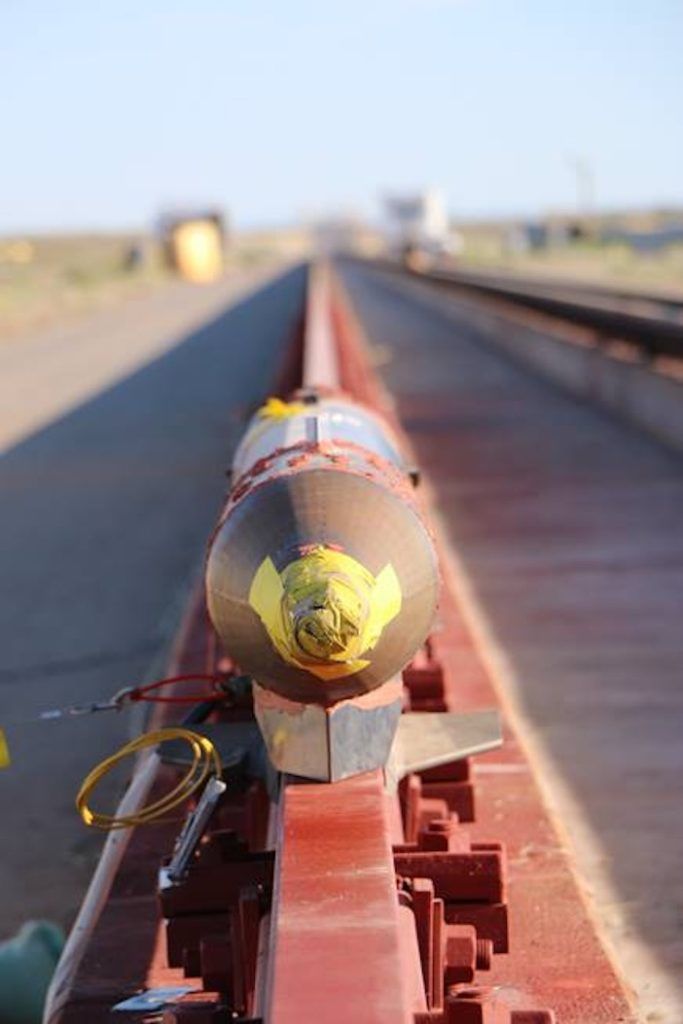
Rocket sled
The 9in monorail sled launched on the Holloman High Speed Test Track as part of a series of tests in preparation for future rocket sled testing (Image: USAF)

In preparation for an increased demand of its services over the next decade, including testing work slated to begin next year, engineers at Holloman Air Force Base, New Mexico have been working to get its hypersonic sled testing program up to speed.

The 846th Test Squadron, a unit of the 704th Test Group of the Arnold Engineering Development Complex, is conducting a series of preparatory rocket sled tests at the Holloman High Speed Test Track (HHSTT).

At nearly 51,000ft, the HHSTT is the longest facility of its type in the world. The rocket sled track, which is operated by the 846th Test Squadron is a testbed which links laboratory investigations and full-scale flight testing by simulating selected portions of the flight environment under programmed and instrumented conditions. The sleds which serve as the test vehicles are accelerated to mission velocities by means of solid rocket motors, frequently in multi-stage operation.

The preparatory tests are part of an initiative known as the Hypersonic Readiness (HSR) program. The planning stages for this program began around four years ago, with the first sled test conducted last summer. The HSR program currently consists of multiple dynamic sled test velocities, sled designs, environments and different braking media.
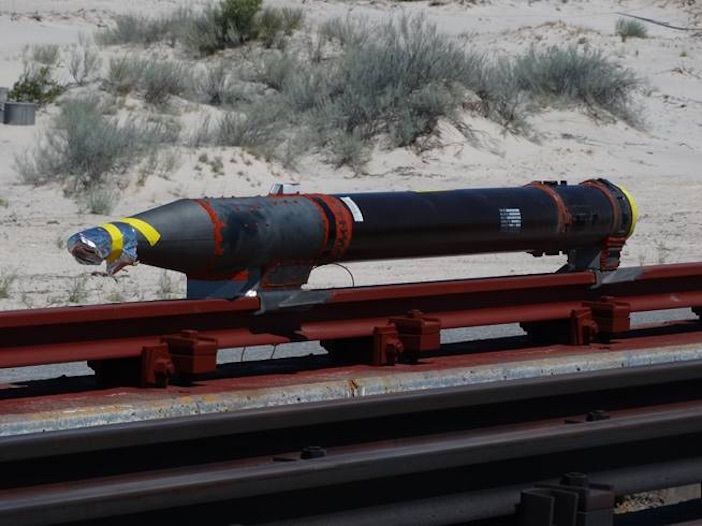
rocket sled
Rocket sled before launch as part of testing to prepare for future hypersonic weapons tests

After the HSR program the 846th Test Squadron will carry out the Hypersonic Test and Evaluation Investment Portfolio (HyTIP), Air-Launched Rapid Response Weapon (ARRW) and other anticipated recovered hypersonic sled tests.

“Due to current DOD priorities, it is expected that the frequency and complexity of hypersonic testing will increase over the next 10 years at HHSTT,” said capability development lead Lee Powell.

Sled testing in support of HyTIP is planned for 2021, starting with weather effects testing, such as simulated rain encounter. Such testing in support of ARRW is expected to get underway the following year.


Putting the brakes on

With this expected uptick in testing at the HHSTT and the testing already set to occur in the next calendar year, it was necessary for the 846 TS to revive, develop and rehearse hypersonic monorail sled test capabilities. The HSR program is primarily focused on the hypersonic 9-inch monorail sled test capability and includes the revival of old, as well as the development of new, high-speed braking capabilities.

“Historical hypersonic sled braking techniques have been retired and current braking methods do not allow entry at the speeds required to recover hypersonic monorail sleds,” Powell said.

Before the HyTIP missions slated for next year and the subsequent ARRW missions are carried out, alternative high-speed braking methods and workforce training is being developed and demonstrated. The HSR effort mainly consists of the development of rail-top braking methods to ensure the sleds launched during testing can be recovered on the rail for post-test analysis.
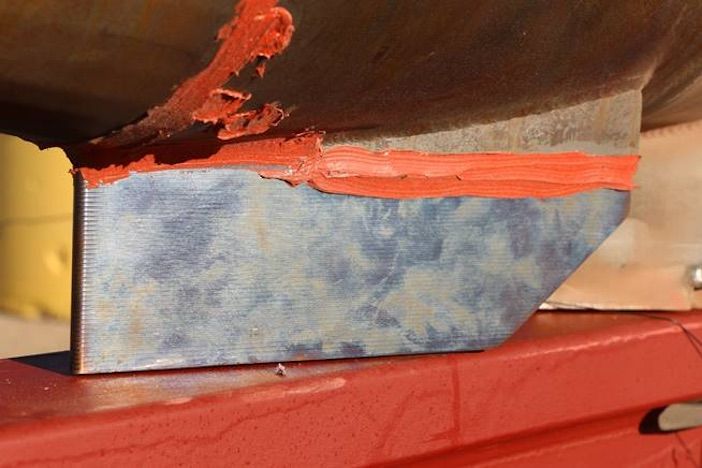
braking wedge
The new braking wedge design used in the second Hypersonic Readiness program test conducted by the 846th Test Squadron at the Holloman High Speed Test Track at Holloman Air Force Base, New Mexico (Image: USAF)

Four tests have been conducted at the HHSTT as part of the HSR program thus far, the first occurring on June 26, 2019, and the most recent on August 6, 2020. The tests have called for the acceleration of a monorail sled to the supersonic or hypersonic regime. The sleds then coast from peak to speeds ranging from 2,299 ­– 2,900 feet per second before braking. A new braking wedge design was developed and used on the sleds to interact with rail-top water bag braking and induce a momentum exchange to slow the sled during the testing.
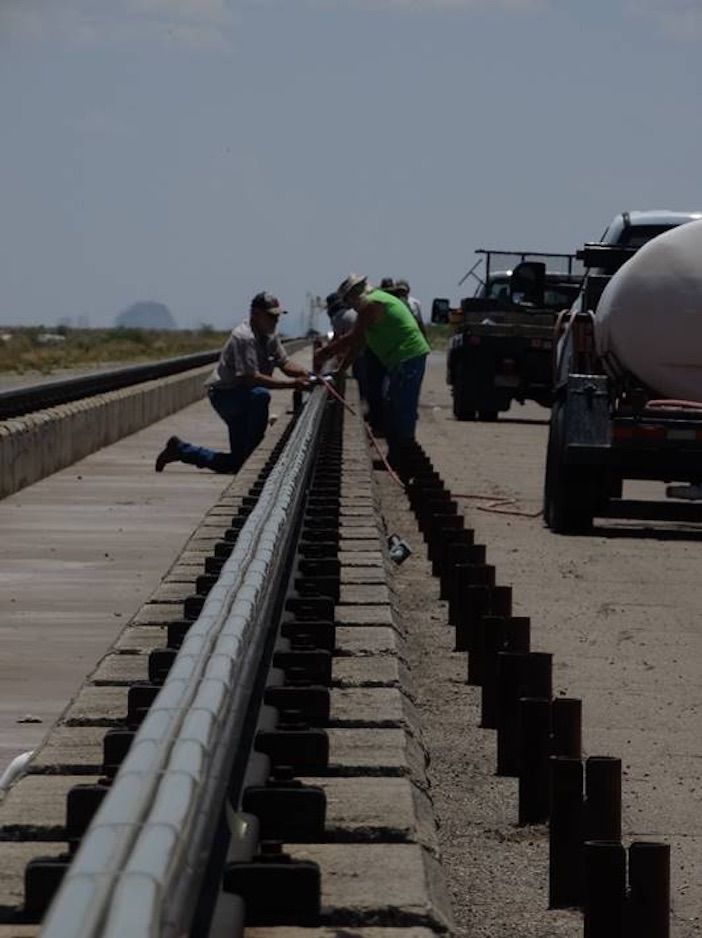
rail for hypersonic sled
Rail-top water bags used as part of the rocket sled braking system are placed along the Holloman High Speed Test Track at Holloman Air Force Base, New Mexico (Image: USAF)

Making it rain

In addition to studying braking performance, the fourth and most recent test called for the sled to be exposed to a 400ft section of the newly-upgraded 6,000ft HHSTT “rainfield,” a sprinkler head system designed to simulate natural rain.

Bryan Sinkovec, capability development program manager said, “The basic concept was to demonstrate exposure of a developmental material to a rain environment in order to test the effects of water droplets hitting a test article at hypersonic velocities; think about the understanding of whether a missile will survive being launched through a rain cloud.

“The HHSTT rainfield was recently upgraded with a state-of-the-art fiber optic control and data collection system in time to support the 2021 HyTIP missions.”

After exposure to the rainfield, the sled was projected to enter braking at 2,900 feet per second, but it entered much faster than planned.

The three prior tests were considered successful in determining the effectiveness of the new sled design. Each test resulted in safely-recovered sleds from the rail. The fourth test was considered a partial success because the sled departed the rail prematurely and was not recovered. However, some sled performance data was acquired.

Sinkovec said the experimental sled tests comprising the HSR program are designed to push the limits of the HHSTT, adding that regardless of whether they result in complete successes, knowledge is always gained from the tests.

“Each mission has provided knowledge on sled performance, the first three being successful and the fourth not fully but still providing useful information,” Sinkovec said. “There is a failure investigation underway looking at the potential issues that led to sled loss, and the results of this investigation are expected to provide insight on how to improve when a path forward is developed, whether that be a direct repeat of the latest mission or an alternative path forward.”


Recovering knowledge and expertise

The tests are also proving important for the expertise being collected throughout the HSR program. Prior to the test conducted last June, the last recovered hypersonic mission was conducted at the HHSTT in 2004. Powell said the majority of personnel who were active during the pinnacle of monorail hypersonic testing are no longer at the HHSTT, leaving a workforce with limited experience in recovered hypersonic sled runs.

“This led to a need to assess, validate and improve performance aspects that are specific to recovered monorail sled runs, such as hypersonic sled survivability and performance, data collection at high speeds requiring high sample rates, and tight sled design and manufacturing tolerances,” Powell said. “It is also necessary to capture and document this corporate knowledge to prevent the loss of expertise in the future.”
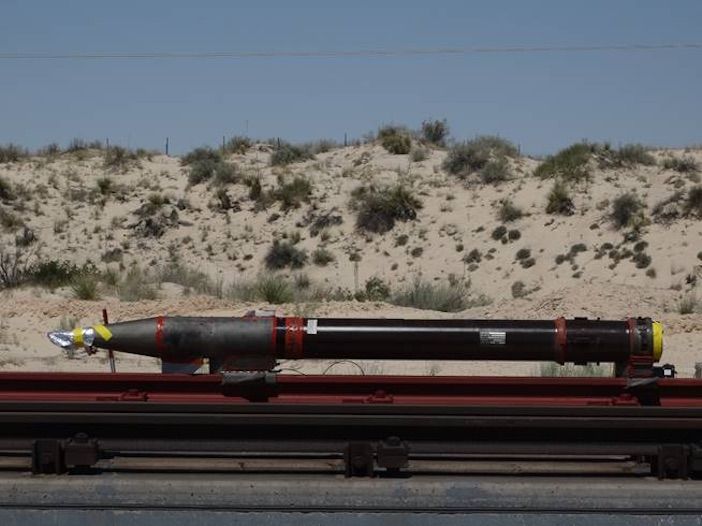
rocket sled
Improvements to braking systems and staff training have been part of the preparations for hypersonic weapons testing at the Holloman High Speed Test Track in New Mexico, USA

The HSR program is expected to continue into the spring of 2021 and wrap up prior to the HyTIP sled tests set to begin around summer 2021.

Powell said the current and future capabilities of the HHSTT will “bridge a critical gap” in US DOD (Department of Defense) test facilities in support of these modernization efforts.

“These programs require timely and relevant test data to verify lethality effects, impact survivability, aerothermal and weather effects, separation dynamics, guidance system performance, sensor performance and other key performance metrics,” said Powell.

“Test results also serve to validate modeling and simulation efforts, ensuring critical edge-of-envelope conditions are accurately characterized. Robust ground testing can identify serious deficiencies before incurring orders-of-magnitude greater costs in flight test, production or operations.”

Sinkovec said, “The HHSTT strives to provide the world’s best rocket sled test team and offer capabilities that are not offered anywhere else in the world. There are ground test facilities and even other tracks in this state, country and world, but recovered hypersonic monorail testing is something that cannot be done anywhere else in the world due to the HHSTT’s unmatched length and alignment.”


Share. Twitter LinkedIn Facebook Email
Previous ArticlePodcast: Derek Hinton, chair of the International Telemetry Conference
Next Article The world’s thinnest condenser microphones
Ben Sampson

Ben has worked as a journalist and editor, covering technology, engineering and industry for the last 20 years. Initially writing about subjects from nuclear submarines to autonomous cars to future design and manufacturing technologies, he was editor of a leading UK-based engineering magazine before becoming editor of Aerospace Testing in 2017.

Related Posts

A large balloon ascends at sunrise carrying a cone-shaped flight test payload above a desert launch site
Flight Testing

US engineers develop Aires Tide flight-test vehicle in five months using AI supercomputers

25th June 20264 Mins Read
Defense

UK tests low-cost deep-strike missiles for Ukraine

22nd June 20263 Mins Read
Defense

Amentum to advance UK hypersonic missile design

19th February 20262 Mins Read
Latest Posts
Heart Aerospace X1 electric demonstrator aircraft in flight against an orange sunset sky over water

Heart Aerospace’s X1 demonstrator electric aircraft makes first flight

14th August 2026
Stratasys F3300 industrial 3D printer with its build chamber illuminated in blue light on a factory floor

Stratasys wins government funding to develop in situ 3D printing quality monitoring

13th August 2026

MIL-STD 810H Part Two: Method 511.7 Explosive Atmosphere

13th August 2026
Supplier Spotlights
  • Precision Filters, Inc. (PFI)
  • Evolution Measurement
  • CALCULEX
  • Hottinger Brüel & Kjær
  • AVL List GmbH
  • Tekna
  • InnovMetric
  • CGM CIGIEMME S.p.A.
  • SET GmbH
  • Tyto Robotics
    Tyto Robotics Inc.
  • Bartington Instruments
    Bartington Instruments
  • Ametek
    AMETEK Programmable Power
  • Delta Information Systems logo
    Delta Information Systems
  • Helling GmbH
    Helling GmbH
  • Matec Instrument Companies, Inc.
    Matec Instrument Companies, Inc.
  • Endevco
  • Ipetronik
    IPETRONIK GmbH & Co. KG
  • VJ Technologies
  • Durr NDT
    DÜRR NDT GmbH & Co. KG
  • Dewesoft
  • Bruker Alicona Dimensional metrology & surface roughness measurement
    Bruker Alicona
  • Vzlu
    VZLU – Czech Aerospace Research Centre
  • ATG Advanced Technology Group
    ATG – Advanced Technology Group
  • Dytran Instruments, Inc.
  • Kistler Group
    Kistler Group
  • Diversified Technical Systems (DTS)
  • Scanivalve Corporation
  • G Systems
  • CEC Vibration Products LLC.
  • dSPACE
  • Safran Data Systems
  • Photron
  • YXLON International
  • Telspan Data
  • TotalTemp Technologies, Inc.
  • Vector Informatik GmbH
  • Vibration Research
  • TEST-FUCHS
  • Siemens Digital Industries Software
    Siemens Digital Industries Software
  • PCB Piezotronics, Inc.
  • Testia
  • Treo – Labor für Umweltsimulation GmbH
  • W5 Engineering
  • National Institute for Aviation Research
  • North Star Imaging
  • MK Test Systems Ltd.
  • Intertek
  • I.N.C.A.S. – NATIONAL INSTITUTE FOR AEROSPACE RESEARCH “ELIE CARAFOLI”
  • FMV Test & Evaluation
  • Glenn L Martin Wind Tunnel
  • GRAS Sound & Vibration
  • Elsys AG
  • EMCCons DR. RAŠEK GmbH & Co.KG
  • European Test Services (ETS) B.V.
  • Chemetall GmbH logo
    Chemetall GmbH
  • Curtiss-Wright
  • Data Physics Corporation
  • AOS Technologies AG
  • Airmo Inc. Pressure Technologies
    Airmo Inc.® Pressure Technologies
Our Social Channels
  • Twitter
  • YouTube
  • LinkedIn
Getting in Touch
  • Subscribe To Magazine
  • Contact Us
  • Meet the Team
  • Media Pack
Related Topics
  • Aircraft Interiors
  • Business Jet Interiors
FREE WEEKLY NEWS EMAIL!

Get the 'best of the week' from this website direct to your inbox every Wednesday

© Copyright 2026 Mark Allen Group. All rights are reserved, including those for text and data mining, AI training, and similar technologies.
  • Cookie Policy
  • Privacy Policy
  • Terms & Conditions

Type above and press Enter to search. Press Esc to cancel.